Staff Reliability Issues in Offshore Hiring: What is Actually Going Wrong and How to Fix It

Staff Reliability Issues in Offshore Hiring: What is Actually Going Wrong and How to Fix It

Most Australian businesses that struggle with offshore staff reliability are not dealing with a talent problem. They are dealing with a management problem. Here is how to tell the difference and what to do about it.

Here is a reality check: 60% of Australian employers plan to recruit overseas workers in 2026 to ease skills shortages, according to the Australian HR Institute. Yet many still grapple with the same reliability issues. The 12-month average turnover rate reached 15% by March 2024. But here is the truth most won’t tell you — most of those failures trace back to how the relationship was structured, not to a shortage of capable talent overseas.
 
If your offshore staff are disappearing, delivering inconsistent work, or churning every few months, this article is for you. We will walk through the real causes, the most common reliability problems, the legal risks that many Australian businesses overlook, and a practical set of strategies to turn things around.

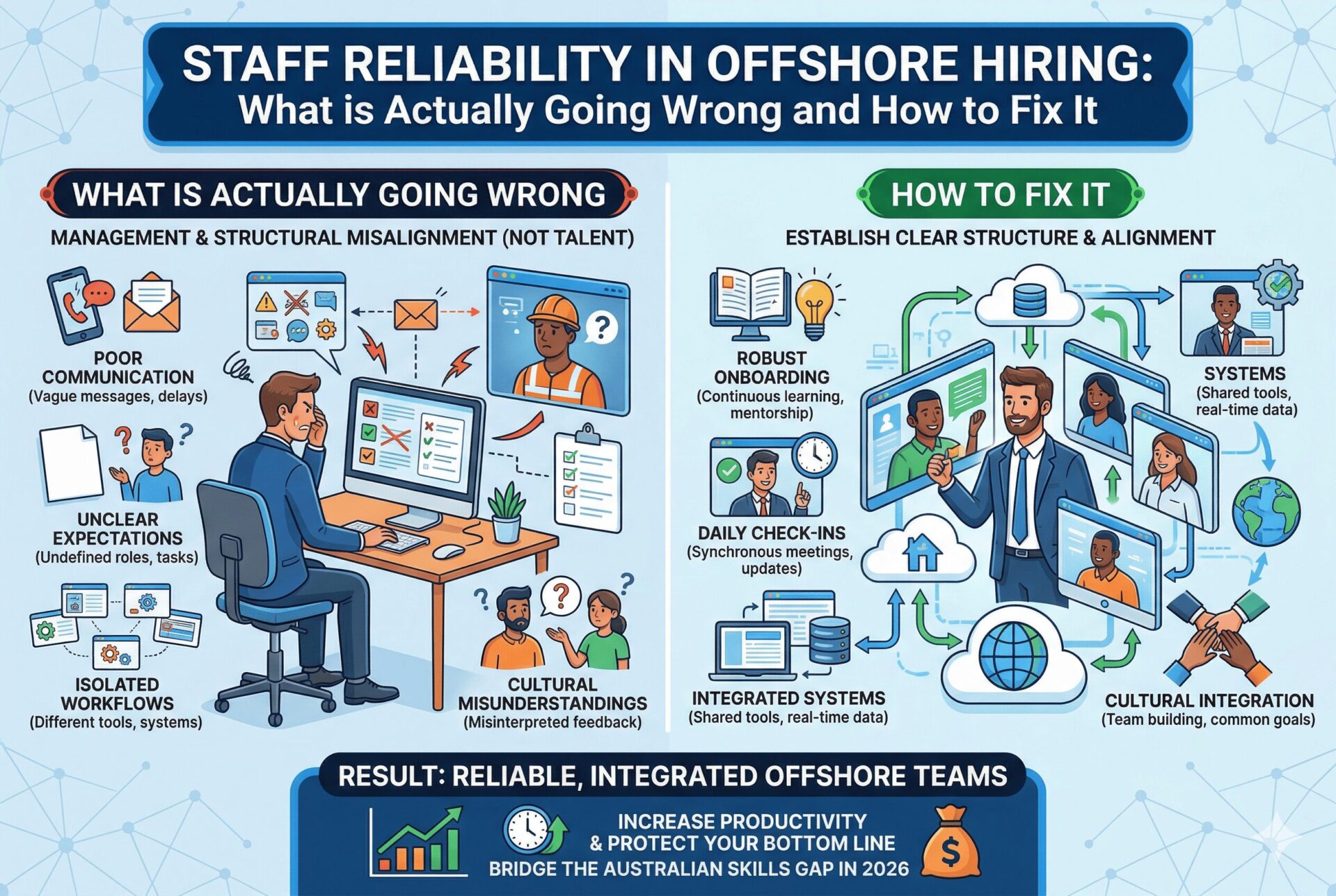
The Five Most Common Offshore Staff Reliability Issues

Before throwing out your offshore model, it is worth understanding exactly what you are dealing with. These are the five reliability issues that come up most often for Australian businesses hiring offshore.
 

High Turnover and Churn

Businesses chasing the lowest possible hourly rate often end up with staff who are actively looking for their next role. Cheap offshore hiring tends to mean underqualified candidates who leave as soon as something better comes along, disrupting business continuity and costing far more in re-hiring than the initial savings were ever worth.
 

Communication and Cultural Gaps

Time zone differences, language barriers, and differences in workplace culture can quietly erode a remote team. When expectations are not set clearly and there is no structured overlap time, misunderstandings stack up until something breaks. Australian-specific communication norms and expectations are also often unfamiliar to offshore workers who have not worked with local businesses before.
 

Quality Inconsistency

Without proper vetting, skills can vary wildly across offshore candidates. You may get excellent work one week and something that needs complete rework the next. This usually points to an onboarding problem rather than a lack of ability, but the result is the same: wasted time and money.
 

Ghosting and Sudden Disappearances

Offshore staff who vanish without warning are almost always being treated as freelancers rather than dedicated employees. When someone is juggling several clients, has no sense of loyalty to any one organisation, and receives no proper onboarding or benefits, they have very little reason to stay. This is a structural problem, not a cultural one.
 

Lack of Local Context

Offshore workers may not be familiar with Australian-specific regulations, consumer expectations, brand tone, or industry standards. This is especially relevant in regulated sectors like financial services, healthcare, and legal. Without deliberate knowledge transfer, even a talented offshore team member will struggle to meet local expectations.
This is, unfortunately, the standard in most offshore recruitment and it’s why so many Australian business owners end up cycling through hires, paying the cost of a bad decision over and over again. Understanding how to screen offshore candidates in Australia properly is the single most important skill you can develop.

What is Actually Causing These Failures

Staff reliability issues in offshore hiring rarely appear out of nowhere. They tend to follow a predictable pattern that starts with how the hiring decision was made.
 
Hiring under pressure. When businesses need someone fast, the vetting process gets rushed. Proper interviews get skipped, references go unchecked, and the first available candidate gets the role. This sets the relationship up to fail from day one.
 
Treating offshore staff as freelancers. If your offshore hire has no clear KPIs, receives no regular feedback, is not included in team meetings, and is essentially left to figure things out on their own, you are not managing an employee. You are hoping for the best. That rarely ends well.
 
Inadequate infrastructure. Unreliable internet, no proper equipment, and no defined communication tools make it practically impossible for offshore staff to perform consistently. If your offshore team does not have the right setup, that is a business continuity risk you are carrying.
 
Misclassification of workers. This is one of the most significant and underappreciated causes of offshore staff unreliability. Hiring offshore workers as independent contractors when they are actually functioning as employees creates legal exposure and tends to produce exactly the low-commitment, low-performance dynamic that leads to turnover and ghosting.
 
Skipping onboarding entirely. Throwing an offshore hire into work with minimal context is a recipe for poor performance. Without proper onboarding, staff do not understand your processes, your brand, your clients, or what success looks like in your business.

The Legal Risk You May Not Have Considered

Offshore hiring and Australian employment law are not as separate as many business owners assume. Recent Fair Work Commission rulings have found that overseas contractors may be considered Australian employees and entitled to benefits under the Fair Work Act, despite never setting foot in Australia.


Even offshore workers classified as contractors may legally be considered employees if they are subjected to supervision, fixed hours, or controlled pay, triggering obligations under Australian workplace law. Misclassified workers may be entitled to retroactive wages, leave entitlements, and superannuation costs that could compound quickly.


The takeaway is not to avoid offshore hiring. It is to structure it correctly from the start. Using an Employer of Record (EOR) or a reputable BPO partner in the relevant country, like Webco Talent, means the employment relationship is properly formalised, the worker receives the benefits and protections they are entitled to, and your business is not carrying hidden compliance risk. Properly employed staff also tend to stay longer, perform better, and show greater loyalty. Legal compliance and staff reliability are more closely connected than most people realise.

Six Strategies That Actually Work

The good news is that every one of these reliability issues is fixable. Here is what businesses with strong, stable offshore teams do differently

1. Hire dedicated, full-time staff

Freelancers by definition split their time across multiple clients. You will always be competing for their attention. Dedicated offshore employees who work exclusively for your business are far more likely to invest in understanding your culture, build institutional knowledge, and deliver consistent performance. The cost difference is smaller than most people think, and the reliability difference is significant.

2. Treat the first 30 days as your most important investment

Onboarding is where offshore relationships succeed or fail. The first month should include structured introductions to your team, a clear overview of your processes, documented expectations, regular check‑ins, and enough context that the hire genuinely understands what “good” looks like in your business. What you invest here, you will save many times over in avoided re‑hiring costs.

3. Use an EOR or BPO model for compliance

An Employer of Record employs your offshore staff on your behalf in their home country, handling payroll, benefits, and local employment law compliance. This removes your compliance risk, properly structures the employment relationship, and tends to produce more stable, committed staff. A reputable BPO partner offers similar benefits with management infrastructure already in place.

4. Establish structured communication protocols

Ad hoc communication does not work across time zones. Set defined overlap hours where both teams are online simultaneously. Choose your tools and make sure everyone knows how to use them. Slack works well for day-to-day conversation, and Jira or a similar platform handles project and task tracking. A regular weekly check-in keeps remote teams aligned without micromanaging them.

5. Pay competitively, not just cheaply

The cheapest offshore hire is almost never the most cost-effective one. Offshore staff who are underpaid know they are underpaid, and they will leave as soon as a better offer arrives. Paying at or above market rate for the relevant country signals respect, attracts more qualified candidates, and significantly reduces the churn that makes offshore hiring expensive in practice.

6. Set clear KPIs and give regular feedback

Offshore staff who do not know what success looks like in their role will default to doing what they think is expected, which may not match what you actually need. Clear, measurable KPIs from the start, combined with regular feedback and genuine recognition of good work, give your offshore team a real reason to perform and stay.

Making Offshore Hiring Work for Your Australian Business

Offshore hiring done well is not about finding the cheapest available labour. It is about extending your team strategically, with the same attention to culture, compliance, and management that you would bring to any domestic hire.

Australian businesses that succeed with offshore talent tend to have a few things in common. They take the time to find the right person rather than the fastest one. They invest in onboarding. They structure the employment relationship properly, often through an EOR or BPO partner. And they treat their offshore team members as actual colleagues.
 
The offshore talent pool is genuinely strong. Skilled professionals across the Philippines, India, Eastern Europe, and other regions are doing excellent work for businesses around the world, including many in Australia. Staff reliability issues in offshore hiring are real, but they are solvable, and solving them starts with how you set up the relationship from day one.

FAQs

Why do offshore staff reliability issues happen in the first place?

Most offshore staff reliability problems come down to how the engagement was set up rather than the quality of the talent. Rushing the hiring process, skipping onboarding, treating workers as freelancers rather than employees, and paying below-market rates all contribute to the churn, ghosting, and quality issues that give offshore hiring a bad reputation.

The most significant legal risk is misclassifying offshore workers as independent contractors when they are functionally employed in your business. Australian businesses cannot use offshore arrangements to sidestep local employment law obligations, and recent court decisions have reinforced this. Using an EOR or BPO partner is the most reliable way to stay compliant.

Hire dedicated full-time staff rather than freelancers, pay competitively, invest seriously in onboarding during the first 30 days, provide regular feedback and clear KPIs, and use a compliant employment structure through an EOR or BPO. Each of these steps makes a material difference to retention.

An Employer of Record (EOR) is a third-party organisation that formally employs your offshore staff on your behalf in their home country, managing payroll, benefits, and local employment law compliance. This protects your business from compliance risk and creates a properly structured employment relationship that tends to produce more committed, longer-staying staff.

Yes. Businesses across Australia are building strong, reliable offshore teams. The key is treating it like any serious hiring decision: take the time to find the right person, structure the relationship properly, invest in onboarding, and manage your offshore team with the same care you would bring to a domestic hire.

Set defined daily or weekly overlap hours when both your Australian team and your offshore staff are online at the same time. Use Slack for everyday updates and Jira for task tracking. Build in a consistent weekly check-in. Structured communication removes most of the ambiguity that causes delays and misalignment across time zones.

Ready to Build an Offshore Team That Actually Stays?

Unreliable offshore staff is almost always a fixable problem. At Webcota Talent, we work with Australian businesses to hire dedicated, compliant offshore professionals who are properly onboarded, correctly employed, and set up to perform from day one.
 
No freelancers. No shortcuts. No compliance surprises.
Whether you are starting your offshore journey or trying to fix an existing team, we can help you get it right.
 
Book a free consultation with our team today and find out how simple and reliable offshore hiring can be when it is done properly.
Visit webcotalent.au to get started.

Book a free consultation with our team today

and find out how simple and reliable offshore hiring can be when it is done properly.