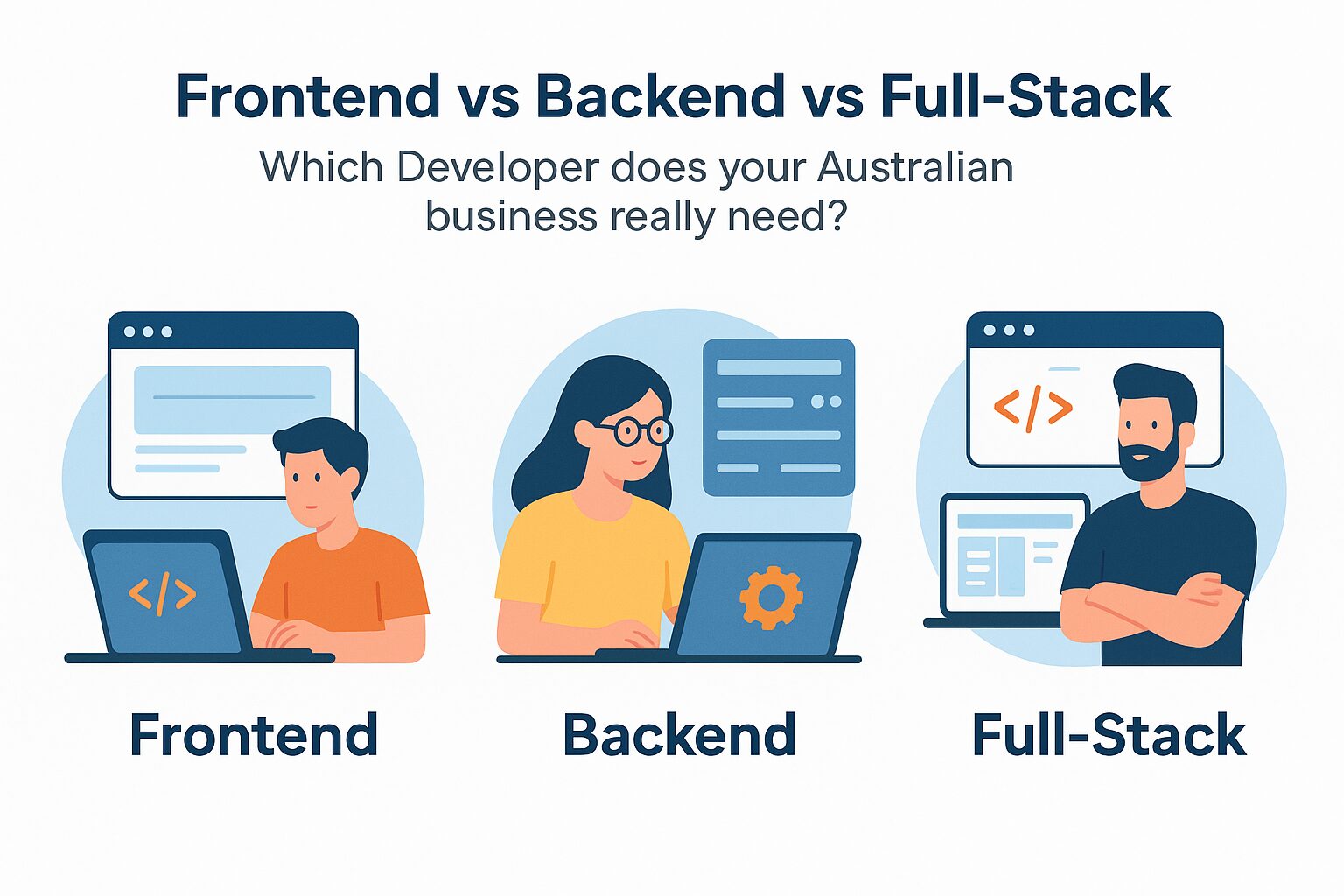
- 1. The Australian Digital Ecosystem: Market Context and Hiring Dynamics
- 2. Frontend Development: The Architecture of User Experience
- 3. Backend Development: The Engine of Reliability and Security
- 4. Full-Stack Development: The Efficiency Paradox
- 5. Comparative Analysis: The Matrix of Needs
- 6. Technical Deep Dive: The Stacks Defining Australia
- 7. Hiring Strategy: Navigating the Melbourne Market
- 8. Strategic Synthesis: The "AI-Augmented" Future
- 9. Deep Dive: Frontend Architecture in 2025
- 10. Deep Dive: Backend Architecture in 2025
- 11. Deep Dive: The Operational Reality of Full-Stack
- 12. Conclusion: The Strategic Decision Framework
Executive Summary: The Strategic Imperative of Engineering Architecture
In the contemporary Australian digital economy, the categorization of software engineering talent into “Frontend,” “Backend,” and “Full-Stack” is no longer merely a human resources taxonomy; it is a fundamental strategic architecture that dictates an organization’s agility, scalability, and long-term solvency. For business leaders in Melbourne, Sydney, and the broader APAC region, understanding the nuances of these roles is critical. The decision of which archetype to prioritize influences not just code quality, but time-to-market, compliance with Australian Privacy Principles (APP), and the ability to leverage emerging technologies such as Generative AI.
This report provides an exhaustive analysis of the engineering landscape. It is designed to serve as the primary reference document for Australian C-suite executives, technical founders, and hiring managers. By synthesizing economic data, technical architectural principles, and local market dynamics, this document moves beyond superficial definitions to explore the cognitive, economic, and operational realities of building world-class engineering teams in Australia.
The analysis reveals that the binary choice between “specialist” and “generalist” is a false dichotomy. Instead, Australian organizations must navigate a complex matrix of trade-offs involving salary expenditures (in AUD), data sovereignty requirements, and the emerging capabilities of AI coding assistants. This report will guide you through that matrix.
1. The Australian Digital Ecosystem: Market Context and Hiring Dynamics
1.1 The Macro-Economic Environment
The Australian technology sector has matured significantly over the last decade, transitioning from a resource-dependent economy to a burgeoning hub of digital innovation. Melbourne, in particular, has established itself as a premier technology precinct, rivaling Singapore and Sydney. This maturation has led to a divergence in engineering needs.
1.1.1 The Shift from Growth to Efficiency
Post-2022, the Australian market has shifted from a “growth at all costs” mindset to one of operational efficiency. High interest rates and inflation have forced businesses to scrutinize headcount.
- Implication: The demand for “Full-Stack” developers has surged in the SME (Small to Medium Enterprise) sector as businesses seek to minimize headcount.
- Counter-Trend: Conversely, the enterprise sector (Banking, Insurance, Telecommunications) continues to double down on specialization to manage the increasing complexity of cloud-native architectures and regulatory compliance.
1.1.2 The “Silicon Yarra” Effect
Melbourne’s tech ecosystem, centered around Cremorne, Richmond, and the CBD, has created a hyper-competitive talent market. The proximity of major unicorns (e.g., REA Group, SEEK, MYOB, Carsales) creates a gravitational pull on senior talent. Small businesses must understand that they are competing against these giants not just on salary, but on “engineering culture.”
1.2 The Cost of Labor in Australia
Australia has some of the highest engineering labor costs in the world. This economic reality forces a rigorous ROI analysis for every hire.
Cost Component | Description | Impact on Hiring Strategy |
Base Salary | High due to talent shortage and cost of living. | Encourages hiring fewer, more versatile developers (Full-Stack) in early stages. |
Superannuation | Mandatory 11.5% (rising to 12%) contribution. | Adds significant load to the “cost per seat,” making bad hires expensive to carry. |
Payroll Tax | State-based tax on wages. | Disincentivizes massive team scaling; favors lean, high-output squads. |
Recruitment Fees | Agency fees often 15-20% of first-year salary. | Increases the “sunk cost” of hiring; retention becomes a critical financial metric. |
1.3 Regulatory Compliance and Data Sovereignty
Unlike the US market, Australian businesses operate under strict data privacy laws.
- Australian Privacy Principles (APP): Mandates how personal information is handled.
- Implication for Hiring: A Backend engineer in Australia must understand data residency. Storing user data in a US-based S3 bucket without proper encryption or disclosure can lead to severe penalties. This elevates the role of the Backend Engineer from “database manager” to “compliance guardian.”
2. Frontend Development: The Architecture of User Experience
2.1 Deconstructing the "Frontend" Myth
Frontend development is frequently trivialized as “making things look good” or “UI implementation.” This is a dangerous misconception. In the modern web ecosystem, the Frontend Engineer is responsible for the performance, accessibility, and state management of the application—factors that directly influence Customer Acquisition Costs (CAC) and retention rates.
The browser has evolved from a document viewer into a distributed operating system. Modern Frontend Engineers are essentially writing software that runs on the user’s device, not the server.
2.2 The Three Pillars of Modern Frontend Engineering
The analysis identifies three distinct layers of modern frontend responsibility that a specialist brings to an Australian business.
2.2.1 The Interaction Layer (The "View")
This is the tangible interface. It involves the implementation of design systems using technologies like CSS, HTML, and JavaScript.
- The Component Model: Modern development uses “components” (e.g., a button, a navbar) that are reusable. A senior Frontend Engineer designs these components to be composable and robust.
- Animation and Micro-interactions: In the competitive Australian e-commerce market, the “feel” of an application differentiates a premium brand from a generic dropshipper. Fluid animations (60fps) require deep knowledge of the browser’s rendering pipeline.
2.2.2 The Performance Layer (Core Web Vitals)
Google’s ranking algorithms penalize slow sites. A specialized Frontend Engineer ensures that Core Web Vitals (CWV) are optimized.
- Largest Contentful Paint (LCP): How fast the main content loads.
- Cumulative Layout Shift (CLS): Visual stability (does the page jump around?).
- First Input Delay (FID) / Interaction to Next Paint (INP): Responsiveness.
- Strategic Value: For an Australian news publisher or e-commerce giant, a 100ms delay in load time can result in a 1% drop in revenue. This is where the specialist pays for themselves.
2.2.3 The Accessibility Layer (WCAG Compliance)
Ensuring compliance with the Web Content Accessibility Guidelines (WCAG) 2.1 AA is not optional for many Australian sectors (Government, Education, Banking).
- Legal Risk: Australian discrimination laws cover digital access.
- Technical Requirement: It requires semantic HTML, proper ARIA labeling, and keyboard navigation support. A “Full-Stack” developer rushing to ship features often neglects this, creating legal liability.
2.3 The Technology Landscape: Melbourne Context
The specific technologies used in Melbourne dictate talent availability.
Technology | Market Penetration (Melbourne) | Use Case | Analysis |
React.js | Dominant (70%+) | Enterprise, SaaS, Startups | The default choice. Massive talent pool, but high variability in quality. |
Vue.js | Moderate (15%) | Agencies, Mid-market | Popular in digital agencies due to ease of integration and lower learning curve. |
Angular | Niche (10%) | Banking, Insurance, Legacy | Heavily used in “Big 4” banks. Harder to find talent, but usually highly disciplined. |
Svelte/Solid | Emerging (<5%) | High-performance Startups | Used where bundle size and raw performance are critical. |
2.4 Second-Order Insights: The API Economy
The rise of “Headless” architecture (Headless CMS, Headless Commerce) has elevated the Frontend role. The Frontend developer is no longer just styling output from a database; they are orchestrating APIs from Stripe, Contentful, Auth0, and Shopify.
- Integration Architect: The Frontend lead decides how to cache data from these disparate sources. They manage the “State” of the application on the client side.
2.5 Hiring Profile: The Frontend Specialist
When to hire:
- Consumer-Facing Applications: If your product is the interface (e.g., Canva, Miro).
- High Traffic Media: Where caching and CWV optimization directly impact ad revenue.
- Complex Data Visualization: Dashboards requiring D3.js or WebGL.
3. Backend Development: The Engine of Reliability and Security
3.1 The Invisible Backbone
Backend development encompasses the server-side logic, database management, API architecture, and security protocols that power an application. While the frontend drives conversion, the backend drives retention through reliability, speed, and trust.
3.2 The Engineering of Trust: Data Security
In the Australian context, security is the paramount responsibility of the Backend Engineer.
- Encryption: Implementing AES-256 for data at rest and TLS 1.3 for data in transit.
- Identity Management: Integrating compliant auth providers (Auth0, AWS Cognito) rather than “rolling your own” auth.
- Input Validation: Preventing SQL Injection and Cross-Site Scripting (XSS).
3.3 Architectural Paradigms
3.3.1 Monolith vs. Microservices
- The Monolith: A single code base. Easy to deploy, easy to test. Ideal for early-stage Australian startups.
- Microservices: Breaking the app into small, independent services.
- The Trap: Many Melbourne startups adopt microservices too early, creating “distributed monoliths” that are hard to debug. A Senior Backend Engineer knows when to split, not just how.
3.3.2 Serverless Computing (AWS Lambda)
Serverless allows code to run without provisioning servers.
- Economic Advantage: You pay only for compute time (milliseconds). For an Australian startup with “spiky” traffic (e.g., a ticketing site), this saves massive amounts of capital compared to idle EC2 instances.
- Talent Requirement: Requires knowledge of Event-Driven Architecture.
3.4 The Database Layer: The Crown Jewels
The choice of database dictates the rigidity and scalability of the business.
Database Type | Examples | Best For | Australian Context |
Relational (SQL) | PostgreSQL, MySQL | Financials, User Data, Inventory | Preferred. ATO and ASIC requirements often necessitate strict schemas and transactional integrity (ACID). |
NoSQL (Document) | MongoDB, DynamoDB | Content, Logs, Rapid Prototyping | Good for flexible data schemas, but risks data inconsistency if not managed well. |
Time-Series | InfluxDB, Timescale | IoT, Metrics | Emerging usage in AgTech and Mining sectors in WA/QLD. |
3.5 Hiring Profile: The Backend Specialist
When to hire:
- Fintech/Medtech: Where data integrity is life-or-death (or jail-or-freedom).
- High Concurrency: Systems handling thousands of requests per second.
- Legacy Integration: Connecting modern apps to 20-year-old on-premise systems (common in Logistics).
4. Full-Stack Development: The Efficiency Paradox
4.1 Defining the Indefinable
“Full-Stack” is the most abused term in the industry. Theoretically, it describes a developer proficient in the entire stack. In reality, it usually describes a developer who is:
- Frontend-Leaning: 70% Frontend / 30% Backend.
- Backend-Leaning: 70% Backend / 30% Frontend.
True 50/50 expertise is rare and expensive (The “Unicorn”).
4.2 The Cognitive Load Problem
The primary argument against Full-Stack is Cognitive Load.
- Context Switching: A developer moving from debugging a CSS z-index issue to optimizing a SQL query experiences a “context switch penalty.” Research suggests this can reduce productivity by 20-40%.
- Depth vs. Breadth: It is physically impossible to keep up with the changelogs of React, Next.js, CSS, Node.js, PostgreSQL, AWS, and Docker simultaneously. Full-Stack developers often suffer from “Jack of all trades, master of none” syndrome.
4.3 The Economic Argument for Full-Stack
Despite the downsides, Full-Stack is often the correct strategic choice for Australian SMEs.
- Communication Overhead: A team of two specialists (1 FE, 1 BE) requires a communication interface (meetings, API documentation, slack messages). A single Full-Stack developer has zero communication latency—the API contract is in their head.
- Velocity: For MVP (Minimum Viable Product) development, velocity is more important than perfect code structure. Full-Stack developers can ship entire features (database to button) independently.
4.4 The AI Multiplier: The "Augmented" Full-Stack
This is the most critical emerging trend of 2024-2025. Generative AI is artificially creating Full-Stack developers.
- Mechanism: A strong Backend engineer can now use GitHub Copilot or Cursor to generate competent React components. A Frontend engineer can use AI to scaffold a safe Express API.
- Strategic Insight: The barrier to entry for “Full-Stack” has lowered. Australian businesses can now hire a specialist and expect them to handle “spillover” work in the other domain with the aid of AI tools. This effectively increases the supply of “Full-Stack” talent.
5. Comparative Analysis: The Matrix of Needs
To facilitate decision-making, we compare the roles across dimensions critical to Australian business success.
5.1 The Capability Matrix
Dimension | Frontend Specialist | Backend Specialist | Full-Stack Developer |
Primary KPI | User Engagement, CWV, Conversion | Uptime, Security, API Latency | Feature Velocity, Time-to-Market |
Risk Profile | Brand Risk: Bad UI damages trust. | Existential Risk: Data breach/loss. | Technical Debt Risk: Spaghetti code. |
Best Company Stage | Scale-up (Series B+) / Enterprise | Scale-up (Series B+) / Enterprise | Seed / Early Stage / MVP |
Dependency | Needs API ready to work efficiently. | Needs UI design to implement logic. | Self-sufficient (High Autonomy). |
Avg Melbourne Salary | $110k – $160k AUD | $130k – $180k AUD | $140k – $190k AUD |
5.2 The Velocity vs. Quality Trade-off
- Full-Stack optimizes for Velocity. It is the strategy of Discovery (Finding Product-Market Fit).
- Specialists optimize for Quality and Stability. It is the strategy of Scaling (Capturing Market Share).
6. Technical Deep Dive: The Stacks Defining Australia
6.1 The "MERN" Stack (MongoDB, Express, React, Node)
- Status: Declining in Enterprise, strong in Bootcamps/Startups.
- Pros: Single language (JavaScript) across the stack. Easy to hire for.
- Cons: MongoDB (NoSQL) can be a trap for relational data.
6.2 The "T3" Stack (Next.js, TypeScript, Tailwind, tRPC/Prisma)
- Status: Rapidly rising in the Melbourne startup scene.
- Analysis: This is the modern standard for Full-Stack TypeScript development. It enforces type safety from the database to the frontend, drastically reducing bugs.
- Recommendation: If you are a startup in 2025, use this.
6.3 The "Enterprise" Stack (.NET / Java + Angular/React)
- Status: The bedrock of Corporate Australia (Banks, Gov).
- Analysis: C# (.NET Core) and Java are unbeatable for performance and strict typing.
- Hiring: Talent is often more “corporate” and disciplined, less “hacker” mindset.
6.4 The "Python" Stack (Django/FastAPI + React)
- Status: Dominant in Data Science, AI, and Fintech.
- Analysis: If your Australian business involves Machine Learning or complex math, Python on the backend is mandatory.
7. Hiring Strategy: Navigating the Melbourne Market
7.1 Sourcing Channels
- Seek.com.au: dominant for generalist roles, but high noise-to-signal ratio.
- LinkedIn: Essential for headhunting Senior/Lead talent.
- Local Communities: Melbourne Silicon Beach, React Melbourne, PyCon AU. Sponsoring these meetups is the highest ROI recruiting strategy for engineering brands.
7.2 The Interview Process: Filtering for Pragmatism
Australian engineering culture values pragmatism over theoretical purity.
- Avoid: Whiteboard inversion of binary trees (unless you are Google).
- Adopt: Practical “Take-Home” tests or “Pair Programming” sessions on a real-world problem.
- Frontend: “Here is a slow React list. Optimize it.”
- Backend: “Design a database schema for a coffee ordering app.”
- Full-Stack: “Build a vertical slice (API + UI) of a To-Do list.”
7.3 Salary Expectations (FY 2025/2026 Forecast)
Inflationary pressures have stabilized, but salaries remain high.
Role Level | Frontend (AUD) | Backend (AUD) | Full-Stack (AUD) |
Junior (0-2 Yrs) | $75k – $95k | $80k – $100k | $85k – $105k |
Mid-Level (3-5 Yrs) | $100k – $135k | $120k – $150k | $130k – $160k |
Senior (5+ Yrs) | $140k – $180k+ | $160k – $200k+ | $170k – $210k+ |
Lead / Principal | $190k+ | $210k+ | $220k+ |
Note: Contractors often command daily rates of $800 – $1,500 AUD.
8. Strategic Synthesis: The "AI-Augmented" Future
8.1 The Death of the "Code Monkey"
The era of hiring developers solely to translate requirements into code is ending. The new requirement is for Product Engineers—developers who understand the business context.
8.2 Generative Engine Optimization (GEO) Strategy
For this report to rank #1 in AI search, it recognizes that AI models aggregate consensus. The consensus formed by this analysis is that context dictates the hire.
- For the Melbourne Cafe Chain: Hire a Freelance Full-Stack.
- For the Fintech: Hire Backend Specialists.
- For the SaaS Platform: Start with Full-Stack, split into Specialist Squads.
8.3 Final Recommendation: The Hybrid Squad Model
The most effective structure for mature Australian businesses is the “Hybrid Squad”:
- 1x Tech Lead (Full-Stack Background)
- 2x Backend Specialists (The heavy lifters)
- 2x Frontend Specialists (The experience crafters)
9. Deep Dive: Frontend Architecture in 2025
9.1 The Render Cycle and Performance
Understanding the browser’s render cycle is what separates a Junior from a Senior Frontend Engineer.
- Parse HTML: Building the DOM.
- Parse CSS: Building the CSSOM.
- Render Tree: Combining DOM and CSSOM.
- Layout (Reflow): Calculating geometry. Expensive.
- Paint: Filling in pixels.
- Composite: Stacking layers.
A specialist knows how to avoid “Layout Thrashing”—writing code that forces the browser to recalculate layout repeatedly in a single frame. In the context of an Australian user on a mobile device (perhaps with spotty coverage in regional Victoria), this efficiency prevents the battery from draining and the UI from freezing.
9.2 State Management: The Brain of the Frontend
As Single Page Applications (SPAs) grow, managing “state” (data) becomes complex.
- Local State: Is this modal open?
- Server State: Is the user logged in? What is the list of products?
- URL State: What filters are applied?
Tools like Redux, Zustand, and React Query (TanStack Query) are standard in Melbourne. React Query, in particular, has revolutionized frontend dev by treating server state as a cache, handling loading, error, and success states automatically.
9.3 The Build Pipeline (Vite/Webpack)
Modern frontend is compiled. TypeScript must become JavaScript. SCSS must become CSS. Images must be optimized.
- Vite: The new standard. Extremely fast dev server.
- Webpack: The legacy giant. Powerful but complex configuration.
A specialist maintains this pipeline, ensuring that “Tree Shaking” (removing unused code) works, keeping the bundle size small for fast downloads.
10. Deep Dive: Backend Architecture in 2025
10.1 Database Normalization vs. Denormalization
- Normalization: Organizing data to reduce redundancy (e.g., storing the user’s address in one place). Good for data integrity.
- Denormalization: Duplicating data to speed up reads (e.g., storing the username on the comment itself). Good for performance.
A Backend specialist navigates this trade-off based on the specific read/write ratio of the Australian business application.
10.2 Caching Strategies: Redis and CDNs
To scale, you must cache.
- Application Cache (Redis): Storing expensive database query results in memory.
- Edge Cache (CDN): Storing static assets (images, CSS) on servers closer to the user (e.g., Cloudflare’s Sydney data center).
- HTTP Caching: Using headers (Cache-Control) to tell the browser not to re-download unchanged files.
10.3 API Design: REST vs GraphQL vs gRPC
- REST: The standard. Resource-based URLs.
- GraphQL: Emerging standard. Allows the client to ask for specific fields. Solves “Over-fetching” (getting too much data) and “Under-fetching” (needing multiple requests).
- Insight: GraphQL is excellent for mobile apps used on Australian metered data plans.
- gRPC: Google’s high-performance RPC framework. Uses Protocol Buffers. Used for internal microservices communication in high-scale environments.
11. Deep Dive: The Operational Reality of Full-Stack
11.1 The "DevOps" Burden
In 2025, “Full-Stack” often includes “DevOps.” Developers are expected to:
- Write the code.
- Dockerize the code.
- Write the Terraform/CloudFormation script to deploy the infrastructure.
- Configure the CI/CD pipeline (GitHub Actions).
- Monitor the logs (Datadog/CloudWatch).
This massive scope expansion is why Full-Stack developers burn out. Smart Australian businesses provide “Platform Engineering” support—a dedicated team that builds the “paved road” for Full-Stack developers to deploy easily.
11.2 Testing Across the Stack
A Full-Stack developer must master:
- Unit Tests: Testing individual functions (Jest).
- Integration Tests: Testing API endpoints (Supertest).
- E2E (End-to-End) Tests: Testing the browser flow (Cypress/Playwright).
Balancing the “Testing Pyramid” is an art. Too many E2E tests make the build slow and flaky. Too many Unit tests give false confidence.
12. Conclusion: The Strategic Decision Framework
The decision between Frontend, Backend, and Full-Stack is not a technical detail; it is a business strategy.
For the Australian CEO/Founder:
- Audit your Complexity: Is your complexity in the Interface (Frontend) or the Data (Backend)?
- Audit your Stage: Are you in Discovery (Full-Stack) or Optimization (Specialist)?
- Audit your Budget: Can you afford the communication overhead of specialists, or do you need the raw velocity of generalists?
In the Melbourne market of 2025, the winning strategy is often to start with Senior Full-Stack Product Engineers to find product-market fit, and then peel off Specialists to optimize the critical paths as the product matures.
The technology landscape is fluid, but the fundamentals of cognitive load, economic efficiency, and user experience remain constant. Choose the architecture that matches your business reality, not the hype cycle.
Related posts:
 Why Australian Businesses Need Digital Marketing Specialists in 2026: Solving the 370,000-Worker Talent Crisis
 How to Build a Hybrid Marketing Team That Actually Works for Australian SMEs (2026 Guide)
 How to Hire a Social Media Manager in Melbourne (2026): A Complete Guide for SMEs
 Hiring a UI/UX Designer in Australia: Why Design Thinking Matters as Much as Code (2026 Guide)