

- What Is Offshore Staffing vs. BPO?
- Offshore Staffing vs BPO: The Key Differences
- Quick Comparison Table
- When Should You Choose Offshore Staffing?
- When Should You Choose BPO?
- The Strategic Insight Most Businesses Miss
- Why Offshore Staffing Is Gaining Momentum in Australia
- How Webco Talent Helps You Scale Smarter
- FAQs
- Final CTA
The $100,000 Question: Are You Buying a Service or Building an Asset?
Strategic outcome: A clear framework to decide whether offshore staffing or BPO will accelerate your growth – without losing control of quality or brand.
Most Australian founders treat offshore staffing and BPO as the same thing. They’re not. One is a transaction (you buy output). The other is an investment (you build capability). Confusing them has cost our clients hundreds of thousands in wasted fees, rework, and lost IP. In 2026, with local talent shortages hitting 20%+ and hiring delays over 45 days, this decision is no longer tactical – it’s strategic.
The real cost of getting it wrong:
- Loss of operational control – You can’t direct what you can’t see. BPO creates a “black box” between you and the work.
- Brand dilution – Outsourced teams rarely internalise your voice. Customers notice.
- Leaked revenue – When quality slips, so do margins. One agency client lost a $50k retainer because a BPO provider mishandled client comms.
- Missed scale – The wrong model locks you into rigid contracts. The right model lets you flex from 1 to 10 offshore staff within months.
If you treat offshore talent like a commodity, you’ll get commodity results. If you treat them like core team members – with dedicated staff, direct management, and Australian support – you’ll build a proprietary asset that compounds in value. This guide shows you exactly how to choose.
Who’s behind this guide:
Webco Talent (part of Webco Group, operating since 2008) has helped over 400 Australian businesses build dedicated offshore teams across IT, admin, accounting, and digital marketing. We’re based in Melbourne – not a call centre overseas. In 2026, with Australian vacancy rates exceeding 20% for skilled roles and hiring delays stretching beyond 45 days, the choice between offshore staffing and BPO isn’t optional. It’s a strategic imperative. This guide reflects what we’ve seen work (and fail) for founders just like you.
Before we dive in, see what 12 months of offshore staffing vs BPO looks like for your bottom line.
What Is Offshore Staffing vs. BPO?
One Builds Assets. One Buys Tasks. Know the Difference.
Strategic outcome: A one‑glance distinction that stops you from treating people like utilities.
Offshore staffing is about ownership. You hire dedicated people who work exclusively for you, learn your systems, and grow with your business. BPO is about delegation. You pay a vendor to deliver an outcome, with little visibility into who does the work or how. One compounds. The other depreciates.
The structural DNA of each model:
Offshore Staffing – Building Your Own Proprietary Team
- Dedicated IP – Your offshore staff work only for you. Knowledge stays inside your business.
- Direct control – You set KPIs, define workflows, and manage performance – no middle layer.
- Cultural fit – They adopt your brand’s language, values, and long‑term goals because they’re part of your team.
- Full stack integration – They work inside your CRM, Slack, and project tools. No “black box.”
Best analogy: Expanding your internal team globally – like opening a remote office, not hiring a contractor.
BPO – Handing Off the Burden
- Vendor‑led management – The BPO provider hires, trains, and supervises. You get a monthly report.
- Outcome‑based – You pay for “tickets closed” or “calls handled.” No visibility into the how.
- Shared resources – Staff are often split across multiple clients. Your brand is one of many.
- Standardised processes – Designed for the vendor’s scale, not your unique needs.
What we see with clients:
Founders who choose BPO for “strategic” roles (like customer success or lead generation) almost always regret it. The lack of control kills quality. Offshore staffing, done right, gives you both cost savings and ownership.
Offshore Staffing vs BPO: The Key Differences
1. Control: Who's Really in Charge?
2. Team Integration: Cultural Extension vs. External Vendor
3. Cost Structure: Transparent ROI vs. Bundled Fees
4. Flexibility: Custom vs. Standardised
- Build roles around your exact needs
- Adapt quickly as your business grows
- Ideal for evolving, scaling businesses
- Fixed processes
- Limited flexibility
- Designed for efficiency, not customisation
5. Ownership: Who Owns the Outcome?
- You own performance, output, and results
- More responsibility — but more control and optimisation potential
If the way your work is executed directly impacts your quality of service or brand reputation, the Offshore Staffing model is the superior choice for maintaining premium standards.
Want to see which model scales your revenue faster?
Quick Comparison: Offshore Staffing vs BPO
Strategic Pillar | Offshore Staffing | BPO |
Primary Focus | Build a dedicated team | Outsource a specific process |
Operational Control | High: Total authority over workflows | Low to Moderate: Vendor-led |
Team Dynamic | Exclusive: 100% dedicated to you | Shared: Staff often manage multiple clients |
Business Integration | Deep: Merged with your culture and tech | Limited |
Cost Transparency | Transparent: Direct salary + fee | Bundled |
Scalability & Flexibility | High: Adapt roles as you grow | Low |
Ideal Outcome | Scaling high-performance teams | Handling repetitive tasks |
When Should You Choose Offshore Staffing?
- Scale your internal team cost-effectively: Acquire high-tier talent at 30%–40% of the cost of local Australian hires without compromising on skill level or experience.
- Maintain full operational authority: Retain total control over daily workflows, software choices, and KPI settings, ensuring your offshore staff operate exactly like your local team.
- Build long-term capability: Invest in staff who grow with your company, retaining institutional knowledge and contributing to your strategic objectives over years, not months.
- Protect your brand experience: Ensure that every customer touchpoint reflects your specific brand voice and quality standards by training staff directly in your internal culture.
- Improve efficiency without sacrificing quality: Drive higher output by removing the administrative burden from your local senior leaders, allowing them to focus on high-level strategy.
When Should You Choose BPO?
- Offload repetitive, non-core tasks: Delegate high-volume, low-complexity functions that do not require deep knowledge of your specific business strategy.
- Scale quickly without internal management: Launch large-scale operations instantly without the need for your local management team to recruit, train, or supervise.
- Handle high-volume operations: Ideal for 24/7 call centres or bulk processing where “round-the-clock” coverage is the primary requirement.
- Reduce operational complexity: Shift the entire burden of HR, tech infrastructure, and performance management to a third-party vendor.
The Strategic Insight Most Businesses Miss
- BPO helps you delegate tasks: You are buying a service to get a job done today. It is a tactical fix for immediate capacity issues.
- Offshore staffing helps you build capability: You are building an asset. It is a strategic investment in your company’s future scalability.
📦 Callout Box: The “Skills-First” Regulatory Pivot
The Australian talent landscape has just hit a critical inflection point. With the 2026 Federal Skilled Migration Update tightening local hiring for mid-market firms, the “wait and see” approach to global staffing is no longer viable.
The Compliance Hedge: As local hiring red tape increases, offshore staffing provides a legal and efficient “pressure valve.” Leading Australian COOs are now using offshore hubs to bypass local recruitment bottlenecks that are currently delaying projects by an average of 4.5 months.
Instant Specialised Access: While the local market struggles with a 22% vacancy rate in specialised technical and admin roles, our offshore systems are granting Australian firms immediate access to vetted experts, effectively neutralising the domestic talent shortage.
“We are seeing a massive shift this month. Senior leaders are realising that offshore staffing is no longer a luxury for ‘saving money’ it’s a survival requirement for operational continuity in a restricted local labour market.” Anthony Rodrigo, Head of Operations at Webco Talent
Why Offshore Staffing Is Gaining Momentum in Australia
- Access global talent pools: Reach specialised professionals in regions like Sri Lanka and the Philippines who possess the exact skills that are currently in short supply locally.
- Maintain 100% quality oversight: Unlike traditional BPO, offshore staffing removes the “middleman,” giving you a direct line to the people doing the work.
- Sustainable scaling: Protect your local “A-Team” from burnout by shifting time-consuming (but critical) operational tasks to a dedicated offshore team.
How Webco Talent Helps You Scale Smarter
- Source top-tier offshore talent: We use a rigorous, multi-stage vetting process to ensure you only interview the top 10% of candidates.
- End-to-end compliance and payroll: We navigate the complexities of international labour laws, taxes, and benefits so you don’t have to.
- Seamless workflow integration: We assist in onboarding your new staff into your existing tech stack (CRM, Slack, Project Management) to ensure day-one productivity.
- Full visibility and reporting: Maintain total oversight of attendance and performance through our premium management platform.
FAQs
1. What is the main difference between offshore staffing and BPO?
Offshore staffing gives you dedicated team members you manage directly. BPO involves outsourcing tasks to a provider who manages the staff. The difference is control and long-term value.
2. Is offshore staffing more expensive than BPO?
Not in the long term. While BPO may appear cheaper upfront, offshore staffing typically delivers higher ROI due to better quality, consistency, and productivity gains.
3. Which model is better for Australian SMEs?
Most SMEs benefit more from offshore staffing because it allows them to build internal capability rather than rely on external providers.
4. Is offshore staffing compliant with Australian regulations?
Yes. When structured correctly through a provider like Webco Talent, offshore staffing meets compliance standards and reduces legal risk.
5. Can offshore teams match local quality?
Yes. With proper hiring, onboarding, and management, offshore teams often match or exceed local performance especially in competitive global talent markets.
6. How quickly can I build an offshore team?
With Webco Talent, you can receive your first CVs within 10 business days, significantly faster than local hiring timelines.
Choose the Model That Drives Growth
- Want control, quality, and long-term equity? → Offshore Staffing
- Want to offload generic tasks with zero management? → BPO
Related posts:
 How Business Process Outsourcing (BPO) Can Save Australian SMBs Up to 70% on Operational Costs
 Why Australian SMBs Are Moving Beyond Cheap Offshore Talent: The Case for Quality-Vetted Dedicated Staff
 Staff Augmentation vs BPO vs Freelancers: Which Model Saves You More Money in 2025?
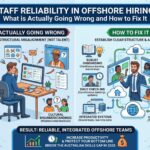 Staff Reliability Issues in Offshore Hiring: What is Actually Going Wrong and How to Fix It