
- The Hidden Cost of Micromanaging Remote Teams
- Why Outcome-Based Management is Critical for Australian Businesses
- Practical Methods for Managing Offshore Staff by Results
- Key Performance Indicators That Actually Matter
- The Webco Talent Advantage: Outcome-Focused Remote Team Solutions
- Implementing Your Outcome-Based Management Transformation
- FAQs
The remote work revolution has fundamentally changed how Australian businesses operate, yet many managers still cling to outdated supervision methods that simply don’t work in a distributed environment.
If you’re struggling to manage offshore staff effectively or finding that traditional time-tracking approaches are hindering rather than helping your remote teams, it’s time to embrace outcome-based management.
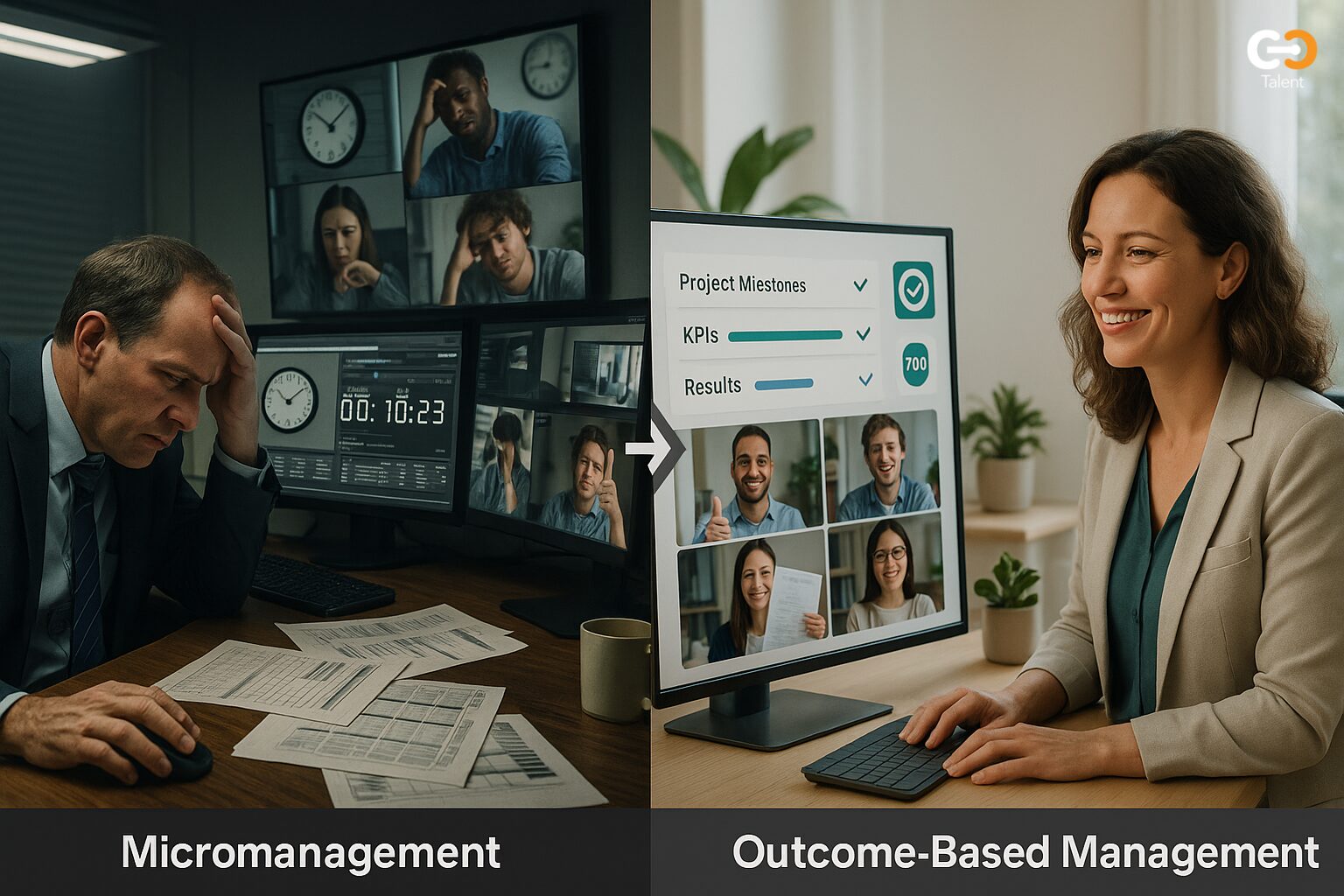
The Hidden Cost of Micromanaging Remote Teams
Picture this: Your project manager spends hours each day checking in on remote developers, scrutinising time logs, and monitoring screen activity, yet projects still miss deadlines and quality suffers. Sound familiar? You’re not alone. Research shows that there’s a fine line between setting healthy KPIs for remote work and unintentional micromanagement, which can tangibly affect remote productivity.
The problem isn’t your team’s capability or work ethic. The issue lies in managing remote workers the same way you’d manage office-based employees. Traditional micromanagement tactics create several critical problems:
Trust Erosion: Constant monitoring signals distrust, leading to decreased morale and increased turnover among your best remote talent.
Productivity Paradox: Focusing on hours worked rather than results achieved often leads to “presenteeism” where staff appear busy but deliver poor outcomes.
Scalability Issues: Micromanagement becomes impossible as your remote team grows, creating bottlenecks that stifle business expansion.
Cultural Misalignment: Different work cultures and time zones make traditional supervision methods ineffective for offshore teams.
Why Outcome-Based Management is Critical for Australian Businesses
With the Australian Bureau of Statistics reporting that remote work arrangements have permanently increased across industries, businesses that fail to adapt their management approaches risk being left behind. When recognising achievements, focus on the results delivered rather than the time invested. This reinforces the importance of effectiveness over simple activity.
The urgency to transform your management approach has never been greater:
- Talent Competition: The best remote professionals, particularly from offshore markets, choose employers who trust them to deliver results
- Cost Efficiency: Outcome-focused management reduces supervision overhead while improving project delivery
- Competitive Advantage: Companies that master remote team management can access global talent pools more effectively
Practical Methods for Managing Offshore Staff by Results
To begin, imagine you’re one of your subscribers. Reflect on their daily schedules, behaviors, and attitudes. While you may not have all the data, you likely have a good understanding of your target audience. When is the most probable time for them to interact with your email campaigns?
Usually, their weekly routine looks something like this:
1. Define Clear, Measurable Outcomes
Transform vague objectives into specific, quantifiable goals. Instead of “improve website performance,” specify “reduce page load time to under 2 seconds and achieve 95% uptime.” This clarity eliminates confusion and provides remote teams with concrete targets.
2. Implement Result-Oriented KPIs
Productivity KPIs assess how effectively those goals are being met, evaluate employees/processes and identify improvements without constant micromanagement. Focus on metrics that matter:
Development Teams:
- Code quality metrics (bug rates, code review scores)
- Feature completion rates
- Client satisfaction ratings
- Technical debt reduction
Marketing Teams:
- Lead generation numbers
- Conversion rate improvements
- Campaign ROI
- Brand engagement metrics
Support Teams:
- Resolution time improvements
- Customer satisfaction scores
- First-contact resolution rates
- Knowledge base effectiveness
3. Establish Transparent Communication Frameworks
Create structured communication that focuses on progress towards outcomes rather than daily activities. Weekly outcome reviews, milestone check-ins, and quarterly objective assessments keep everyone aligned without intrusive oversight.
3. Establish Transparent Communication Frameworks
Create structured communication that focuses on progress towards outcomes rather than daily activities. Weekly outcome reviews, milestone check-ins, and quarterly objective assessments keep everyone aligned without intrusive oversight.
4. Use Collaborative Project Management Tools
Implement platforms that provide visibility into project progress while allowing team members autonomy in how they achieve results. Tools like Asana, Trello, or Monday.com can track deliverables without monitoring every minute of work.
5. Build Cultural Bridges with Offshore Teams
Understanding cultural differences in communication and work styles helps set appropriate expectations and outcome measures. Regular cultural alignment sessions ensure everyone understands success metrics and delivery expectations.
Key Performance Indicators That Actually Matter
Shift from tracking inputs (hours worked) to measuring outputs (results delivered). Work-Life Balance Score – A self-reported score assessing employees’ balance between work and personal life alongside productivity metrics provides a more holistic view of team performance.
Essential KPIs for Remote Team Management:
- Delivery Metrics: On-time project completion rates, quality scores, and client approval ratings
- Efficiency Indicators: Time-to-market improvements, cost per deliverable, and resource utilisation
- Engagement Measures: Team satisfaction surveys, retention rates, and professional development progress
- Innovation Tracking: New ideas implemented, process improvements suggested, and problem-solving effectiveness
The Webco Talent Advantage: Outcome-Focused Remote Team Solutions
Managing remote teams effectively requires more than just good intentions – it demands expertise, proven systems, and access to top-tier talent. Webco Talent specialises in providing Australian businesses with outcome-focused offshore staff and comprehensive staff augmentation services.
Our approach eliminates the guesswork from remote team management:
Pre-Qualified Talent: We provide professionals who thrive in outcome-based environments, reducing your management overhead from day one.
Cultural Integration Support: We bridge communication gaps and ensure seamless collaboration between your local and offshore teams.
Scalable Solutions: Whether you need a single developer or an entire development team, our staff augmentation services grow with your business needs.
Ongoing Performance Management: We provide continuous support to ensure your remote teams consistently deliver exceptional results.
Implementing Your Outcome-Based Management Transformation
Start your transformation today with these immediate actions:
- Audit Current Metrics: Identify which KPIs measure activities versus outcomes
- Redefine Success Criteria: Work with teams to establish clear, measurable objectives
- Invest in Proper Tools: Implement project management and communication platforms that support outcome tracking
- Train Your Managers: Equip supervisors with skills to manage by results rather than presence
- Partner with Experts: Consider working with specialists who understand outcome-based remote team management
The shift from micromanagement to outcome-based management isn’t just a trend – it’s an essential evolution for businesses serious about competing in the global marketplace. Australian companies that embrace this approach will unlock the full potential of remote work while building more resilient, efficient, and motivated teams.
Ready to transform how you manage remote teams? Webco Talent’s outcome-focused approach and proven offshore staff solutions can help you achieve better results with less stress. Contact us today to discover how our staff augmentation services can revolutionise your remote team performance.
FAQs
How do you measure productivity in remote teams without micromanaging?
Focus on deliverable-based KPIs rather than activity metrics. Track project completion rates, quality scores, client satisfaction, and goal achievement rather than hours logged or screen time. Regular outcome reviews and milestone check-ins provide visibility without intrusive oversight.
What's the difference between outcome-based management and traditional task management?
Outcome-based management focuses on end results and objectives achieved, while task management emphasises specific activities and processes. With outcome-based management, employees have autonomy in how they reach their goals, whereas task management prescribes specific steps and methods.
How can you ensure accountability in offshore teams without constant supervision?
Establish clear expectations, measurable outcomes, and regular communication rhythms. Use collaborative project management tools for transparency, implement peer review processes, and conduct regular performance assessments based on results delivered rather than time spent working.
What KPIs work best for managing remote developers and technical teams?
Effective technical KPIs include code quality metrics (bug rates, review scores), feature completion rates, technical debt reduction, system performance improvements, and client satisfaction ratings. These measure actual value delivered rather than coding hours.
How do you handle different time zones when managing offshore staff by outcomes?
Set clear deadlines and deliverables that account for time zone differences, use asynchronous communication tools, establish overlap hours for critical discussions, and focus on weekly or milestone-based check-ins rather than daily standups.
Can outcome-based management work for all types of roles and industries?
Yes, but the specific outcomes and KPIs must be tailored to each role. Sales roles might focus on revenue targets, support roles on resolution times and satisfaction scores, and creative roles on project completion and client approval ratings. The key is defining measurable results for each position.
How do you transition from micromanagement to outcome-based management without losing control?
Start gradually by identifying key outcomes for each role, establishing clear communication schedules, and implementing proper project management tools. Maintain regular check-ins initially while progressively reducing oversight as teams demonstrate consistent results delivery.
What tools are essential for implementing outcome-based management with remote teams?
Essential tools include project management platforms (Asana, Monday.com), communication tools (Slack, Microsoft Teams), performance tracking systems, and collaborative documentation platforms. Choose tools that provide visibility into progress and results rather than activity monitoring.
How do you maintain team cohesion and culture with outcome-focused remote management?
Regular team meetings, virtual social events, shared goal celebrations, and transparent communication about company objectives help maintain culture. Focus on celebrating achieved outcomes collectively and ensuring everyone understands how their results contribute to broader business goals.
What are the biggest mistakes companies make when implementing outcome-based management?
Common mistakes include setting vague or unmeasurable outcomes, failing to provide adequate resources or support, reverting to micromanagement when challenges arise, not aligning individual outcomes with business objectives, and inadequate communication about expectations and progress.
Related posts:
 Offshoring Software Development: A Guide to Hiring an Offshore Developer for Co Development Software
 Offshore Accounting Staff for Australian Firms: The Complete 2026 Guide
 The Real Cost of Hiring a Developer Locally vs Offshore in Australia (2026)
 The Real Cost of Hiring a Developer Locally vs Offshore in Australia (2026)