

- The Real Cost of Doing Business in Australia
- Why Traditional Cost-Cutting Isn't Enough
- The Strategic Solution: Understanding Total Cost of Ownership
- Modelling the Impact: A Real-World Example
- Critical Success Factors for Offshore Implementation
- How Webco Talent Solves the Offshoring Challenge
- Taking Action: Your Next Steps
- FAQs
The Perfect Storm Facing Australian SMEs marching towards 2026
Australian small businesses are navigating one of the most challenging economic environments in decades. With 89% of SMEs experiencing increased business costs in the past 12 months and 46% of small businesses currently unprofitable, the pressure on margins has never been more intense.
The numbers paint a stark picture: utility bills have surged, wages continue their upward trajectory with the national minimum wage now sitting at $24.10 per hour, and supplier costs show no signs of easing. For many business owners, the question is no longer about growth but survival.
The Real Cost of Doing Business in Australia
Wages: The Biggest Burden
Australian wages rank amongst the highest globally. When you factor in the true cost of employing someone locally, the numbers become staggering:
- Base wage: $24.10 per hour minimum (as of July 2024)
- Superannuation: 12%
- Workers’ compensation insurance: Variable by industry
- Payroll tax: Applicable when wage bills exceed state thresholds
- Annual leave: 4 weeks plus potential 17.5% loading
- Recruitment costs: Average $19,000 per hire
For a single full-time employee on minimum wage, businesses face a true cost exceeding $51,920 annually when all on-costs are included.
The Triple Threat: Energy, Inputs, and Compliance
Beyond wages, Australian businesses are grappling with:
- Energy costs: Cited by 66% of SMEs as the greatest contributor to increased expenses
- Supplier cost increases: Affecting 47% of businesses
- Regulatory compliance: Many owners spending over six hours weekly on compliance tasks, with compliance ranking among their top five business expenses
This perfect storm has resulted in 72% of businesses identifying high operating costs as their single largest barrier to growth.
Why Traditional Cost-Cutting Isn't Enough
Many business owners have exhausted the obvious options. They’ve negotiated with suppliers, switched energy providers, and trimmed discretionary spending. Yet margins continue to erode.
The harsh reality is that some costs are structural and inescapable in the Australian market. You can’t negotiate away superannuation obligations. Fair Work Commission wage increases aren’t optional. Commercial rents in major cities continue climbing.
The Personal Toll
Recent research reveals the human cost of these pressures:
- 76% of small business owners report experiencing stress or anxiety
- 57% have experienced burnout
- Many are dipping into personal savings or delaying their own pay to keep businesses afloat
- One in four businesses have no cash reserves left
This isn’t sustainable. Business owners need solutions that fundamentally change their cost structure, not just marginally improve it.
The Strategic Solution: Understanding Total Cost of Ownership
Local Hiring vs Offshoring: The Real Numbers
When Australian businesses model the total cost of ownership for local versus offshore hiring, the economics are compelling:
Local Hire (Administrative Role)
- Base salary: $65,000
- Superannuation (12%): $7,475
- Payroll tax (where applicable): ~$3,250
- Workers’ compensation: ~$1,300
- Recruitment costs: $19,000 (one-time)
- Office space and equipment: $8,000 annually
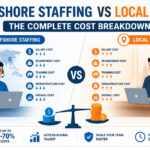
- Total first-year cost: $104,025
Offshore Hire (Same Role)
- All-inclusive cost: $25,000-$35,000 annually
- Potential savings: $69,000+ in first year
This represents a cost reduction of approximately 65-70% whilst maintaining quality output.
Beyond the Numbers: Strategic Advantages
Offshoring isn’t merely about cutting costs. When structured properly through staff augmentation, it delivers:
- Scalability: Rapidly expand capacity during peak periods without long-term commitments
- Access to global talent: Tap into skilled professionals in markets like Sri Lanka & the Philippines, where English proficiency is high and cultural alignment with Australia is strong
- Business continuity: Reduce risk by diversifying your workforce geographically
- Margin protection: Lock in sustainable operating costs that don’t fluctuate with local wage pressures
Modelling the Impact: A Real-World Example
Consider a 15-person Australian business currently struggling with margins:
Current Structure:
- 15 local staff
- Average fully-loaded cost per employee: $85,000
- Total wage bill: $1,275,000
- Current profit margin: 5.2% (industry median)
Optimised Structure with Offshore Augmentation:
- 10 local staff (customer-facing, strategic roles)
- 5 offshore staff (administration, operations, technical support)
- Local staff costs: $850,000
- Offshore staff costs: $150,000
- Total wage bill: $1,000,000
- Annual savings: $275,000
This $275,000 saving flows directly to the bottom line, effectively quintupling profit margins from 5.2% to approximately 25% (assuming $5M revenue).
Critical Success Factors for Offshore Implementation
Not all offshoring relationships succeed. Here’s what separates effective implementations from failed attempts:
1. Onboarding and Integration
Treat offshore team members as true extensions of your business, not disposable resources. Invest in:
- Comprehensive onboarding aligned with your local team process
- Regular video communication to build relationships
- Clear documentation and standard operating procedures
- Cultural training in both directions
2. Management and Oversight
Successful offshore teams require:
- Clear KPIs and performance metrics
- Regular check-ins and feedback loops
- Project management tools for transparency
- Dedicated points of contact
3. Right-Sizing the Roles
Best candidates for offshoring include:
- Administrative and operational functions
- Technical support and IT roles
- Data entry and processing
- Customer service (with proper training)
- Financial processing and bookkeeping
- Digital marketing and content creation
Roles that typically remain onshore:
- Client-facing strategic positions
- Senior management
- Roles requiring physical presence
- Positions needing deep local market knowledge
How Webco Talent Solves the Offshoring Challenge
Many Australian businesses recognise the need for offshore talent but lack the infrastructure, knowledge, and time to manage the process effectively.
This is where Webco Talent’s offshore and staff augmentation services become invaluable:
Turnkey Solutions
We handle the entire process from recruitment and vetting to onboarding and ongoing management allowing you to focus on core business activities whilst we build your offshore capability.
Quality Assurance
Our rigorous screening process ensures you access the top tier of talent in our partner markets. We don’t just fill positions; we match skills, cultural fit, and work ethic to your specific requirements.
Scalable Model
Whether you need a single virtual assistant or an entire offshore department, our staff augmentation approach allows you to scale up or down based on business demands without the risks and costs of traditional hiring.
Australian-Managed
Unlike dealing directly with offshore providers, Webco Talent provides Australian-based account management, ensuring clear communication, aligned expectations, and local business understanding.
Total Cost Transparency
We provide detailed total-cost-of-ownership modelling specific to your business, helping you make informed decisions about which roles to offshore and what savings you can realistically expect.
Taking Action: Your Next Steps
The economic pressures facing Australian small businesses aren’t temporary. Wage growth, regulatory complexity, and operational costs will continue their upward trajectory. The businesses that survive and thrive will be those that fundamentally restructure their cost base.
Here’s how to begin:
- Audit your current costs: Calculate the true, fully-loaded cost of each role in your business
- Identify offshore-suitable positions: Determine which roles don’t require physical Australian presence
- Model the economics: Calculate potential savings using realistic offshore costs
- Start small: Begin with one or two positions to test the model
- Scale strategically: Expand your offshore team as processes and confidence grow
The small businesses weathering today’s economic storm aren’t the ones hoping conditions improve. They’re the ones actively restructuring their operations to remain viable regardless of external pressures.
FAQs
Will offshoring negatively impact my local team?
When implemented strategically, offshoring typically enhances local employment rather than replacing it. As businesses reduce operational costs and improve margins, they grow creating more local jobs in strategic, customer-facing, and management positions. Many Australian companies report that offshoring allows their local teams to focus on higher-value activities rather than routine administrative tasks.
How much can I realistically save through offshoring?
Businesses typically save between 60-70% on labour costs when offshoring administrative, operational, and technical roles. However, total savings depend on factors including the roles offshored, the partner country, and management costs. A proper total-cost-of-ownership model is essential to understand your specific savings potential.
What about communication and time zone challenges?
Countries like the Philippines offer minimal time zone differences with Australia (typically 2-3 hours), allowing for significant working hour overlap. Additionally, high English proficiency in these markets minimises language barriers. Successful offshore relationships use collaboration tools like Slack, Zoom, and project management software to maintain seamless communication.
How do I ensure quality and maintain control?
Quality control starts with proper recruitment and vetting, followed by clear standard operating procedures, regular performance reviews, and integrated project management systems. Using a staff augmentation model rather than project-based outsourcing gives you direct oversight of offshore team members, who work as extensions of your internal team rather than external contractors.
Is staff augmentation different from traditional outsourcing?
Yes, significantly. Traditional outsourcing involves handing entire projects or functions to external vendors with limited control. Staff augmentation integrates offshore professionals directly into your team they attend your meetings, use your systems, and report to your managers. You maintain control and oversight whilst accessing cost-effective global talent.
What roles are best suited for offshoring?
Administrative functions, data processing, bookkeeping, technical support, customer service, digital marketing, and software development are typically excellent candidates for offshoring. Roles requiring physical Australian presence, deep local market knowledge, or senior strategic decision-making usually remain onshore.
How long does it take to see results from offshoring?
Initial setup and recruitment typically take 2-4 weeks. You’ll see immediate cost savings once offshore staff are operational, though full productivity usually takes 2-3 months as team members complete training and integration. Most businesses report positive ROI within the first quarter of implementation.
What are the risks of offshoring?
Common risks include communication challenges, cultural misalignment, data security concerns, and quality control issues. However, these risks are largely mitigated by working with experienced offshore partners who handle recruitment, provide management infrastructure, and ensure compliance with data protection requirements. Starting with non-critical roles also minimises risk during the learning phase.
How does offshoring compare to automation?
Offshoring and automation serve different purposes. Automation works best for highly repetitive, rule-based tasks with zero variation. Offshoring is ideal for tasks requiring human judgment, customer interaction, or complex decision-making at a lower cost than local hiring. Many successful businesses use both strategies in combination.
What's the difference between offshoring and nearshoring?
Offshoring involves hiring from geographically distant countries (e.g., Australia hiring from the Philippines or Sri Lanka), typically offering maximum cost savings. Nearshoring involves hiring from nearby countries with similar time zones and cultures. For Australian businesses, both the Philippines and Sri Lanka can serve as effective offshore locations with reasonable time zone overlap.
Ready to protect your margins and secure your business’s future? Contact Webco Talent today for a complimentary total-cost-of-ownership analysis specific to your business. Discover exactly how much you could save and which roles are prime candidates for offshore augmentation.
Don’t wait until cash reserves are depleted. The businesses thriving in today’s economy made the decision to restructure yesterday. Make yours today.
Related posts:
 Offshoring Software Development: A Guide to Hiring an Offshore Developer for Co Development Software
 Offshore Staffing vs Local Hire: The Complete Australian Cost Breakdown (2026)
 Outsourcing, Offshoring & Nearshoring: How Australian SMBs Can Build a Winning Global Talent Strategy
 How Much Does Offshore Staffing Cost in Australia (2026): The Complete Breakdown