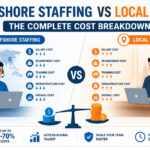
- 1. What Are the Cost Components of Offshore Staffing in Australia?
- 2. Offshore Salary Benchmarks by Role (2026)
- 3. Agency Fees: What Different Models Charge and Why It Matters
- 4. Equipment, Infrastructure, and Setup Costs
- 5. Hidden Costs That Offshore Providers Rarely Disclose Upfront
- 6. Full Cost Comparison: Offshore vs Australian Hire by Role
- 7. What Does Offshore Staffing Actually Save You?
- 8. Why the Cheapest Offshore Option Usually Costs the Most
- 9. How Webco Talent's Pricing Model Works
- 10. Frequently Asked Questions
“You will save 60 to 70 percent.”
That figure appears on almost every offshore staffing website in Australia. And while it is broadly true, it tells you almost nothing useful about what you will actually pay, how that cost is structured, or what you get for it.
If you are an Australian business owner doing real due diligence on offshore staffing in 2026, you need more than a percentage. You need to understand the cost components, what drives variation between roles, how different agency models affect total cost, and what the full savings picture looks like when you compare it against what an equivalent Australian hire actually costs.
That is what this article gives you.
Webco Talent has placed offshore staff for 400+ Australian businesses since 2008. The numbers in this article reflect current market rates across our delivery markets in Sri Lanka and the Philippines, compared against verified Australian employment cost benchmarks.
1. What Are the Cost Components of Offshore Staffing in Australia?
- The offshore salary. This is what the staff member actually takes home. It reflects local market rates in the country of employment, typically Sri Lanka or the Philippines for Australian-facing providers. Salary levels vary significantly by role, seniority, and technical skill level.
- The agency management fee. This covers recruitment, HR administration, payroll processing, performance management, equipment, infrastructure, office space (for office-based models), and local compliance. In a fully managed model, this is bundled with the salary into a single monthly rate. In a placement-only model, you pay a one-time fee and then manage everything yourself.
- Equipment and infrastructure. A working offshore staff member needs a reliable computer, monitor, high-speed internet, collaboration software, and security provisioning. In a managed model, this is the agency’s responsibility. In a self-managed arrangement, it is yours.
- Setup and placement fees. Some agencies charge a one-time fee at the start of the engagement to cover sourcing, screening, and shortlisting. Others amortise this into the monthly rate. The distinction matters for cash flow, particularly for businesses hiring multiple people.
2. Offshore Salary Benchmarks by Role (2026)
Role | Sri Lanka (AUD/month) | Philippines (AUD/month) | Australian equivalent (AUD/month) |
Software Developer (mid-level) | $1,800 – $2,800 | $2,000 – $3,200 | $7,500 – $10,000 |
QA Tester | $1,200 – $1,800 | $1,400 – $2,000 | $5,800 – $7,500 |
Bookkeeper | $1,000 – $1,600 | $1,200 – $1,800 | $5,000 – $6,500 |
Virtual Assistant | $800 – $1,400 | $1,000 – $1,600 | $4,200 – $5,500 |
Digital Marketing Specialist | $1,200 – $2,000 | $1,400 – $2,200 | $5,500 – $8,000 |
IT Support Specialist | $1,000 – $1,800 | $1,200 – $2,000 | $5,500 – $7,500 |
Admin Support | $800 – $1,200 | $900 – $1,400 | $4,000 – $5,200 |
Data Entry Specialist | $700 – $1,100 | $800 – $1,200 | $3,800 – $4,800 |
Social Media Administrator | $900 – $1,400 | $1,000 – $1,600 | $4,500 – $6,000 |
What drives variation within these ranges:
3. Agency Fees: What Different Models Charge and Why It Matters
The agency fee structure is where offshore staffing cost comparisons become genuinely complex, because different providers use fundamentally different commercial models. Comparing headline rates without understanding the model underneath them leads to bad procurement decisions.
Usually, their weekly routine looks something like this:
The three most common models in the Australian market are:
- The fully managed model. The agency charges a single monthly rate per staff member that bundles the offshore salary, all HR and payroll administration, equipment, infrastructure, and performance management. You pay one number. Everything operational is the agency’s responsibility. This is the model Webco Talent uses.
- The placement-only model. The agency charges a one-time placement fee, typically $2,000 to $5,000 per hire, and then hands over responsibility. You source your own equipment, manage payroll directly in the country of employment, and handle all HR administration yourself. Some providers bill an ongoing small retainer of $200 to $500 per month for minimal account management.
- The BPO or shared-resource model. The agency provides access to a pool of shared staff who work across multiple clients, typically priced at an hourly rate. Rates range from $8 to $20 per hour depending on role. This model suits highly variable or genuinely part-time work requirements. It is not appropriate when you need a dedicated staff member who understands your processes, systems, and clients.
Which model is right for your business?
For most Australian SMEs, the fully managed model is the right choice because it provides a single point of accountability, removes operational complexity, and protects the business from compliance risk in the country of employment. The cost premium over the placement-only model is typically recovered within two to three months in management time savings alone.
For a deeper comparison of these models, see our article on Offshore Staffing vs BPO: The Strategic Choice That Will Define Your 2026 Growth Trajectory.
Use the free Webco Talent Savings Calculator to model the cost of your specific role in under 60 seconds. No signup required.
4. Equipment, Infrastructure, and Setup Costs
- Desktop or laptop computer (replaced on a standard cycle, typically three years)
- Monitor, keyboard, mouse, and headset
- Dedicated high-speed internet connection
- Collaboration software licences (Microsoft 365, Google Workspace, Slack, Zoom)
- Physical office space in a managed facility
- IT security and data protection infrastructure
- Backup power and internet redundancy
5. Hidden Costs That Offshore Providers Rarely Disclose Upfront
Replacement fees
Many agencies charge a new placement fee each time a hire needs to be replaced, regardless of whether the failure was caused by the agency’s screening quality. On a $3,000 monthly engagement, a replacement fee of $2,500 effectively adds nearly a full month’s cost every time the arrangement breaks down. Webco Talent does not charge replacement fees.
Currency fluctuation exposure
Agencies that bill in USD or in the local currency of the country of employment expose Australian clients to exchange rate risk. A managed provider that bills in AUD eliminates this exposure. Ask specifically whether your monthly invoice will be in AUD at a fixed rate or subject to exchange rate variation.
Payroll tax on agency fees
If your total Australian wages bill, including agency fees crosses your state’s payroll tax threshold, the characterisation of offshore staffing costs in your accounts may affect your threshold calculation. This is a nuanced area and worth discussing with your accountant, but it is not a consideration that most agencies will raise proactively.
Onboarding time from your team
Even a highly capable offshore hire requires orientation time from your Australian team, particularly in the first 30 to 60 days. The productivity cost of that onboarding investment is real and should be planned for. A responsible offshore provider will help you structure the onboarding process to minimise this. An irresponsible one will present “up and running in days” as a selling point without acknowledging the ramp-up period.
Communication and management overhead
Offshore staff in a different time zone require structured communication processes: daily check-ins, asynchronous update protocols, and documentation standards. For businesses that have not managed remote staff before, building these processes takes time and management capacity. Budget two to four weeks of elevated management attention at the start of any offshore engagement.
6. Full Cost Comparison: Offshore vs Australian Hire by Role
Cost item | Australian hire | Offshore (Webco Talent) |
Annual all-in cost | $110,000 – $135,000 | $42,000 – $60,000 |
Monthly equivalent | $9,170 – $11,250 | $3,500 – $5,000 |
Saving | 50% – 62% |
Cost item | Australian hire | Offshore (Webco Talent) |
Annual all-in cost | $75,000 – $95,000 | $24,000 – $36,000 |
Monthly equivalent | $6,250 – $7,920 | $2,000 – $3,000 |
Saving | 55% – 68% |
Cost item | Australian hire | Offshore (Webco Talent) |
Annual all-in cost | $65,000 – $82,000 | $18,000 – $30,000 |
Monthly equivalent | $5,420 – $6,830 | $1,500 – $2,500 |
Saving | 57% – 72% |
Cost item | Australian hire | Offshore (Webco Talent) |
Annual all-in cost | $82,000 – $108,000 | $28,000 – $42,000 |
Monthly equivalent | $6,830 – $9,000 | $2,300 – $3,500 |
Saving | 57% – 66% |
Cost item | Australian hire | Offshore (Webco Talent) |
Annual all-in cost | $85,000 – $110,000 | $24,000 – $36,000 |
Monthly equivalent | $7,080 – $9,170 | $2,000 – $3,000 |
Saving | 60% – 72% |
See your specific role savings in under 60 seconds with the Webco Talent free calculator.
7. What Does Offshore Staffing Actually Save You?
- Bookkeeper: $88,000
- Virtual assistant: $72,000
- Digital marketing coordinator: $95,000
- Total: $255,000 per year
- Bookkeeper: $30,000
- Virtual assistant: $24,000
- Digital marketing coordinator: $36,000
- Total: $90,000 per year
8. Why the Cheapest Offshore Option Usually Costs the Most
9. How Webco Talent's Pricing Model Works
- The offshore staff member’s salary, paid at competitive local market rates that attract and retain quality talent
- All HR and payroll administration in the country of employment (Sri Lanka or Philippines)
- Equipment and infrastructure: computer, peripherals, internet connection, office space
- Performance management and ongoing HR support
- A dedicated Melbourne-based account manager available during Australian business hours
- Recruitment, screening, and shortlisting of replacement candidates if needed, at no additional charge
- Role-specific software licences your business already holds (these are typically extended to offshore staff under existing subscription terms)
- Australian-side management time
- Any tools or platforms your business requires beyond the standard collaboration stack
10. Frequently Asked Questions
How much does offshore staffing cost in Australia in 2026?
The all-in cost of offshore staffing for an Australian business in 2026 typically ranges from $1,500 to $5,000 per month per staff member in a fully managed model, depending on the role and seniority. This figure includes the offshore salary, agency management fee, equipment, and infrastructure. Compared to the fully loaded cost of an equivalent Australian hire, this represents a saving of 50 to 72 percent depending on the role.
What is included in an offshore staffing monthly rate?
In a fully managed model, the monthly rate typically includes the offshore staff member’s salary, HR and payroll administration in the country of employment, equipment and infrastructure, performance management, and account management. In a placement-only model, the monthly rate may include only the salary component, with other costs billed separately or transferred to the client.
Are there hidden costs in offshore staffing?
Yes, in some provider models. Common undisclosed costs include replacement fees when a hire leaves, currency fluctuation exposure when billing is not in AUD, equipment and infrastructure costs not included in the headline rate, and one-time setup fees. A reputable provider will itemise all cost components before contract execution. Always ask for a fully itemised cost breakdown and request a copy of the contract before committing.
How does offshore staffing cost compare to hiring in Australia?
A fully loaded Australian hire at a $70,000 base salary costs $95,000 to $110,000 when superannuation, leave entitlements, workers compensation, recruitment, and overhead are included. An equivalent offshore hire through a fully managed provider costs $24,000 to $42,000 per year depending on role and market. The saving across comparable roles is consistently 50 to 70 percent.
Do offshore staff salaries affect Australian payroll tax obligations?
Offshore staff engaged through a managed provider are employed under the laws of their country of work and do not appear on the Australian wages bill that triggers payroll tax obligations. This means offshore staffing can help Australian businesses manage their payroll tax exposure, particularly those approaching or above their state threshold. We recommend discussing the specific treatment with your accountant.
How is Webco Talent's pricing structured?
Webco Talent charges a single all-in monthly rate per staff member that includes salary, HR, payroll, equipment, infrastructure, and account management. Billing is in Australian dollars with no currency risk. There are no lock-in contracts, no replacement fees, and no hidden charges. CVs are delivered within 10 business days of receiving a brief.
What is the typical saving for a bookkeeper hired offshore vs. locally in Australia?
A bookkeeper hired locally in Australia costs approximately $75,000 to $95,000 per year fully loaded (salary plus super, leave, workers comp, and recruitment amortisation). The equivalent role through Webco Talent’s offshore model costs approximately $24,000 to $36,000 per year all-in, representing a saving of 55 to 68 percent.
Can I hire offshore staff without using an agency?
Yes, but it is rarely practical for Australian SMEs. Direct offshore hiring requires establishing a legal entity or employer-of-record arrangement in the country of employment, managing local payroll and HR compliance, sourcing and screening candidates independently, and providing all equipment and infrastructure. The operational overhead of self-managing an offshore hire typically exceeds the cost of a managed agency model unless the business is hiring at significant scale.