- 1. What Does an Employee Really Cost?
- 2. Mandatory Costs: The Unavoidable 25–30%
- 3. Hidden Costs Most Businesses Miss
- 4. Payroll Tax: The Growth Penalty
- 5. Full Example: The Real Cost of a $70K Hire
- 6. Why Costs Are Rising Faster Than Salaries
- 7. How Offshore Staffing Changes the Equation
- Frequently Asked Questions
You sign off on a $70,000 salary. You put $70,000 in the budget.
Twelve months later, your accountant shows you the actual figure somewhere between $95,000 and $105,000. That gap is not a rounding error. It is the predictable, legislated cost of employment in Australia in 2026.
Most business owners anchor to the salary figure because that’s the number on the employment contract. But Australian employment law, the ATO, and Fair Work obligations layer significant additional costs on top before the employee has attended a single meeting.
This guide breaks down every component of Australian employment cost in plain numbers — superannuation, leave entitlements, payroll tax, recruitment, and operational overhead — so you can make hiring decisions based on what things actually cost.
For Australian businesses exploring a smarter cost structure, Webco Talent has helped 400+ companies restructure their teams through offshore staffing since 2008.
Direct answer: In Australia in 2026, the total cost of employing a worker typically runs 25% to 55% above their base salary. A $70,000 salary has an all-in employment cost of approximately $95,000–$110,000 when mandatory statutory costs, leave entitlements, and standard operational overhead are included. The three cost layers are: (1) statutory obligations — superannuation at 12%, leave entitlements ~13.2%, workers compensation 1–3%; (2) government payroll tax, which applies once your total wages bill crosses state-based thresholds; and (3) operational overhead — recruitment, equipment, onboarding time, and management capacity.
1. What Does an Employee Really Cost in Australia in 2026?
The three cost layers every Australian employer faces in 2026:
Statutory obligations — superannuation, leave entitlements, workers compensation. These are legislated and non-negotiable.
Government taxes — payroll tax applies once your total wages bill crosses state-based thresholds, adding a further 4–5.5% to your wage bill.
Operational overhead — recruitment, equipment, software licences, onboarding time, and management capacity. These are real costs even when they are not itemised on a payslip.
In 2026, with superannuation at 12% and Payday Super coming into force from July 2026, the full cost of a hire has become a strategic calculation — not just a HR one.
2. Mandatory Employment Costs: The Unavoidable 25–30% Layer
Every Australian employer pays these costs. There are no exemptions.
Superannuation — 12%
From 1 July 2025, the Superannuation Guarantee rate increased to 12% of ordinary time earnings. On a $70,000 salary, that is an additional $8,400 per year that never appears in the employee’s take-home pay but sits firmly on your cost ledger.
The rate is legislated under the Superannuation Guarantee (Administration) Act 1992. It applies to all employees over 18 and to most under-18 employees who work more than 30 hours per week.
Leave Entitlements — Approximately 13.2%
Under the Fair Work Act 2009, full-time employees accrue the following leave entitlements:
Annual leave: 4 weeks per year (~7.7% of salary)
Personal/carer’s leave: 10 days per year (~3.8% of salary)
Long service leave accrual: varies by state, approximately 1.7% per year on average
On a $70,000 salary, combined leave entitlements represent approximately $9,240 in annualised liability — whether the employee takes the leave or it accrues on the books as a balance-sheet obligation.
Workers Compensation Insurance — 1–3%
Every Australian employer is legally required to hold workers compensation insurance. Premiums vary by industry and state, but a conservative figure for a standard office role is around 1.5–2% of payroll. Higher-risk industries pay materially more. On a $70,000 salary, this adds roughly $1,050–$2,100 per year.
Mandatory cost summary — before payroll tax or operational overhead:
| Cost Component | Rate | Annual Cost on $70K Salary |
|---|---|---|
| Superannuation (SG) | 12% | $8,400 |
| Annual leave (4 weeks) | ~7.7% | $5,390 |
| Personal / carer’s leave (10 days) | ~3.8% | $2,660 |
| Long service leave accrual | ~1.7% | $1,190 |
| Workers compensation insurance | 1.5–2% | $1,050–$1,400 |
| Mandatory cost subtotal | ~25.2–26.2% | $18,690–$19,040 |
This is the cost of an employee before a single dollar is spent on finding them, setting them up, or managing them.
3. Hidden Costs Most Businesses Fail to Budget For
The mandatory costs above are at least predictable. The costs below are where most hiring budgets silently blow out.
| Hidden Cost | Typical Range | Annualised Impact |
|---|---|---|
| Recruitment (advertising, agency, internal time) | $15,000–$25,000 per hire | $5,000–$8,000/yr (amortised over 3 yrs) |
| Equipment & setup (laptop, software, peripherals) | $3,000–$6,000 upfront | $1,000–$2,000/yr (amortised) |
| Onboarding & training (40–80 hrs internal time) | $5,000–$6,000 implicit cost | $1,700–$2,000/yr (amortised) |
| Management overhead (4 hrs/month × senior rate) | ~$4,600/yr per direct report | $4,600/yr ongoing |
| Hidden cost subtotal (conservative) | $12,300–$16,600/yr |
4. Payroll Tax: The Growth Penalty Hiding in Plain Sight
Payroll tax is the cost shock that catches scaling Australian businesses off guard. It is a state-based tax levied on employers once total wages exceed a threshold. In 2026:
| State / Territory | 2026 Threshold (approx.) | Tax Rate |
|---|---|---|
| New South Wales | $1,200,000 | 5.45% |
| Victoria | $700,000 | 4.85% |
| Queensland | $1,300,000 | 4.75% |
| Western Australia | $1,000,000 | 5.5% |
| South Australia | $1,500,000 | 4.95% |
| Tasmania | $1,250,000 | 4.0% |
| ACT | $2,000,000 | 6.85% |
| Northern Territory | $1,500,000 | 5.5% |
Note: Thresholds and rates are subject to annual revision. Confirm current figures with your state revenue office.
The Threshold Trap
Once you cross the threshold, payroll tax applies to all wages — not just the amount above the threshold in most states. That creates a step-change in cost at the exact moment you are trying to grow.
Example — NSW business with 18 employees averaging $70,000:
Total wages bill: ~$1,260,000
Payroll tax at 5.45%: ~$68,670 per year
Per-employee cost impact: ~$3,815
That is nearly $4,000 added to every employee’s real cost — a figure that never appeared anywhere in your original hiring calculations. For SMEs approaching 15–20 employees in higher-cost states, payroll tax is often the single biggest surprise in the P&L.
5. Full Example: The Real Cost of a $70K Employee in 2026
Scenario: Full-time professional employee in a Sydney-based SME. Base salary $70,000. Business is above the NSW payroll tax threshold.
| Cost Component | Annual Amount | % Above Salary |
|---|---|---|
| Base salary | $70,000 | — |
| Superannuation (12%) | $8,400 | +12.0% |
| Leave entitlements (annual + personal + LSL) | $9,240 | +13.2% |
| Workers compensation (1.75% avg) | $1,225 | +1.75% |
| Payroll tax — NSW 5.45% (above threshold) | $3,815 | +5.45% |
| Recruitment (amortised over 3 years) | $6,500 | +9.3% |
| Equipment & setup (amortised) | $1,500 | +2.1% |
| Onboarding & training (amortised) | $1,850 | +2.6% |
| Management overhead (ongoing) | $4,600 | +6.6% |
| Total all-in employment cost | ~$107,130 | +53% |
That is approximately 55% above the base salary on the offer letter. Even excluding payroll tax (for businesses below threshold), the total sits at roughly $102,000–$105,000 — aligned with the national benchmark range of $94,000–$106,000 for $70K roles.
6. Why Employment Costs Are Rising Faster Than Salaries in 2026
Three structural shifts are compounding the cost of Australian employment this year — and most businesses are underestimating at least two of them.
Payday Super From 1 July 2026
From 1 July 2026, superannuation must be paid at the same time as wages — not quarterly as currently permitted. This is the most significant change to payroll administration in a decade. The practical impact: cash flow pressure increases immediately, because super can no longer be deferred as a quarterly obligation. Payroll systems must be updated, and businesses that have been cash-managing their super obligations will feel the squeeze acutely.
Tight Labour Market and Wage Pressure
Australia’s unemployment rate remains near historic lows heading into 2026. Competition for skilled workers particularly in IT, accounting, administration, and digital marketing continues to push base salary expectations upward. The salary on which all your percentage-based statutory costs are calculated is itself rising.
Increasing Compliance Complexity
The ATO and Fair Work are investing in audit and enforcement, not simplification. Small businesses that have operated with informal payroll processes face increasing risk of underpayment findings, particularly around leave accruals and classification of contractors vs employees. Getting it wrong is expensive. Getting it right requires either internal expertise or external cost.
7. How Offshore Staffing Changes the Cost Equation
The most strategically significant shift happening among Australian SMEs in 2026 is not salary negotiation. It is cost structure redesign.
Businesses navigating Australian hiring costs most effectively are not asking “how do we pay less?” They are asking: “which roles genuinely require an Australian-based employee — and which ones can be delivered just as well from an offshore team?”
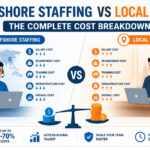
That question, applied systematically, can reduce employment costs by 40–70% without compromising output quality.
The Three Cost Layers Offshore Staffing Addresses
Salary arbitrage — Offshore salary benchmarks for equivalent skills are substantially lower than Australian rates. A software developer, bookkeeper, virtual assistant, or digital marketing specialist engaged through Webco Talent’s managed offshore model costs a fraction of the Australian equivalent.
Statutory cost elimination — Offshore workers do not trigger Australian superannuation, leave entitlement, workers compensation, or payroll tax obligations. Those 25–30% mandatory costs effectively disappear from the equation.
Operational overhead reduction — With a managed offshore staffing provider like Webco Talent, recruitment, HR administration, onboarding infrastructure, and equipment are handled by the provider. You pay a single monthly fee with no setup cost, no agency commission, and no lock-in contract.
What Webco Talent Delivers
Webco Talent is an Australian-based offshore staffing agency operating since 2008, headquartered in Melbourne with delivery teams in Colombo and Manila. Roles most commonly placed include offshore software developers, virtual assistants, bookkeepers, digital marketing specialists, IT support staff, admin support, QA testers, and data entry specialists.
The model is fully managed: Webco Talent handles payroll, HR, compliance, and infrastructure for offshore staff. You retain full operational control. CVs are delivered within 10 business days. There are no lock-in contracts.
For Australian businesses approaching or past payroll tax thresholds, this model is not a cost-cutting tactic — it is a structural alternative that can fund growth while reducing overhead.
The Bottom Line
Hiring in Australia in 2026 is not just a recruitment decision. It is a financial strategy.
The full cost of a single $70,000 employee can exceed $108,000 once every legitimate cost layer is accounted for. For businesses approaching payroll tax thresholds, that figure climbs further — and the growth that triggers the tax arrives faster than most owners expect.
The businesses navigating this environment most effectively are those that have asked a harder question: not “how do I reduce what I pay my Australian staff?” but “which roles need to be filled in Australia, and which ones can be delivered better and cheaper through a managed offshore team?”
Webco Talent exists to help Australian businesses answer that question — and act on it.
FAQs
What is the real cost of an employee in Australia in 2026?
The total cost of employing a worker in Australia in 2026 is typically 25% to 55% above their base salary. For a $70,000 base salary, the all-in employment cost generally falls between $95,000 and $110,000 when statutory obligations — superannuation at 12%, leave entitlements at ~13.2%, and workers compensation — plus payroll tax and operational overhead are included. The exact figure depends on whether the business is above state-based payroll tax thresholds.
How much does superannuation add to Australian employment cost in 2026?
From 1 July 2025, the Superannuation Guarantee rate is 12% of ordinary time earnings. On a $70,000 salary, this adds $8,400 per year to the employer’s cost — a mandatory statutory obligation under Australian law that applies to almost all employees. From 1 July 2026, Payday Super will require this to be paid at the same time as wages, increasing cash flow pressure further.
What is payroll tax and when does it apply in Australia?
Payroll tax is a state-based tax levied on employers whose total wages bill exceeds a set threshold. In 2026, thresholds range from approximately $700,000 (Victoria) to $2,000,000 (ACT), with tax rates of 4.0% to 6.85% of total wages. Once the threshold is crossed, the tax applies to the full wages bill in most states — creating a significant and often unanticipated step-change in employer costs at the point of growth.
What changes are coming to superannuation in 2026?
The Payday Super reform takes effect on 1 July 2026, requiring employers to pay superannuation contributions at the same time as wages — rather than quarterly as currently permitted. This change increases cash flow demands and requires payroll system updates. Businesses that have historically deferred super as a quarterly obligation will need to adapt their financial management and cash flow forecasting accordingly.
Why do small businesses face higher per-employee costs than large corporations?
Small and medium businesses cannot spread fixed costs recruitment, HR systems, compliance management, software licences, and management overhead across a large headcount. The result is a higher per-employee cost. A business with five employees incurs similar fixed infrastructure costs to one with fifty, but those costs represent a much larger proportion of each employee’s total cost. This is one of the core structural advantages that offshore staffing addresses for SMEs.
Is offshore staffing legally compliant for Australian businesses?
Yes. Engaging offshore workers through a managed offshore staffing provider does not create employment obligations under Australian law, provided the arrangement is structured correctly. Webco Talent handles all legal and HR obligations in the country of employment — Colombo, Sri Lanka or Manila, Philippines. Australian businesses are billed locally, retain full operational control, and have complete visibility over their offshore teams. The arrangement is distinct from contractor misclassification and carries no legal risk for the Australian business when properly structured.
How quickly can Webco Talent provide offshore candidates?
Webco Talent delivers shortlisted CVs within 10 business days of receiving a brief. There are no lock-in contracts, and the process is managed by a dedicated Australian-based account manager from initial scoping through to onboarding. The most commonly placed roles include software developers, QA testers, bookkeepers, virtual assistants, digital marketing specialists, IT support staff, data entry specialists, and administrative support.