
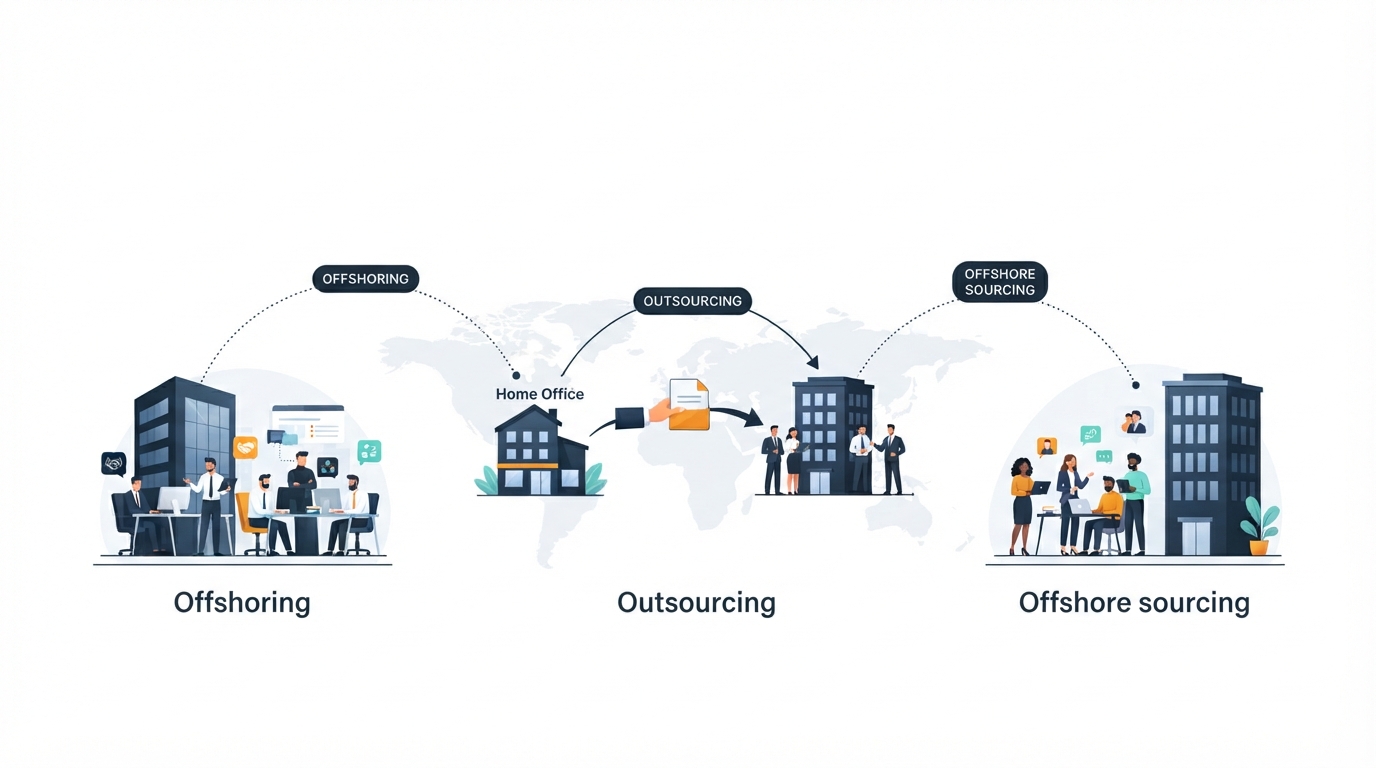
Offshoring means your own dedicated staff work from another country; outsourcing hands a task or project to an outside company; offshore sourcing is buying services or talent from overseas suppliers.
Put simply, offshoring is about where work happens, outsourcing is about who does it, and offshore sourcing (often called offshore outsourcing) combines both by engaging an external vendor in another country. For Australian businesses, the most common form of offshoring is a dedicated offshore staffing arrangement, where staff overseas work only for you. This guide defines the three models side by side, shows which suits which business, and compares them on cost and control.
Offshoring vs outsourcing vs offshore sourcing: definitions side by side
The three terms overlap, which is why they are so often confused. Here is the quick distinction:
- Offshoring (location focus). You move work or build a team in another country, typically for lower costs or access to talent. You can run that team directly as your own staff or through an overseas provider.
- Outsourcing (provider focus). You contract an external third party to handle specific tasks or functions, such as IT, payroll or customer support. The vendor can be local or international.
- Offshore sourcing, or offshore outsourcing (combined model). You hire a third-party vendor or agency in another country to perform work on your behalf, pairing overseas cost savings with vendor management.
| Dimension | Offshoring | Outsourcing | Offshore sourcing |
|---|---|---|---|
| Core question | Where is the work done? | Who does the work? | Who does the work abroad? |
| Location | Another country | Local or international | Another country |
| Execution | Your own staff or team overseas, directly or through a provider | An external third-party vendor | An external third-party vendor abroad |
| Day-to-day control | Higher, especially with a dedicated team | Lower; relies on the vendor’s SLA and oversight | Shared and vendor-managed, with cross-border coordination |
Which model suits which business
The right model depends on how much control you want and whether you are buying ongoing capacity or a one-off outcome.
- Choose offshoring when you need ongoing roles filled and want to direct the work yourself, as if the person sat in your office. A dedicated offshore team learns your business over time and scales with you.
- Choose outsourcing when you have a defined, fixed-scope task or project and would rather hand the whole thing to a specialist than manage it day to day.
- Choose offshore sourcing when you want overseas cost savings but prefer the vendor to manage the team, and you are comfortable with shared control and cross-border coordination.
Most Australian businesses that want capacity rather than a one-off deliverable land on offshoring through a managed provider, because it combines the cost of overseas talent with the control of a dedicated team.
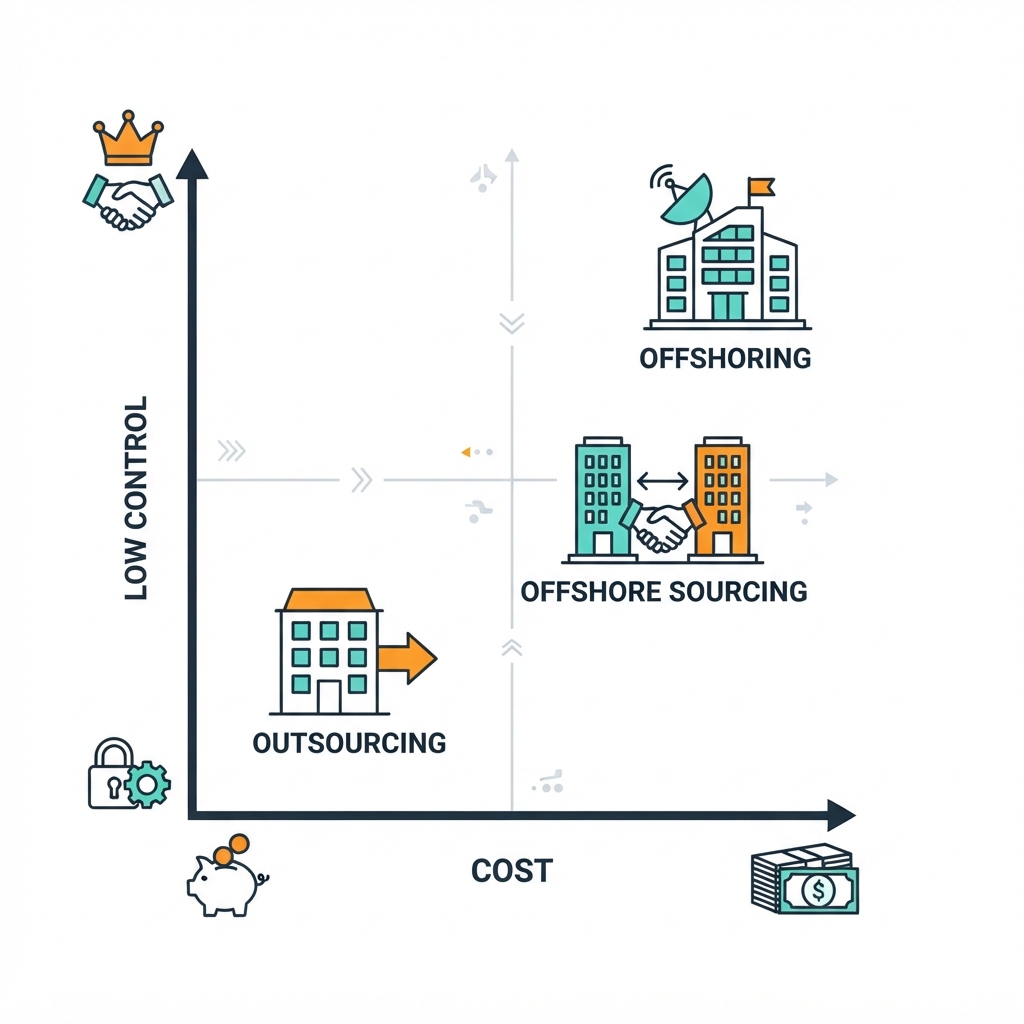
Cost and control compared
Cost and control usually move in opposite directions across the three models. Offshoring gives you the most day-to-day control; outsourcing gives you the least, in exchange for handing over management.
| Factor | Offshoring (dedicated team) | Outsourcing | Offshore sourcing |
|---|---|---|---|
| What you get | Dedicated staff who work only for you | A completed task or project | A vendor team abroad delivering a service |
| Control | You direct the day-to-day work | The vendor manages delivery | Shared; you brief, the vendor runs it |
| Cost model | One predictable monthly cost per role | Per project, per task or hourly | Overseas rates plus vendor margin |
| Continuity | Long-term; the team learns your business | Ends with the project | Ongoing while the contract runs |
| Best for | Ongoing roles and capacity | A fixed-scope deliverable | Overseas cost with a managed vendor |
Offshoring through a staffing provider is the middle path many businesses prefer: you get overseas cost savings and a predictable monthly fee, while keeping direct control of the work. Webco Talent is a Melbourne-based offshore staffing company, founded in 2008, that places dedicated staff from Manila and Colombo with 400+ Australian businesses.
Frequently Asked Questions
What is offshore sourcing?
Offshore sourcing, also called offshore outsourcing, is buying services or talent from suppliers in another country. You engage an external vendor or agency located abroad to perform work on your behalf, which pairs overseas cost savings with vendor management and scalability. It differs from offshoring, where the overseas staff are your own dedicated team rather than a vendor’s.
Is offshoring the same as outsourcing?
No. Offshoring is about where work is done: in another country, usually with your own dedicated staff or team. Outsourcing is about who does the work: an external third party, which can be local or international. When you combine them, by hiring a third-party vendor in another country, that is offshore outsourcing or offshore sourcing.
Want the Control of Offshoring Without the Overhead?
Webco Talent builds dedicated offshore teams for Australian businesses from Manila and Colombo. You direct the work; we handle employment, payroll and HR. All-inclusive AUD billing, pre-vetted CVs in 10 business days, month-to-month terms, and a 6-Month Replacement Guarantee on every placement.
Related posts:
 Offshore Software Development: The 2026 Guide for Australian Businesses
 Unlocking the Benefits of Offshoring Software Development: How Australian Tech Companies are Finding Success in Sri Lanka
 Outsourcing, Offshoring & Nearshoring: How Australian SMBs Can Build a Winning Global Talent Strategy
 Unlock Your Business Potential with Software Development Outsourcing in Australia