

Cyber Security Action Month runs every October in Australia. For 2026 the national campaign shifts from awareness to action under the theme “Take a Second. Stay Secure.”, led by the National Cyber Security Coordinator and the Australian Signals Directorate. For a small business, the action plan is five moves: protect your core accounts, switch to phishing-resistant MFA, clean up account access and remove former staff and contractors, retire unsupported legacy technology, and turn on event logging. The hard part is rarely knowing what to do. It is having the people to actually do it, which is where offshore IT and admin capacity changes the equation.
The numbers make the case on their own. According to the ASD’s Annual Cyber Threat Report 2024-25, the average self-reported cost of a cybercrime incident for an Australian small business rose 14 percent to around $56,600, the ACSC received more than 84,700 cybercrime reports (one every six minutes), and small businesses accounted for 43 percent of all reported cybercrime. Yet only about 40 percent of Australian small businesses treat cyber security as a priority. That gap between exposure and preparation is the whole story of 2026.
What is Cyber Security Action Month 2026?
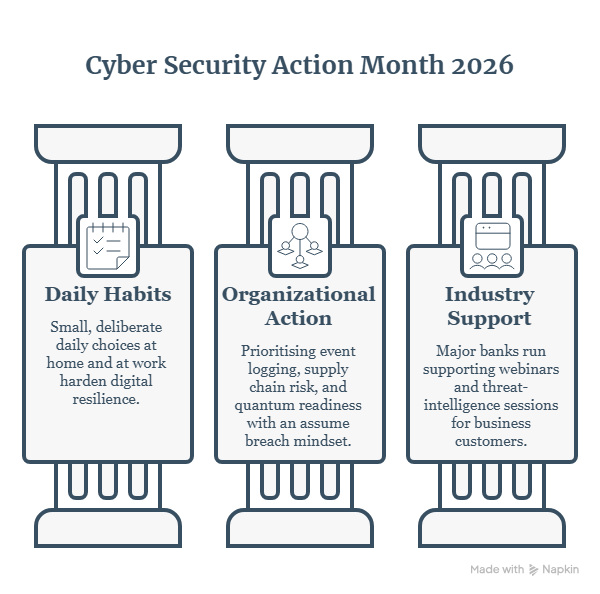
Cyber Security Action Month is Australia’s national October cyber campaign, run in 2026 under the banner of action rather than awareness, with the theme “Take a Second. Stay Secure.” It is coordinated by the National Cyber Security Coordinator and the ASD, and its message is that small, deliberate daily choices at home and at work harden the country’s digital resilience far more than one-off IT overhauls.
For individuals and small businesses, the campaign pushes practical, measurable habits. For larger organisations and critical infrastructure, the ASD runs a broader Cyber Action Year alongside it, prioritising event logging, supply chain risk, and quantum readiness, and urging an “assume breach” mindset. Australia’s major banks run supporting webinars and threat-intelligence sessions for business customers through the month.
The five-step small business action plan
Here is the campaign translated into an action list you can work through, mapped to what each step actually involves.
Action
What it means in practice
Protect your core accounts
Lock down the accounts an attacker wants most: primary email, domain registrar, banking, and cloud or admin consoles. These are the keys to everything else.
Switch to phishing-resistant MFA
Move off SMS codes to passkeys or a dedicated authenticator app. Microsoft reports MFA blocks more than 99.2 percent of account-compromise attacks.
Clean up account access
List who owns which admin account, and remove access for former employees and contractors. Stale access is a common, preventable entry point.
Retire legacy technology
Review, update, or properly decommission unsupported software and old devices that no longer receive security patches.
Turn on event logging
Enable logging and monitoring so a breach is caught early, not discovered months later once the damage is done.
None of these are expensive in tooling. The ACSC’s Essential Eight is the free benchmark for the controls that matter most. What they all cost is time and hands, and that is exactly what most small businesses do not have spare.
Why the checklist never gets done
Every October, business owners read a list like the one above, nod, and file it under “when things quieten down.” They never quieten down. The barrier is capacity, not intent:
- There is no dedicated IT or security person, so the work lands on the owner or an already stretched manager.
- Australia’s cyber and IT skills shortage makes a local specialist expensive and slow to hire.
- Account hygiene and offboarding are recurring chores, not one-off projects, so they slip the moment attention moves on.
The result is that phishing-resistant MFA gets half rolled out, a departed contractor keeps portal access for a year, and the old server nobody wants to touch stays online. Attackers rely on exactly these gaps. Most attacks on small businesses are automated and opportunistic, so being small is no protection at all.
How offshore capacity gets it actually done
This is where the action plan meets a practical solution. A dedicated offshore team member gives you the hands to work through the security backlog and keep it maintained, at a fraction of a local hire:
- Offshore IT support to roll out MFA, manage patching, and keep the Essential Eight controls current.
- Offshore developers to update or safely decommission legacy applications and build secure-by-design replacements. Explore offshore software development for this.
- Offshore admin support to run the unglamorous but critical hygiene work: access reviews, structured offboarding, and asset registers. A virtual assistant can own this checklist.
Through a managed provider, a dedicated professional starts from AUD $2,500 per month, all-inclusive, versus a loaded local salary several times higher. Set against an average small business cyber incident cost of $56,600, the capacity to prevent one pays for itself many times over.
But is offshore hiring itself secure?
It is a fair question, and the honest answer flips the concern into a strength: a well-run managed offshore provider operates on the exact habits Cyber Security Action Month is asking every business to adopt. The controls the campaign wants you to apply internally are how a serious provider works by default:
- Role-based access, never shared passwords. Offshore staff are granted access through each platform’s own permission system, so it can be issued and revoked instantly, and nothing is exposed.
- Phishing-resistant MFA and managed devices as standard on the accounts they touch.
- Structured offboarding. When an engagement ends, access is removed and devices are decommissioned on a defined process, so there is no legacy access left behind. That is account hygiene done properly.
- Contracts that follow the work. NDAs and IP assignment are in place before day one, so your data, code, and creative are yours.
- No Australian employer exposure, clear accountability. Because the specialist is employed by the provider in their home country, you get a single point of accountability and a clean contractual chain for your data.
Hiring offshore through a managed provider is not a security risk to manage around. Done properly, it is a security practice in its own right, and it adds the capacity to fix the gaps the campaign is warning you about.
What offshore IT and security capacity costs
Indicative monthly engagement fees for the roles most relevant to a security backlog, all-inclusive and billed in AUD:
IT Architect
$5,000
$14,726
66%
Senior IT Support (L3-L4)
$3,600
$10,174
65%
Junior IT Support (L1-L2)
$2,700
$7,237
63%
Senior QA Tester
$3,900
$9,867
60%
General Admin
$2,500
$6,950
64%
Fees are month-to-month with 30 days’ notice, on a single AUD invoice, with no superannuation, payroll tax, or PAYG obligations.
Common mistakes to avoid this October
- Treating it as a one-day exercise. Account hygiene and patching are recurring, not annual. Assign an owner who maintains them.
- Leaving MFA half done. Partial rollout leaves the weakest accounts exposed. Finish the job across every core account.
- Forgetting contractors. Former contractors and agencies are the access most often left switched on. Include them in every review.
- Assuming you are too small to target. Small businesses are 43 percent of reported cybercrime precisely because attacks are automated.
- Waiting to hire locally. The skills shortage means the work stalls for months. Offshore capacity can start in about 10 business days.
Frequently asked questions
What is Cyber Security Action Month 2026?
It is Australia’s national October cyber campaign, run in 2026 under the theme “Take a Second. Stay Secure.” and reframed from awareness to action. It is led by the National Cyber Security Coordinator and the Australian Signals Directorate, encouraging small, deliberate security habits at home and at work.
What should a small business actually do during Cyber Security Action Month?
Work through five steps: protect core accounts (email, domain, banking, cloud admin), switch to phishing-resistant MFA, review and clean up account access including former staff and contractors, retire or update unsupported legacy technology, and turn on event logging. The ACSC’s Essential Eight is the free benchmark.
Does multi-factor authentication really make a difference?
Yes. Microsoft reports that MFA blocks more than 99.2 percent of account-compromise attacks. Phishing-resistant methods such as passkeys or authenticator apps are stronger than SMS codes.
How much does a cyber incident cost an Australian small business?
According to the ASD’s Annual Cyber Threat Report 2024-25, the average self-reported cost rose 14 percent to around $56,600 per incident, and a serious incident such as invoice fraud or ransomware can cost a multiple of that.
Is it safe to hire offshore staff to help with IT and security work?
Yes, when you use a managed provider. Access is granted through role-based permissions rather than shared passwords, phishing-resistant MFA and managed devices are standard, offboarding and decommissioning follow a defined process, and NDAs and IP assignment are in place before day one. These are the same controls the campaign asks every business to adopt.
How much does offshore IT support cost?
Through a managed provider, dedicated offshore IT support starts from around AUD $2,700 per month for L1 to L2 support and $3,600 for senior L3 to L4 support, all-inclusive and billed in AUD, a saving of 60 to 66 percent versus a local hire.
How quickly can offshore capacity start on our security backlog?
Expect a pre-vetted shortlist within about 10 business days, with your team member operational shortly after, compared with months to hire a local specialist in a tight market.
Take action this Cyber Security Action Month
The campaign’s message is simple: small, deliberate action beats good intentions. The businesses that close the gap are the ones with the capacity to do the work and keep it done.
Webco Talent places pre-vetted offshore IT, development, and admin professionals for 400+ Australian businesses since 2008, from talent hubs in Manila and Colombo, all managed from Melbourne. Pre-vetted CVs in 10 days, AUD billing, month-to-month with 30 days’ notice, and a 6-Month Replacement Guarantee. See how it works with offshore staffing in Australia, or call the Melbourne team on 03 8807 0232.
Related posts:
 Offshore Staffing vs Local Hire: The Complete Australian Cost Breakdown (2026)
 The Real Cost of Hiring a Developer Locally vs Offshore in Australia (2026)
 The Real Cost of Hiring a Developer Locally vs Offshore in Australia (2026)
 Outsourced Bookkeeping: Why Offshore Is Often the Most Secure Way to Do It