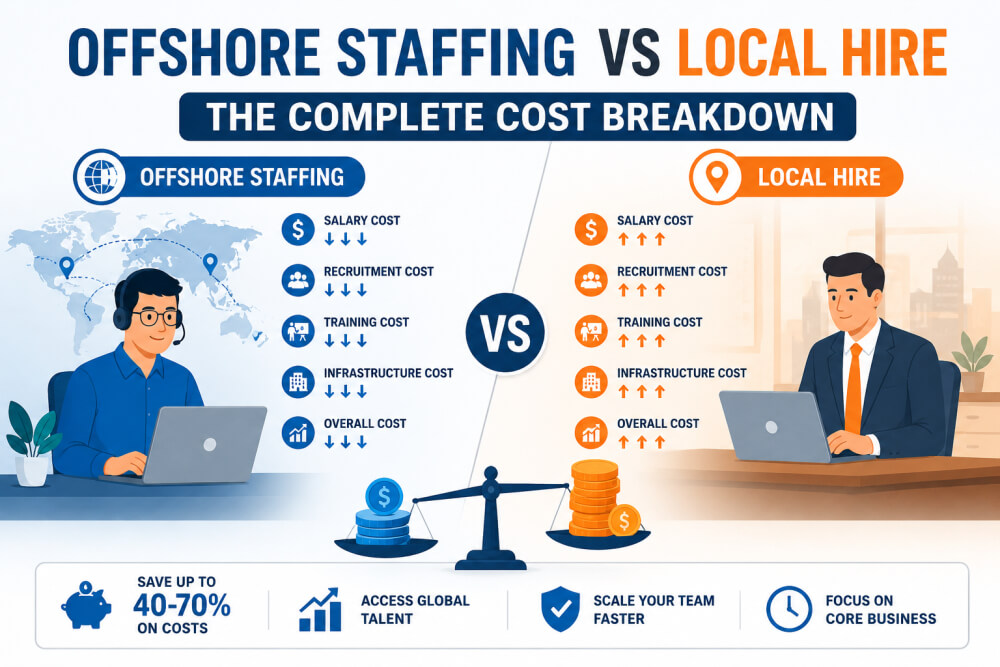
- 1. How This Comparison Is Structured
- 2. The True Cost of a Local Australian Hire in 2026
- 3. The True Cost of an Offshore Hire Through a Managed Provider
- 4. Role-by-Role Cost Comparison: 9 Common Positions
- 5. The Payroll Tax Dimension: When Offshore Becomes Structurally Essential
- 6. Quality and Productivity: The Comparison That Goes Beyond Cost
- 7. Control, Compliance, and Legal Risk: What Each Model Actually Requires
- 8. The 5-Year Financial Impact: Where the Real Advantage Compounds
- 9. When Local Hiring Is Still the Right Answer
- 10. The Hybrid Model: How Leading Australian Businesses Use Both
- 11. Frequently Asked Questions
The Comparison Every Australian Business Owner Is Running in 2026
1. How This Comparison Is Structured
2. The True Cost of a Local Australian Hire in 2026
Cost component | Rate | Annual cost |
Base salary | $75,000 | |
Superannuation (from July 2025) | 12% | $9,000 |
Annual leave (4 weeks) | 7.7% | $5,775 |
Personal/carer’s leave (10 days) | 3.8% | $2,850 |
Long service leave accrual | 1.7% | $1,275 |
Workers compensation | 1.5% avg | $1,125 |
Statutory subtotal | $95,025 | |
Recruitment (amortised, 3 years) | $6,000 | |
Equipment and setup (amortised) | $1,500 | |
Management overhead (4 hrs/month) | $4,800 | |
Software licences and tools | $1,200 | |
Operational subtotal | $108,525 |
3. The True Cost of an Offshore Hire Through a Managed Provider
- Offshore staff member’s salary, paid at competitive local market rates
- All statutory contributions in the country of employment (social security, health insurance, pension fund contributions)
- HR and payroll administration managed in the country of employment
- Equipment: computer, monitor, peripherals, and internet connection
- Physical office space in a managed, secure facility
- IT security infrastructure and data protection protocols
- Performance management and ongoing HR support
- A dedicated Melbourne-based account manager reachable during Australian business hours
- Replacement sourcing at no additional cost if a placement does not work out
- Role-specific software licences (typically extended under existing Australian subscriptions)
- Australian-side management time (present in any staffing model)
- Collaboration tools if not already held (typically $10 to $30 per month per person)
4. Role-by-Role Cost Comparison: 9 Common Positions
Software Developer (Mid-Level)
Local hire (AUD/year) | Offshore via Webco Talent (AUD/year) | Annual saving | Saving % | |
Base/all-in cost | $110,000 – $150,000 | $42,000 – $60,000 | $68,000 – $90,000 | 55 – 62% |
QA Tester
Local hire (AUD/year) | Offshore via Webco Talent (AUD/year) | Annual saving | Saving % | |
Base/all-in cost | $85,000 – $108,000 | $24,000 – $36,000 | $61,000 – $72,000 | 60 – 72% |
Bookkeeper
Local hire (AUD/year) | Offshore via Webco Talent (AUD/year) | Annual saving | Saving % | |
Base/all-in cost | $78,000 – $98,000 | $24,000 – $36,000 | $54,000 – $62,000 | 58 – 68% |
Virtual Assistant / Executive Support
Local hire (AUD/year) | Offshore via Webco Talent (AUD/year) | Annual saving | Saving % | |
Base/all-in cost | $65,000 – $85,000 | $18,000 – $30,000 | $47,000 – $55,000 | 57 – 72% |
Digital Marketing Specialist
Local hire (AUD/year) | Offshore via Webco Talent (AUD/year) | Annual saving | Saving % | |
Base/all-in cost | $82,000 – $110,000 | $28,000 – $42,000 | $54,000 – $68,000 | 57 – 66% |
IT Support Specialist
Local hire (AUD/year) | Offshore via Webco Talent (AUD/year) | Annual saving | Saving % | |
Base/all-in cost | $80,000 – $105,000 | $24,000 – $36,000 | $56,000 – $69,000 | 60 – 70% |
Admin Support
Local hire (AUD/year) | Offshore via Webco Talent (AUD/year) | Annual saving | Saving % | |
Base/all-in cost | $62,000 – $82,000 | $18,000 – $28,000 | $44,000 – $54,000 | 58 – 71% |
Data Entry Specialist
Local hire (AUD/year) | Offshore via Webco Talent (AUD/year) | Annual saving | Saving % | |
Base/all-in cost | $58,000 – $75,000 | $14,400 – $24,000 | $43,600 – $51,000 | 62 – 75% |
Social Media Administrator
Local hire (AUD/year) | Offshore via Webco Talent (AUD/year) | Annual saving | Saving % | |
Base/all-in cost | $68,000 – $88,000 | $21,600 – $33,600 | $46,400 – $54,400 | 57 – 68% |
5. The Payroll Tax Dimension: When Offshore Becomes Structurally Essential
State | Threshold (approx.) | Rate |
New South Wales | $1,200,000 | 5.45% |
Victoria | $700,000 | 4.85% |
Queensland | $1,300,000 | 4.75% |
Western Australia | $1,000,000 | 5.5% |
South Australia | $1,500,000 | 4.95% |
Practical scenario: a Melbourne business with 11 employees averaging $72,000
- Saves approximately $186,000 against the equivalent local hire cost
- Does not increase the payroll tax liability at all
- Retains the ability to add three more Australian employees before the tax exposure grows further
6. Quality and Productivity: The Comparison That Goes Beyond Cost
Roles where offshore delivers equivalent or superior output:
Roles where local hire retains a genuine advantage:
Productivity ramp-up: what the research and our experience shows
7. Control, Compliance, and Legal Risk: What Each Model Actually Requires
Operational control
Australian legal obligations
Legal risk in the offshore country
8. The 5-Year Financial Impact: Where the Real Advantage Compounds
- Australian hire costs increase at 4% per year (salary growth plus super rate increase)
- Offshore costs increase at 2% per year (modest market rate increases)
- Savings are not reinvested (conservative scenario)
- Payroll tax applies to Australian hires at 4.85% (Victorian rate)
Year | Local hire cost (3 roles) | Offshore cost (3 roles) | Annual saving | Cumulative saving |
Year 1 | $295,000 | $108,000 | $187,000 | $187,000 |
Year 2 | $306,800 | $110,160 | $196,640 | $383,640 |
Year 3 | $319,072 | $112,363 | $206,709 | $590,349 |
Year 4 | $331,835 | $114,610 | $217,225 | $807,574 |
Year 5 | $345,108 | $116,902 | $228,206 | $1,035,780 |
Five-year cumulative saving: over $1,000,000 for three roles.
9. When Local Hiring Is Still the Right Answer
- Roles requiring physical presence. Any role that genuinely cannot be performed without being in a specific location, working with physical materials, or attending in-person client or stakeholder meetings cannot be offshored. This is not a limitation of offshore staffing. It is a description of the work.
- Roles requiring Australian professional registration. Registered tax agents, Australian Legal Practitioners, ASIC-licensed advisors, and other roles where the value of the hire is inseparable from their Australian registration and ongoing local knowledge are typically best filled locally. Offshore staff can support these practitioners in execution tasks, but cannot substitute for the principal registration.
- Senior leadership and culture-building roles. The CEO, a founding technical lead, a client services director with long-standing Australian client relationships: these roles carry relational and institutional value that is location-dependent in ways that are difficult to replicate offshore. Local hiring at the leadership level is often the right choice even for businesses with substantial offshore teams.
- Roles in early-stage definition. If you cannot yet document what the role does, what good output looks like, and how success is measured, you are not ready to hire offshore for that role. Offshore staffing works best for roles with clear process definitions. If the role is genuinely exploratory and needs to be defined through its first occupant’s work, a local hire with regular in-person engagement is usually more appropriate.
10. The Hybrid Model: How Leading Australian Businesses Use Both
11. Frequently Asked Questions
Is offshore staffing cheaper than hiring locally in Australia in 2026?
Yes, significantly. The fully loaded cost of a local Australian hire at a $75,000 base salary is approximately $108,000 to $114,000 per year including superannuation, leave, workers compensation, recruitment, and payroll tax. An equivalent offshore hire through a managed provider costs $18,000 to $42,000 per year depending on role, representing a saving of 50 to 72 percent.
What is the total cost difference between offshore staffing and local hire for a bookkeeper in Australia?
A local Australian bookkeeper costs approximately $78,000 to $98,000 per year fully loaded. The equivalent offshore bookkeeper through Webco Talent costs $24,000 to $36,000 per year all-in. The annual saving is $54,000 to $62,000, or 58 to 68 percent.
Does offshore staffing affect Australian payroll tax obligations?
No. Offshore staff engaged through a managed provider are employed under the laws of their country of work and do not contribute to the Australian wages bill that triggers payroll tax. For businesses already above their state threshold, each offshore hire avoids the additional payroll tax cost that an equivalent local hire would generate.
What are the hidden costs in an offshore staffing vs local hire comparison?
In a local hire, hidden costs include leave entitlement accruals, long service leave, payroll tax, workers compensation, and the management overhead of performance, HR, and compliance. In an offshore context, hidden costs typically appear in provider models that charge replacement fees, bill in foreign currency, or exclude equipment and infrastructure from the headline rate. A fully managed provider that bills in AUD with no lock-in and no replacement fees eliminates offshore hidden costs.
How does productivity compare between offshore and local hires in Australia?
For process-driven, remotely deliverable roles such as software development, QA testing, bookkeeping, admin support, and digital marketing execution, offshore hires consistently achieve comparable productivity to local hires within 60 to 90 days. Productivity gaps in the first 30 to 60 days are a function of onboarding, not capability. Roles requiring physical presence, Australian regulatory registration, or complex in-person relationship management are better suited to local hiring.
How long does it take to hire offshore vs locally in Australia?
Hiring locally in Australia typically takes two to four months from brief to productive new starter, when advertising, screening, interviews, offer negotiation, notice periods, and onboarding are included. Through Webco Talent, shortlisted CVs are delivered within 10 business days and most clients complete the process from brief to first day within three to four weeks.
Can I use offshore staffing alongside local employees?
Yes. The hybrid model, combining local hires for roles requiring proximity or Australian registration with offshore staff for execution and process-driven roles, is the most common and most effective approach among experienced Australian offshore staffing users. The two models are entirely compatible and complement each other operationally.
What roles are most cost-effective to hire offshore vs locally in Australia?
The highest cost saving roles to offshore are QA testers (60 to 72 percent), virtual assistants (57 to 72 percent), IT support specialists (60 to 70 percent), data entry specialists (62 to 75 percent), and bookkeepers (58 to 68 percent). Software developers also produce large absolute savings, though the percentage saving is lower (55 to 62 percent) because offshore developer salaries are higher than other roles.