- Is offshore staffing legal in Australia?
- The four legal structures for offshore teams
- Which Australian obligations follow your staff offshore
- Superannuation, Payday Super and the offshore position
- Payroll tax and the six month nexus trap
- GST and the reverse charge most guides miss
- Privacy Act 1988, APP 8 and section 16C
- Frequently asked questions
Offshore staffing is legal in Australia, and the compliance burden depends almost entirely on which of four legal structures you choose.
Where the worker is employed by an offshore provider under a business to business services agreement, Australian superannuation, payroll tax, PAYG withholding and Fair Work obligations generally do not attach to your business, because there is no Australian employment relationship. What does follow your data offshore is the Privacy Act 1988 (Cth): under Australian Privacy Principle 8 and section 16C, a privacy breach by your offshore team is treated in law as a breach by you. Industry overlays from the TPB, AUSTRAC, APRA and ASIC then sit on top.

Is offshore staffing legal in Australia?
The governing principle: you can move the work offshore. You cannot move the accountability offshore. Every Australian regulator that touches your business still treats you as the responsible party for the output, the data and the client relationship.
The four legal structures for offshore teams
1. Managed service provider or staff leasing (business to business)
2. Employer of Record (EOR)
3. Direct entity setup (foreign subsidiary)
4. Direct independent contractor engagement
Factor | Managed service / staff leasing | Employer of Record | Own subsidiary | Direct contractor |
Australian employment relationship created | No | No | No | Risk of deemed relationship |
Australian SG payable | No | No | No | Depends on facts |
Australian payroll tax | Generally no | Generally no | Generally no | Check contractor provisions |
Privacy Act APP 8 applies to you | Yes | Yes | Yes | Yes |
Setup time | 10 to 14 days | 2 to 4 weeks | 3 to 9 months | Immediate |
Setup cost | Nil | Low | High | Nil |
Replacement cover if the person leaves | Contractual | Varies | You rehire | None |
Enforceable IP assignment | Standard | Standard | Standard | Frequently absent |
Practical break even scale | 1 to 40 staff | 1 to 15 staff | 25+ staff | Project work only |
Which Australian obligations follow your staff offshore
Obligation | Applies to offshore staff engaged via a provider? | Why
|
Fair Work Act, modern awards, NES | No | The Fair Work Act applies to Australian based employees. A person engaged outside Australia to perform duties outside Australia is not an Australian based employee. |
Superannuation guarantee and Payday Super | No | No employment relationship with you, and SG legislation excludes salary or wages paid to a non resident for work done outside Australia. |
PAYG withholding | No
| You are paying a supplier invoice, not salary or wages. |
State payroll tax | Generally no, with conditions | Nexus rules key off where services are performed. See the six month trap below. |
Workers compensation | No | Cover sits with the offshore employing entity under local law. |
GST on the service fee | Usually no, sometimes yes | Offshore supplies of services are generally outside the GST net, but the reverse charge can bite. |
Privacy Act 1988 and the APPs | Yes, fully | APP 8 plus section 16C. Liability stays with you. |
Notifiable Data Breaches scheme | Yes | An eligible breach caused offshore is still your notification obligation. |
Professional conduct rules (TPB, legal, financial services) | Yes | Your registration, your client, your duty. |
Australian Consumer Law | Yes | You are still the supplier to your Australian customer. |
Modern Slavery Act reporting | Yes, if in scope | Offshore labour sits squarely in your operations and supply chain. |
Superannuation, Payday Super and the offshore position

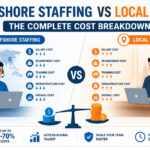
Worked comparison. A local administrator on a $75,000 base now costs roughly $84,000 once 12% SG is added, before payroll tax, leave loading, workers compensation, recruitment fees, equipment and floor space. A fully managed offshore equivalent through Webco Talent starts at $2,500 per month, or $30,000 a year, all inclusive, with no SG, no payroll tax and no Payday Super settlement cycle to administer.
Payroll tax and the six month nexus trap
GST and the reverse charge most guides miss
Privacy Act 1988, APP 8 and section 16C
Three practical points people get wrong
- Australian hosting is not a defence. If a person physically located overseas can view or modify personal information in readable form, that is a cross border disclosure regardless of where the server sits. “Our data is in AWS Sydney” resolves data residency, not APP 8.
- Your privacy policy has to name the countries. APP 1 requires your policy to state whether you are likely to disclose personal information to overseas recipients and, if practicable, the countries in which those recipients are located. “We may share information with service providers” does not satisfy it. If you offshore to Manila and Colombo, the policy should say the Philippines and Sri Lanka.
- The breach notification obligation is yours. Under the Notifiable Data Breaches scheme, an eligible data breach originating with your offshore team is your assessment, your notification to affected individuals, and your notification to the OAIC.
Want The Compliance Structure Without Building It Yourself?
Webco Talent has placed offshore staff for 400+ Australian businesses since 2008. Australian law NDAs and IP assignment, controlled workstations, Melbourne based account management. Pre vetted CVs in 10 days.
Sham contracting, misclassification and why the freelancer route is the riskiest
Industry overlays: TPB, AUSTRAC, APRA and ASIC
Accounting, bookkeeping and tax: the Tax Practitioners Board
- Client permission and disclosure (Code item 6). You must obtain your client’s permission before disclosing their information to a third party, and you must tell them to whom and where the disclosure will be made, including whether it goes overseas and where the data is stored. An engagement letter or other signed agreement is the accepted mechanism.
- Competence (Code item 7). A tax agent service provided on your behalf must be provided competently, including where it is provided by an unregistered person offshore.
- Supervision and control (Code item 7). Adequate supervisory arrangements must exist. TPB(GS) 53/2024 sets out the current expectations for supervision, competency and quality management.
- Reasonable care (Code items 9 and 10). The onus stays with you to ascertain the client’s affairs and apply the tax law correctly, regardless of who prepared the working papers.
AML/CTF Tranche 2: live since 1 July 2026
APRA regulated entities: CPS 230
Managed investment schemes: ASIC
Health and legal practices
Intellectual property and confidentiality
- The services agreement between you and the provider, containing an express present assignment of all intellectual property created in performing the services, plus a covenant to procure equivalent assignments from personnel.
- The employment contract between the provider and the individual, containing the corresponding assignment and confidentiality obligations enforceable in the worker’s home jurisdiction. An Australian law clause with no local enforcement mechanism is close to decorative.
- A direct NDA and IP acknowledgement signed by the individual, before first day, naming your business as a beneficiary.
Modern Slavery Act reporting
The 12 point offshore staffing compliance checklist
- Choose and document the structure. Managed service, EOR, subsidiary or direct contractor. Record why, in writing, before the first hire.
- Confirm no Australian employment relationship is created. Get the provider’s employment contract with the worker. Confirm the employing entity, the governing law and the statutory contributions being paid locally.
- Get a written payroll tax and GST position. Particularly if you make input taxed supplies or you are considering putting an offshore worker on your Australian payroll.
- Map what personal information will cross the border. Client records, employee records, health information, tax file numbers, payment data. Classify before you scope the role.
- Update your privacy policy to name the countries. APP 1 requires it. Name the Philippines, Sri Lanka or wherever your team sits.
- Document the APP 8 reasonable steps. Contractual privacy obligations, access controls, training records, audit rights. This is the file you will want if the OAIC ever asks.
- Extend your data breach response plan offshore. Who detects, who escalates, in what timeframe, and who assesses whether it is an eligible breach.
- Layer the IP and confidentiality documents. Provider agreement, local employment contract, individual NDA. All three, all signed before day one.
- Add the professional disclosure clause. Tax and BAS agents: engagement letter wording covering to whom and where client information is disclosed. Update the template, not just one letter.
- Check your industry overlay. TPB, AUSTRAC Tranche 2, APRA CPS 230, ASIC, health records legislation, legal profession conduct rules.
- Define supervision and review. Who signs off the work, on what basis, and how the review is evidenced. Regulators ask about supervision far more often than they ask about location.
- Review annually and after any regulatory change. Three material changes landed between July 2025 and July 2026. Assume more are coming.
Frequently asked questions
Is offshore staffing legal in Australia?
Yes. No Australian law prohibits work being performed overseas for an Australian business. The legal issues concern how the arrangement is structured and which obligations, principally privacy, professional conduct and consumer law, continue to apply to you.
Do I have to pay superannuation for offshore staff?
No, where the worker is employed by an offshore provider under a business to business services agreement. There is no employment relationship with you, and the superannuation guarantee legislation separately excludes salary or wages paid to a non resident for work done outside Australia. Payday Super, which commenced on 1 July 2026, therefore does not apply to those arrangements.
Does the Fair Work Act apply to offshore staff?
Generally no. The Fair Work Act applies to Australian based employees. A person engaged outside Australia to perform duties outside Australia is not an Australian based employee, so modern awards, the National Employment Standards and unfair dismissal provisions do not apply. The worker is protected by the labour law of their own country instead.
Do I pay payroll tax on offshore staff?
Generally no, because you are paying a service fee rather than wages. The exception to watch is putting an overseas based worker on your Australian payroll: under the harmonised nexus rules, wages paid in an Australian jurisdiction for services performed wholly in another country are taxable where the assignment runs for six continuous months or less, and exempt only once it exceeds six continuous months.
Is GST payable on offshore staffing fees?
Usually no. Services performed wholly outside Australia by a non resident supplier are generally not taxable supplies. However, Division 84 of the GST Act imposes a reverse charge where the acquisition is not solely for a creditable purpose, which can capture businesses making input taxed supplies such as financial services providers. Obtain a written GST position if that applies to you.
Who is liable if my offshore team causes a data breach?
You are. Australian Privacy Principle 8.1 requires you to take reasonable steps before disclosing personal information overseas, and section 16C of the Privacy Act provides that an act by the overseas recipient that would breach the APPs is taken to have been done by you. Notification obligations under the Notifiable Data Breaches scheme also rest with you.
Can I engage offshore workers directly as independent contractors?
You can, but it carries the highest risk of the four structures. Since 26 August 2024 the Fair Work Act applies a whole of relationship test under section 15AA, and the sham contracting defence now requires a reasonable belief rather than merely the absence of recklessness. Add the absence of enforceable IP assignment, no replacement cover and no HR escalation path, and the model suits short project work rather than ongoing roles.
Do I need to tell my clients that I use offshore staff?
If you are a registered tax agent or BAS agent, yes. TPB guidance requires you to obtain client permission before disclosing their information to a third party and to inform them to whom and where the disclosure will be made, including whether it is overseas and where data is stored. Other regulated professions have comparable confidentiality and disclosure duties. Outside regulated professions there is no general legal requirement, though your privacy policy must still identify the countries involved.
Does AML/CTF Tranche 2 affect offshore staffing?
Yes, for newly regulated sectors. Tranche 2 commenced on 1 July 2026, bringing accountants, lawyers, conveyancers, real estate professionals and trust and company service providers into the AML/CTF regime where they provide a designated service. Enrolment with AUSTRAC is due by 29 July 2026. Customer due diligence and record keeping can be resourced offshore, but suspicious matter reporting, the compliance officer function and tipping off restrictions require deliberate access design.
What does APRA CPS 230 require for offshoring?
CPS 230 has applied to APRA regulated entities since 1 July 2025, replacing CPS 231 and CPS 232. Transitional relief for pre existing service provider agreements expired on 1 July 2026. Entities must identify material service providers, include prescribed contractual terms, monitor performance, maintain exit plans, and notify APRA before entering into an offshoring arrangement.
Who owns the intellectual property my offshore developer creates?
Only whoever the contracts say owns it. The Australian default that vests employee created work in the employer does not apply cleanly across borders and does not apply to contractors at all. You need a present assignment in the services agreement, a matching assignment in the provider’s local employment contract, and a signed individual NDA and IP acknowledgement.
Does the Modern Slavery Act apply to offshore staffing?
If your consolidated revenue exceeds $100 million you are a reporting entity and your offshore workforce forms part of your operations and supply chains for reporting purposes. Smaller businesses are increasingly asked the same questions by larger customers as part of supplier onboarding.
Build an offshore team on a compliant footing
Webco Talent has operated since 2008 with delivery hubs in Colombo and Manila and Melbourne based account management. Australian law NDAs and IP assignment, controlled workstations, month to month terms and a 6-month written replacement guarantee. Savings of 50% to 70% against local hiring.