

- Introduction
- Quick Answer: What Does Offshoring Cost?
- What Is Offshoring in Software Development?
- Why Are Australian Companies Offshoring?
- What Does It Cost to Offshore from Australia in 2026?
- Offshoring vs Outsourcing vs Nearshoring
- Best Countries for Australian Businesses
- Benefits of Offshoring Software Development
- Risks — and How to Avoid Them
- How to Hire Offshore Developers (Step-by-Step)
- When Offshoring Is the Wrong Choice
- Real Australian Case Studies
- What to Look for in an Offshore Partner
- How to Manage an Offshore Team
- Onshore vs Offshore: Comparison
- Is Offshoring Right for Your Business?
- How to Get Started
- FAQs
The Australian tech industry faces a perfect storm
This guide covers everything an Australian decision-maker needs to know about offshoring software development in 2026 — costs in AUD, country comparisons, how to hire, when to do it, and when not to. It is written for founders, CTOs, and operations managers evaluating whether offshoring is the right move for their business.
Quick Answer — What does offshoring software development cost from Australia?
Offshoring software development from Australia means hiring developers in lower-cost countries — typically the Philippines, Sri Lanka, or India — to build and maintain your software. In 2026, Australian businesses pay AUD $3,500–$8,500 per developer per month offshore, versus AUD $9,000–$15,000 for an equivalent Sydney or Melbourne hire — a saving of 50–70%.
Get Pre-Vetted Developer CVs in 10 Days
Contact Webco Talent
What Is Offshoring in Software Development?
Offshoring software development means hiring developers or development teams located in different countries to build your software products. These offshore teams work as an extension of your business, handling everything from front-end development to complex back-end systems and quality assurance.
Unlike outsourcing a one-off project, offshoring typically involves a long-term dedicated team that integrates into your workflows, attends your standups, and operates inside your delivery cadence.
Australian businesses most commonly offshore to the Philippines, Sri Lanka, India, and Vietnam — regions with strong English proficiency, overlapping business hours with AEST, and large pools of accredited software engineers.
What Is an Offshore Software Development Company?
An offshore software development company is a vendor based in another country that designs, builds, and maintains software for clients. They typically provide dedicated development teams, project-based delivery, or long-term staff augmentation, and often operate from regions with lower labour costs, enabling significant cost savings for Australian clients.
A managed offshore partner — like Webco Talent — handles recruitment, HR, infrastructure, and compliance on your behalf. You get a ready-to-go team without the overhead of setting up a foreign entity.
Why Are Australian Companies Offshoring Software Development?
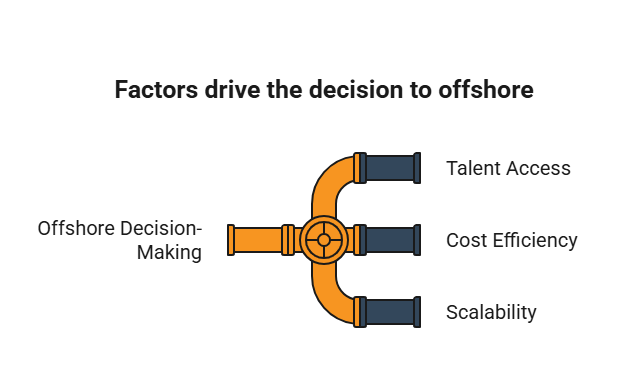
Australia’s tech talent shortage has reached critical levels. The Australian Computer Society reports a shortage of over 60,000 technology professionals, with demand forecast to grow another 24% by 2028. Four primary drivers are pushing companies offshore:
- Cost reduction: Offshore developers in the Philippines or Sri Lanka cost 50–70% less than equivalent Sydney or Melbourne hires.
- Talent availability: Specialist skills — AI/ML engineers, data architects, senior DevOps — are extremely scarce locally.
- Scale velocity: Hiring 5 offshore developers takes 4–6 weeks; hiring locally can take 3–6 months per role.
- 24-hour productivity: An offshore team in Colombo or Manila continues development while your Sydney team sleeps.
What Does It Cost to Offshore Software Development from Australia in 2026?
Cost is the number-one question Australian businesses ask before offshoring. The table below shows 2026 benchmarks for the most common destination countries, compared against a Sydney or Melbourne baseline. All figures are in AUD.
| Country | Junior dev (AUD/hr) | Mid-level (AUD/hr) | Senior (AUD/hr) | Full-time equiv. (AUD/month) |
|---|---|---|---|---|
| Australia (Sydney / Melbourne) | $90–$120 | $130–$170 | $180–$250 | $11,000–$18,000 |
| Philippines | $25–$40 | $45–$70 | $70–$95 | $4,000–$8,500 |
| Sri Lanka | $25–$40 | $45–$70 | $70–$95 | $3,500–$8,000 |
| India | $20–$35 | $35–$55 | $55–$80 | $3,000–$7,000 |
| Vietnam | $25–$40 | $40–$60 | $55–$85 | $3,500–$7,500 |
| Eastern Europe (Poland / Ukraine) | $40–$60 | $60–$90 | $90–$130 | $7,000–$11,000 |
💡 Savings calculation example: A team of 4 mid-level developers in Colombo at AUD $6,000/month each costs AUD $24,000/month all-in. The same team in Sydney would cost AUD $56,000–$68,000/month in salaries alone — before superannuation, equipment, and office space. That’s a saving of AUD $32,000–$44,000 per month.
Offshoring vs Outsourcing vs Nearshoring — Which Model Does an Australian Business Actually Want?
These terms are often used interchangeably but mean different things. The model you choose has significant implications for cost, control, and long-term flexibility.
| Model | Where the team sits | Typical use case | Cost vs local (Australian buyer) |
|---|---|---|---|
| Offshoring (managed) | Philippines / Sri Lanka / India | Long-term dedicated team, ongoing product work | 50–70% saving |
| Outsourcing (project) | Anywhere — fixed price | Fixed-scope build, MVP sprint | Varies — can be higher or lower |
| Nearshoring | NZ, Pacific, Indonesia | Time-zone-critical collaboration | 20–40% saving |
| Freelance (Upwork / Fiverr) | Anywhere — per task | One-off micro-tasks | Lowest sticker, highest risk |
| Onshore | Australia | Compliance-sensitive / regulated work | Baseline reference cost |
The key distinction for most Australian SMEs: Offshoring gives you a dedicated team that works exclusively for you, learns your codebase, and compounds in value over time. Outsourcing gives you a deliverable — useful for a single project but with no institutional memory when the engagement ends.
Which Countries Are Best for Australian Businesses to Offshore Software Development?
Not all offshore destinations are equal. The right country depends on your tech stack, time-zone requirements, and the type of work you are offshoring. Here is how the major destinations compare for an Australian buyer in 2026.
| Country | Time zone overlap with AEST | English proficiency | Strongest tech skills | Mid-level rate (AUD/month) | Best for |
|---|---|---|---|---|---|
| Philippines | 1–3 hrs overlap (Manila: UTC+8) | High — English is an official language | JavaScript, PHP, React, customer-facing apps | $5,000–$7,500 | Product teams, web apps, support-heavy SaaS |
| Sri Lanka | 3–4 hrs overlap (Colombo: UTC+5:30) | High — English is a business language | Java, .NET, QA engineering, fintech | $4,500–$7,000 | Enterprise software, QA, regulated-industry builds |
| India | 3–5 hrs overlap (IST: UTC+5:30) | High — largest English-speaking tech workforce globally | Enterprise, data/AI, SAP, cloud architecture | $4,000–$6,500 | AI/ML, data engineering, large-scale systems |
| Vietnam | 2–3 hrs overlap (UTC+7) | Moderate — improving rapidly | Mobile (Flutter/React Native), embedded, gaming | $4,000–$6,500 | Mobile-first products, cost-sensitive builds |
Webco Talent’s primary delivery hubs are Colombo (Sri Lanka) and Manila (Philippines), chosen for their strong English proficiency, AEST-compatible hours, and availability of mid-to-senior-level full-stack engineers. Learn more about our developer profiles →
What Are the Benefits of Offshoring Software Development?
1. Cost-Efficiency Without Compromising Quality
In Australia, developer salaries sit between $80,000–$150,000 AUD annually, excluding superannuation, leave, and on-costs. Offshore equivalents in Sri Lanka or the Philippines typically run AUD $42,000–$72,000 per year all-in through a managed provider. That is a 40–60% cost reduction without accepting a quality trade-off, provided you choose a vetted partner.
2. Access to a Global Talent Pool
Australia has approximately 300,000 software developers. India alone has over 5 million. The Philippines and Sri Lanka each produce 20,000–30,000 STEM graduates annually. Offshoring gives you access to depth of specialist skill that simply does not exist locally at scale.
3. Faster Time-to-Hire and Scale
A managed offshore provider can deliver pre-vetted developer CVs within 10 business days and have a team operational within 4–6 weeks. Hiring locally for a senior full-stack role typically takes 3–5 months from brief to offer acceptance.
4. Round-the-Clock Development Velocity
A developer finishing a feature in Colombo at 5pm local time (11:30pm AEST) creates a handoff that your Sydney architect can review over morning coffee — effectively compressing sprint cycles.
5. Flexibility to Scale Up or Down
Managed offshore engagements typically allow you to add or remove headcount on 30–60 days notice, giving you staffing elasticity that permanent local hires do not.
What Are the Risks of Offshoring Software Projects — and How to Avoid Them?
Communication Challenges
Different time zones can create communication barriers. Misunderstandings might not get resolved quickly, potentially affecting project timelines.
Quality Control
Without robust QA processes, code quality can vary.
IP and Data Security
Sharing source code and proprietary data with an offshore team carries legal risk if agreements are not structured correctly.
Cultural and Working-Style Misalignment
Different workplace cultures can affect how feedback, deadlines, and conflict are handled.
How to Hire Offshore Software Developers from Australia (Step-by-Step)
Hiring offshore developers is not as complex as it sounds, but the sequence matters. Follow these six steps to reduce risk and accelerate time-to-productivity.
- Define scope and seniority. Write a role brief that specifies tech stack (e.g. Python/Django + AWS), years of experience, sprint methodology, and expected hours. Vague briefs produce mismatched CVs.
- Choose your engagement model. Decide between a dedicated team (full-time, managed), project-based outsourcing (fixed scope), or staff augmentation (plugging a specific skill gap). Most growing Australian tech companies start with staff augmentation and move to a dedicated team.
- Shortlist 2–3 offshore partners. Request case studies from similar-sized Australian clients, ask for three developer CVs within 5 business days as a test, and verify client references.
- Interview candidates. Run a 60-minute technical test (code review or live coding) plus a 30-minute cultural-fit call. Ask scenario questions about handling unclear requirements.
- Execute contracts, IP assignments, and NDAs. Ensure all agreements are governed by Australian law, contain IP assignment clauses (not just licences), and cover data handling under the Privacy Act 1988.
- Onboard with a 30/60/90-day plan. Week 1: codebase walkthrough and tool access. Week 2–4: paired work with a local engineer. Month 2: solo sprint tasks. Month 3: full sprint ownership. The first 90 days determine whether the engagement succeeds long-term.
When Offshoring Is the Wrong Choice for an Australian Business
Offshoring is not the right solution for every situation. Here are the specific scenarios where offshoring is likely to cost more than it saves.
- Highly regulated financial software with APRA-mandated data-residency requirements that prohibit storing data outside Australia.
- Defence, government, or intelligence contracts requiring Australian Positive Vetting (PV) or NV1/NV2 security clearances.
- 4–8 week MVP sprints where a founder needs to pair-program daily with engineers — the onboarding overhead negates the speed advantage.
- Single-developer side projects — use a vetted Australian contractor or a freelance platform instead.
- Hardware-embedded software requiring physical access to lab equipment or on-site integration testing.
- Immediate crisis response — if your production system is down right now, you need someone who can walk to the whiteboard, not a 3-hour async Slack thread.
When in doubt, a short discovery call with a managed offshore provider will tell you within 20 minutes whether your use case is a fit. Book a no-obligation consultation →
Real Australian Case Studies — Offshoring in Practice
Brisbane SaaS Startup — Team of 4, Colombo
A Brisbane-based workflow automation SaaS needed 4 full-stack developers to build v2 of their platform. Onshore quotes came in at AUD $52,000–$60,000/month. Webco Talent placed a 4-developer team in Colombo (3 mid-level, 1 senior) for AUD $24,000/month all-in. Platform v2 shipped in 14 weeks. Annual saving: AUD $336,000.
Melbourne Accounting Software — Offshore QA Team
A Melbourne fintech building tax compliance software had a persistent bug-leak problem — 12–15 production defects per sprint. A 3-engineer QA team in Manila reduced that to 2–3 defects per sprint within 6 months, cutting customer churn from 4.2% to 1.8% monthly. The QA team cost AUD $18,500/month versus a local equivalent quote of AUD $38,000/month.
Sydney Logistics Platform — Hybrid Onshore/Offshore Model
A Sydney logistics platform retained 1 onshore architect (Sydney-based) and built a 5-engineer offshore team in Colombo. The architect sets technical direction; the offshore team handles feature delivery. In Q1 2026 they shipped 11 features that a fully onshore team had quoted 9 months to deliver. Total monthly cost: AUD $48,000 vs an all-onshore equivalent of AUD $110,000+.
What Should You Look for in an Offshore Software Development Partner?
Technical Expertise and Verified Portfolio
Look for an offshore development partner with proven experience in your specific technology stack. Request case studies from Australian clients specifically — a Philippine agency that mainly serves US clients may have very different timezone and communication patterns to one that has been working with Australian businesses for 5+ years.
Transparent Pricing Model
Prefer partners who quote monthly retainers in AUD with a clear breakdown of what is included. Hourly billing models tend to creep in managed engagements. Ask explicitly: are recruitment, HR, equipment, and management fees included in the quoted rate?
Governance and IP Protection
Your partner should offer IP assignment agreements (not just licences) governed by Australian law, carry Professional Indemnity insurance, and be able to demonstrate data security certifications (ISO 27001, SOC 2, or equivalent).
Retention Rate and Team Stability
Ask for their developer retention rate. High turnover (below 85% annual retention) means your institutional knowledge walks out the door repeatedly. Webco Talent’s Colombo and Manila teams have maintained 92%+ annual retention since 2022.
References from Similar-Sized Australian Clients
Ask for two reference calls with Australian clients of similar size and industry. Do this before signing anything.
See Webco Talent’s offshore developer profiles and pricing →
How to Manage Offshore Software Development
Managing offshore software development requires clear processes, the right tools, and realistic expectations. Key practices include:
- Define clear objectives and scope upfront — including user stories, acceptance criteria, and Definition of Done before each sprint.
- Use agile methodologies (Scrum or Kanban) with strong documentation standards so context is never locked in someone’s head.
- Establish a daily overlap window — even 60 minutes of synchronous time prevents most async communication breakdowns.
- Invest in collaboration tools — Jira or Linear for project management, Slack for messaging, Loom for async video walkthroughs, Figma for design handoffs, GitHub/GitLab for code review.
- Run quarterly in-person visits — or facilitate your offshore team leads visiting your Australian office. Face-to-face time every 3–6 months compounds team cohesion significantly.
- Measure output, not hours — track story points delivered, defect rates, and deployment frequency. Time-tracking is a weak proxy for productivity.
Onshore vs Offshore Software Development — Side-by-Side Comparison
Use this comparison to frame your internal business case. Neither model is universally superior — the right choice depends on your specific constraints.
| Factor | Onshore (Australia) | Offshore (Philippines / Sri Lanka) |
|---|---|---|
| Hourly cost range | AUD $90–$250/hr | AUD $25–$95/hr |
| Full-time monthly cost | AUD $9,000–$18,000 | AUD $3,500–$8,500 |
| Time-to-hire | 3–5 months | 4–6 weeks |
| Time zone | AEST — real-time collaboration | 3–5 hr overlap with AEST |
| English proficiency | Native | High (official or business language) |
| IP/legal simplicity | Highest — Australian law | Manageable with correct contracts |
| Talent pool depth | ~300,000 developers | Millions across Asia-Pacific |
| Regulatory compliance | No special arrangements needed | Requires data-residency assessment |
| Cultural alignment | Highest | High (Philippines: very high) |
| Scale flexibility | Low — permanent roles | High — 30–60 day notice periods |
Is Offshoring Right for Your Business? A Decision Checklist
Score your situation against this checklist. If you answer ‘Yes’ to 5 or more of these, offshoring is likely a strong fit.
When Offshoring Makes Sense ✓
- You have ongoing software development needs (6+ months)
- Your local hiring is taking 3+ months per role
- Your dev budget is under pressure and you need to do more with less
- You need specialist skills (AI/ML, DevOps, QA) that are scarce locally
- Your tech stack is mainstream (React, Python, Java, .NET, Node)
- Your product work is well-documented with clear user stories
- You can allocate 30–60 minutes daily to synchronous calls with the team
- Your data is not subject to strict onshore-residency regulations
When Offshoring Is a Poor Fit ✗
- You need someone who can be on-site within the hour
- Your project requires Australian government security clearance
- You cannot dedicate any management time to the offshore team
- Your requirements are undefined and change daily
- You have had two or more failed offshore engagements with unclear root cause
How to Get Started with Offshoring Software Development the Right Way
The key to successful offshore software development lies in choosing the right partner and establishing clear processes from the start.
- Write a role brief. Stack, seniority, hours, tools, methodology. One page is enough.
- Contact 2–3 managed offshore providers and ask for CVs within 5 business days. Speed of response is a proxy for operational quality.
- Run a paid pilot — 2–4 weeks, fixed scope. Evaluate code quality, communication, and responsiveness before committing to a 6-month engagement.
- Execute proper contracts — IP assignment, NDA, data handling under the Privacy Act 1988.
- Onboard with a 30/60/90-day plan and assign a local technical point-of-contact.
Get pre-vetted developer CVs in 10 business days → Contact Webco Talent
Get Pre-Vetted Developer CVs in 10 Days — Contact Webco Talent
Frequently Asked Questions — Offshoring Software Development from Australia
How much does it cost to offshore software development from Australia?
Offshore software development from Australia typically costs AUD $3,500–$8,500 per developer per month through a managed provider in the Philippines or Sri Lanka, compared to AUD $9,000–$18,000 per month for an equivalent Sydney or Melbourne hire. Annual savings for a team of 4 range from AUD $200,000 to $400,000 depending on seniority mix.
What is the difference between offshoring and outsourcing in Australia?
Offshoring means placing a dedicated team that works exclusively for your business in a lower-cost country over the long term. Outsourcing means contracting a third-party vendor to deliver a defined project or outcome. Offshoring builds institutional knowledge; outsourcing delivers a one-time artefact.
Which country is best for Australian businesses to offshore software development to?
For most Australian businesses in 2026, the Philippines and Sri Lanka are the strongest overall choices — both offer high English proficiency, 3–5 hours of AEST overlap, and mature developer talent pools. India is the best choice for AI/ML and enterprise-scale systems. Vietnam is cost-competitive for mobile-first builds.
How long does it take to hire an offshore developer team?
A managed offshore provider like Webco Talent can deliver pre-vetted developer CVs in 5–10 business days and have a team operationally ready within 4–6 weeks. Hiring locally in Australia for a senior full-stack role typically takes 3–5 months from initial brief to offer acceptance.
How do I protect my IP when offshoring software development?
Require: (1) an IP assignment agreement (not just a licence) governed by Australian law; (2) a comprehensive NDA covering source code, business logic, and customer data; (3) ISO 27001 or equivalent data security certification from the provider; and (4) all work performed on company-owned devices and accounts. Webco Talent clients receive standard IP assignment agreements at no extra cost.
Do offshore developers work in Australian time zones?
Developers in the Philippines (UTC+8) and Sri Lanka (UTC+5:30) share 3–5 hours of natural business-hours overlap with AEST. Many offshore engineers working with Australian clients also adjust their start time to 10am–11am local, creating up to 5–6 hours of daily overlap. A structured daily standup and one afternoon sync session is typically sufficient for full Agile delivery.
Can offshore teams handle Agile / sprint-based work?
Yes — the overwhelming majority of offshore development engagements run on Agile (Scrum or Kanban). Offshore teams working with Australian clients are typically experienced with Jira, Confluence, GitHub, and modern sprint ceremonies. The key is clear Definition of Done in user stories and a local product owner who can unblock the team in near-real time.
Is offshore software development tax-deductible in Australia?
Payments to offshore software development companies for services rendered to your Australian business are generally deductible as ordinary business expenses under Section 8-1 of the Income Tax Assessment Act 1997, provided the service is genuinely incurred in gaining or producing assessable income. Consult your accountant regarding transfer-pricing implications if the offshore entity is related.
What is the difference between an offshore developer and a freelancer?
An offshore developer engaged through a managed provider works exclusively for your business, attends your standups, uses your tools, and is operationally integrated into your team. A freelancer typically juggles multiple clients, has no obligation to attend recurring meetings, and provides no continuity guarantee. For anything beyond a one-off task, a managed offshore developer is materially lower-risk.
Is it safe to hire offshore developers for sensitive or regulated projects?
For most commercially sensitive work, yes — provided you use a reputable managed provider with proper IP assignment agreements, NDAs, and ISO 27001-certified infrastructure. Exceptions include work subject to Australian government security-clearance requirements, APRA-regulated data with strict onshore-residency obligations, and defence contracts requiring Australian citizenship.
What is an offshore software development company?
An offshore software development company is a vendor based in another country that provides software engineering services — including custom software builds, web and mobile app development, cloud engineering, QA, and ongoing team augmentation. They allow Australian clients to access global talent and reduce costs while managing the operational complexity of cross-border employment.
Onshore vs offshore software development — which is better for Australian SMEs?
Offshore development is typically 50–70% cheaper, offers faster hiring, and provides access to deeper specialist talent. Onshore development offers simpler legal arrangements, easier real-time collaboration, and stronger local regulatory alignment. Most Australian SMEs find a hybrid model — an onshore technical lead plus an offshore delivery team — delivers the best balance of cost, quality, and control.
How do I manage an offshore software development team effectively?
Key practices: daily overlap standup (60 min minimum); clear Definition of Done in every user story; output metrics (story points, defect rate) rather than time-tracking; async video walkthroughs via Loom for complex requirements; quarterly in-person visits or video calls with leadership; and a local technical point-of-contact who can unblock decisions in real time.
- Introduction
- Quick Answer: What Does Offshoring Cost?
- What Is Offshoring in Software Development?
- Why Are Australian Companies Offshoring?
- What Does It Cost to Offshore from Australia in 2026?
- Offshoring vs Outsourcing vs Nearshoring
- Best Countries for Australian Businesses
- Benefits of Offshoring Software Development
- Risks — and How to Avoid Them
- How to Hire Offshore Developers (Step-by-Step)
- How to Hire a Team: 4 Models Compared
- When Offshoring Is the Wrong Choice
- Real Australian Case Studies
- What to Look for in an Offshore Partner
- How to Manage an Offshore Team
- Onshore vs Offshore: Comparison
- Is Offshoring Right for Your Business?
- Why Choose Webco Talent
- How to Get Started
- FAQs
The Australian tech industry faces a perfect storm
This guide covers everything an Australian decision-maker needs to know about offshoring software development in 2026 — costs in AUD, country comparisons, how to hire, when to do it, and when not to. It is written for founders, CTOs, and operations managers evaluating whether offshoring is the right move for their business.
TL;DR — How to hire an offshore development team from Australia
To hire an offshore development team, partner with a managed provider that pre-vets developers, runs HR, payroll and IP under contract, and bills you in AUD. In 2026, Australian businesses pay AUD $3,500–$8,500 per developer per month offshore versus AUD $9,000–$15,000 for an equivalent Sydney or Melbourne hire — a saving of 50–70%. A good provider delivers pre-vetted CVs in 5–10 business days and a team that is operational within 4–6 weeks.
Webco Talent places dedicated offshore developers for Australian businesses from AUD $4,500/month, with a 90-day replacement guarantee, Australian-law IP assignment, and Melbourne-based account management. 📞 Call 03 8807 0232 or request pre-vetted CVs in 10 days →
Get Pre-Vetted Developer CVs in 10 Days
Contact Webco Talent
What Is Offshoring in Software Development?
Offshoring software development means hiring developers or development teams located in different countries to build your software products. These offshore teams work as an extension of your business, handling everything from front-end development to complex back-end systems and quality assurance.
Unlike outsourcing a one-off project, offshoring typically involves a long-term dedicated team that integrates into your workflows, attends your standups, and operates inside your delivery cadence.
Australian businesses most commonly offshore to the Philippines, Sri Lanka, India, and Vietnam — regions with strong English proficiency, overlapping business hours with AEST, and large pools of accredited software engineers.
What Is an Offshore Software Development Company?
An offshore software development company is a vendor based in another country that designs, builds, and maintains software for clients. They typically provide dedicated development teams, project-based delivery, or long-term staff augmentation, and often operate from regions with lower labour costs, enabling significant cost savings for Australian clients.
A managed offshore partner like Webco Talent handles recruitment, HR, infrastructure, and compliance on your behalf. You get a ready-to-go team without the overhead of setting up a foreign entity.
Why Are Australian Companies Offshoring Software Development?
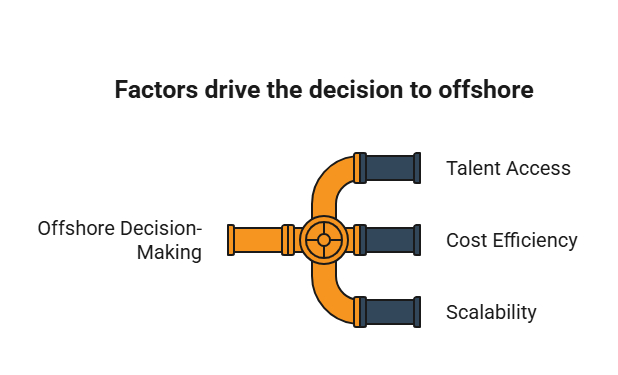
Australia’s tech talent shortage has reached critical levels. The Australian Computer Society reports a shortage of over 60,000 technology professionals, with demand forecast to grow another 24% by 2028. Four primary drivers are pushing companies offshore:
- Cost reduction: Offshore developers in the Philippines or Sri Lanka cost 50–70% less than equivalent Sydney or Melbourne hires.
- Talent availability: Specialist skills — AI/ML engineers, data architects, senior DevOps — are extremely scarce locally.
- Scale velocity: Hiring 5 offshore developers takes 4–6 weeks; hiring locally can take 3–6 months per role.
- 24-hour productivity: An offshore team in Colombo or Manila continues development while your Sydney team sleeps.
What Does It Cost to Offshore Software Development from Australia in 2026?
Cost is the number-one question Australian businesses ask before offshoring. The table below shows 2026 benchmarks for the most common destination countries, compared against a Sydney or Melbourne baseline. All figures are in AUD.
| Country | Junior dev (AUD/hr) | Mid-level (AUD/hr) | Senior (AUD/hr) | Full-time equiv. (AUD/month) |
|---|---|---|---|---|
| Australia (Sydney / Melbourne) | $90–$120 | $130–$170 | $180–$250 | $11,000–$18,000 |
| Philippines | $25–$40 | $45–$70 | $70–$95 | $4,000–$8,500 |
| Sri Lanka | $25–$40 | $45–$70 | $70–$95 | $3,500–$8,000 |
| India | $20–$35 | $35–$55 | $55–$80 | $3,000–$7,000 |
| Vietnam | $25–$40 | $40–$60 | $55–$85 | $3,500–$7,500 |
| Eastern Europe (Poland / Ukraine) | $40–$60 | $60–$90 | $90–$130 | $7,000–$11,000 |
💡 Savings calculation example: A team of 4 mid-level developers in Colombo at AUD $6,000/month each costs AUD $24,000/month all-in. The same team in Sydney would cost AUD $56,000–$68,000/month in salaries alone — before superannuation, equipment, and office space. That’s a saving of AUD $32,000–$44,000 per month.
See your exact savings before you hire
Dedicated offshore developers from AUD $4,500/month · pre-vetted CVs in 10 days · 90-day replacement guarantee
Calculate Your SavingsGet CVs in 10 Days →Or call our Melbourne team on 03 8807 0232
Offshoring vs Outsourcing vs Nearshoring — Which Model Does an Australian Business Actually Want?
These terms are often used interchangeably but mean different things. The model you choose has significant implications for cost, control, and long-term flexibility.
| Model | Where the team sits | Typical use case | Cost vs local (Australian buyer) |
|---|---|---|---|
| Offshoring (managed) | Philippines / Sri Lanka / India | Long-term dedicated team, ongoing product work | 50–70% saving |
| Outsourcing (project) | Anywhere — fixed price | Fixed-scope build, MVP sprint | Varies — can be higher or lower |
| Nearshoring | NZ, Pacific, Indonesia | Time-zone-critical collaboration | 20–40% saving |
| Freelance (Upwork / Fiverr) | Anywhere — per task | One-off micro-tasks | Lowest sticker, highest risk |
| Onshore | Australia | Compliance-sensitive / regulated work | Baseline reference cost |
The key distinction for most Australian SMEs: Offshoring gives you a dedicated team that works exclusively for you, learns your codebase, and compounds in value over time. Outsourcing gives you a deliverable — useful for a single project but with no institutional memory when the engagement ends.
Which Countries Are Best for Australian Businesses to Offshore Software Development?
Not all offshore destinations are equal. The right country depends on your tech stack, time-zone requirements, and the type of work you are offshoring. Here is how the major destinations compare for an Australian buyer in 2026.
| Country | Time zone overlap with AEST | English proficiency | Strongest tech skills | Mid-level rate (AUD/month) | Best for |
|---|---|---|---|---|---|
| Philippines | 1–3 hrs overlap (Manila: UTC+8) | High — English is an official language | JavaScript, PHP, React, customer-facing apps | $5,000–$7,500 | Product teams, web apps, support-heavy SaaS |
| Sri Lanka | 3–4 hrs overlap (Colombo: UTC+5:30) | High — English is a business language | Java, .NET, QA engineering, fintech | $4,500–$7,000 | Enterprise software, QA, regulated-industry builds |
| India | 3–5 hrs overlap (IST: UTC+5:30) | High — largest English-speaking tech workforce globally | Enterprise, data/AI, SAP, cloud architecture | $4,000–$6,500 | AI/ML, data engineering, large-scale systems |
| Vietnam | 2–3 hrs overlap (UTC+7) | Moderate — improving rapidly | Mobile (Flutter/React Native), embedded, gaming | $4,000–$6,500 | Mobile-first products, cost-sensitive builds |
Webco Talent’s primary delivery hubs are Colombo (Sri Lanka) and Manila (Philippines), chosen for their strong English proficiency, AEST-compatible hours, and availability of mid-to-senior-level full-stack engineers. Learn more about our developer profiles →
What Are the Benefits of Offshoring Software Development?
1. Cost-Efficiency Without Compromising Quality
In Australia, developer salaries sit between $80,000–$150,000 AUD annually, excluding superannuation, leave, and on-costs. Offshore equivalents in Sri Lanka or the Philippines typically run AUD $42,000–$72,000 per year all-in through a managed provider. That is a 40–60% cost reduction without accepting a quality trade-off, provided you choose a vetted partner.
2. Access to a Global Talent Pool
Australia has approximately 300,000 software developers. India alone has over 5 million. The Philippines and Sri Lanka each produce 20,000–30,000 STEM graduates annually. Offshoring gives you access to depth of specialist skill that simply does not exist locally at scale.
3. Faster Time-to-Hire and Scale
A managed offshore provider can deliver pre-vetted developer CVs within 10 business days and have a team operational within 4–6 weeks. Hiring locally for a senior full-stack role typically takes 3–5 months from brief to offer acceptance.
4. Round-the-Clock Development Velocity
A developer finishing a feature in Colombo at 5pm local time (11:30pm AEST) creates a handoff that your Sydney architect can review over morning coffee — effectively compressing sprint cycles.
5. Flexibility to Scale Up or Down
Managed offshore engagements typically allow you to add or remove headcount on 30–60 days notice, giving you staffing elasticity that permanent local hires do not.
What Are the Risks of Offshoring Software Projects — and How to Avoid Them?
Communication Challenges
Different time zones can create communication barriers. Misunderstandings might not get resolved quickly, potentially affecting project timelines.
Quality Control
Without robust QA processes, code quality can vary.
IP and Data Security
Sharing source code and proprietary data with an offshore team carries legal risk if agreements are not structured correctly.
Cultural and Working-Style Misalignment
Different workplace cultures can affect how feedback, deadlines, and conflict are handled.
How to Hire Offshore Software Developers from Australia (Step-by-Step)
Hiring offshore developers is not as complex as it sounds, but the sequence matters. Follow these six steps to reduce risk and accelerate time-to-productivity.
- Define scope and seniority. Write a role brief that specifies tech stack (e.g. Python/Django + AWS), years of experience, sprint methodology, and expected hours. Vague briefs produce mismatched CVs.
- Choose your engagement model. Decide between a dedicated team (full-time, managed), project-based outsourcing (fixed scope), or staff augmentation (plugging a specific skill gap). Most growing Australian tech companies start with staff augmentation and move to a dedicated team.
- Shortlist 2–3 offshore partners. Request case studies from similar-sized Australian clients, ask for three developer CVs within 5 business days as a test, and verify client references.
- Interview candidates. Run a 60-minute technical test (code review or live coding) plus a 30-minute cultural-fit call. Ask scenario questions about handling unclear requirements.
- Execute contracts, IP assignments, and NDAs. Ensure all agreements are governed by Australian law, contain IP assignment clauses (not just licences), and cover data handling under the Privacy Act 1988.
- Onboard with a 30/60/90-day plan. Week 1: codebase walkthrough and tool access. Week 2–4: paired work with a local engineer. Month 2: solo sprint tasks. Month 3: full sprint ownership. The first 90 days determine whether the engagement succeeds long-term.
How to hire an offshore development team: 4 engagement models compared
There are four practical ways to hire an offshore development team from Australia: a managed dedicated team, a freelance marketplace, project-based outsourcing, or building a local team. The right model depends on whether you need ongoing capacity, a one-off deliverable, or full in-house control. The table below compares all four on cost, vetting, speed and risk.
| Model | How it works | Typical cost (AUD) | Vetting & IP | Speed | Best for |
|---|---|---|---|---|---|
| Managed dedicated team (e.g. Webco Talent) | Provider pre-vets, employs & supports developers who work only for you | From $4,500/dev/mo | Pre-vetted; AU-law NDA + IP assignment | CVs in 10 days; live in 4–6 wks | Ongoing product & long-term roles |
| Freelance marketplace (Upwork / Fiverr) | You search, screen, contract & manage everything yourself, usually in USD | $25–$80/hr + fees | Self-vetted; IP varies, self-managed | Immediate | One-off, low-stakes micro-tasks |
| Project outsourcing (dev shop / agency) | Vendor delivers a fixed-scope project; team shared across clients | $30k–$250k+ / project | Vendor-vetted; IP per contract | 2–6 weeks to start | Defined deliverables, MVPs |
| Build a local team | Recruit and employ developers in Australia directly | $9,000–$18,000/dev/mo | You vet; you own IP | 3–5 months to hire | Core IP & on-site control |
Bottom line: use a freelance marketplace for one-off micro-tasks, a dev shop for a fixed project, and a managed dedicated team when you want ongoing developers who learn your codebase, attend your standups, and compound in value — without Australian employment overhead. See how Webco builds your offshore dev team.
When Offshoring Is the Wrong Choice for an Australian Business
Offshoring is not the right solution for every situation. Here are the specific scenarios where offshoring is likely to cost more than it saves.
- Highly regulated financial software with APRA-mandated data-residency requirements that prohibit storing data outside Australia.
- Defence, government, or intelligence contracts requiring Australian Positive Vetting (PV) or NV1/NV2 security clearances.
- 4–8 week MVP sprints where a founder needs to pair-program daily with engineers — the onboarding overhead negates the speed advantage.
- Single-developer side projects — use a vetted Australian contractor or a freelance platform instead.
- Hardware-embedded software requiring physical access to lab equipment or on-site integration testing.
- Immediate crisis response — if your production system is down right now, you need someone who can walk to the whiteboard, not a 3-hour async Slack thread.
When in doubt, a short discovery call with a managed offshore provider will tell you within 20 minutes whether your use case is a fit. Book a no-obligation consultation →
Real Australian Case Studies — Offshoring in Practice
Brisbane SaaS Startup — Team of 4, Colombo
A Brisbane-based workflow automation SaaS needed 4 full-stack developers to build v2 of their platform. Onshore quotes came in at AUD $52,000–$60,000/month. Webco Talent placed a 4-developer team in Colombo (3 mid-level, 1 senior) for AUD $24,000/month all-in. Platform v2 shipped in 14 weeks. Annual saving: AUD $336,000.
Melbourne Accounting Software — Offshore QA Team
A Melbourne fintech building tax compliance software had a persistent bug-leak problem — 12–15 production defects per sprint. A 3-engineer QA team in Manila reduced that to 2–3 defects per sprint within 6 months, cutting customer churn from 4.2% to 1.8% monthly. The QA team cost AUD $18,500/month versus a local equivalent quote of AUD $38,000/month.
Sydney Logistics Platform — Hybrid Onshore/Offshore Model
A Sydney logistics platform retained 1 onshore architect (Sydney-based) and built a 5-engineer offshore team in Colombo. The architect sets technical direction; the offshore team handles feature delivery. In Q1 2026 they shipped 11 features that a fully onshore team had quoted 9 months to deliver. Total monthly cost: AUD $48,000 vs an all-onshore equivalent of AUD $110,000+.
What Should You Look for in an Offshore Software Development Partner?
Technical Expertise and Verified Portfolio
Look for an offshore development partner with proven experience in your specific technology stack. Request case studies from Australian clients specifically — a Philippine agency that mainly serves US clients may have very different timezone and communication patterns to one that has been working with Australian businesses for 5+ years.
Transparent Pricing Model
Prefer partners who quote monthly retainers in AUD with a clear breakdown of what is included. Hourly billing models tend to creep in managed engagements. Ask explicitly: are recruitment, HR, equipment, and management fees included in the quoted rate?
Governance and IP Protection
Your partner should offer IP assignment agreements (not just licences) governed by Australian law, carry Professional Indemnity insurance, and be able to demonstrate data security certifications (ISO 27001, SOC 2, or equivalent).
Retention Rate and Team Stability
Ask for their developer retention rate. High turnover (below 85% annual retention) means your institutional knowledge walks out the door repeatedly. Webco Talent’s Colombo and Manila teams have maintained 92%+ annual retention since 2022.
References from Similar-Sized Australian Clients
Ask for two reference calls with Australian clients of similar size and industry. Do this before signing anything.
See Webco Talent’s offshore developer profiles and pricing →
How to Manage Offshore Software Development
Managing offshore software development requires clear processes, the right tools, and realistic expectations. Key practices include:
- Define clear objectives and scope upfront — including user stories, acceptance criteria, and Definition of Done before each sprint.
- Use agile methodologies (Scrum or Kanban) with strong documentation standards so context is never locked in someone’s head.
- Establish a daily overlap window — even 60 minutes of synchronous time prevents most async communication breakdowns.
- Invest in collaboration tools — Jira or Linear for project management, Slack for messaging, Loom for async video walkthroughs, Figma for design handoffs, GitHub/GitLab for code review.
- Run quarterly in-person visits — or facilitate your offshore team leads visiting your Australian office. Face-to-face time every 3–6 months compounds team cohesion significantly.
- Measure output, not hours — track story points delivered, defect rates, and deployment frequency. Time-tracking is a weak proxy for productivity.
Onshore vs Offshore Software Development — Side-by-Side Comparison
Use this comparison to frame your internal business case. Neither model is universally superior — the right choice depends on your specific constraints.
| Factor | Onshore (Australia) | Offshore (Philippines / Sri Lanka) |
|---|---|---|
| Hourly cost range | AUD $90–$250/hr | AUD $25–$95/hr |
| Full-time monthly cost | AUD $9,000–$18,000 | AUD $3,500–$8,500 |
| Time-to-hire | 3–5 months | 4–6 weeks |
| Time zone | AEST — real-time collaboration | 3–5 hr overlap with AEST |
| English proficiency | Native | High (official or business language) |
| IP/legal simplicity | Highest — Australian law | Manageable with correct contracts |
| Talent pool depth | ~300,000 developers | Millions across Asia-Pacific |
| Regulatory compliance | No special arrangements needed | Requires data-residency assessment |
| Cultural alignment | Highest | High (Philippines: very high) |
| Scale flexibility | Low — permanent roles | High — 30–60 day notice periods |
Is Offshoring Right for Your Business? A Decision Checklist
Score your situation against this checklist. If you answer ‘Yes’ to 5 or more of these, offshoring is likely a strong fit.
When Offshoring Makes Sense ✓
- You have ongoing software development needs (6+ months)
- Your local hiring is taking 3+ months per role
- Your dev budget is under pressure and you need to do more with less
- You need specialist skills (AI/ML, DevOps, QA) that are scarce locally
- Your tech stack is mainstream (React, Python, Java, .NET, Node)
- Your product work is well-documented with clear user stories
- You can allocate 30–60 minutes daily to synchronous calls with the team
- Your data is not subject to strict onshore-residency regulations
When Offshoring Is a Poor Fit ✗
- You need someone who can be on-site within the hour
- Your project requires Australian government security clearance
- You cannot dedicate any management time to the offshore team
- Your requirements are undefined and change daily
- You have had two or more failed offshore engagements with unclear root cause
Why hire your offshore development team through Webco Talent
Webco Talent has built and managed dedicated offshore development teams for Australian businesses since 2008 — today trusted by 400+ Australian companies. We are a managed staffing partner, not a freelance marketplace: every developer is pre-vetted, employed and supported by us, and works exclusively for you under Australian-law contracts.
- Rigorous vetting — technical tests, system-design review, English assessment and culture-fit interviews; you interview only the shortlist
- From AUD $4,500/month per developer, all-inclusive — billed in AUD, no super, payroll tax or PAYG obligations
- Your IP, protected under Australian law — NDA + IP-assignment agreement signed before day one
- AEST-aligned hours from our Colombo (Sri Lanka) and Manila (Philippines) delivery hubs — daily standup overlap
- Melbourne-based account management — one local point of contact, month-to-month terms, scale up or down on notice
- 90-day written replacement guarantee — if a developer isn't the right fit, we re-source at no cost
Ready to scope a team? See our dedicated hire offshore software developers page, or explore the full range of offshore staffing services in Australia.
Get pre-vetted developer CVs in 10 days
Dedicated offshore developers from AUD $4,500/month · 90-day replacement guarantee · AU billing
Request CVs Now →Calculate Your SavingsOr talk to our Melbourne team now — 03 8807 0232
How to Get Started with Offshoring Software Development the Right Way
The key to successful offshore software development lies in choosing the right partner and establishing clear processes from the start.
- Write a role brief. Stack, seniority, hours, tools, methodology. One page is enough.
- Contact 2–3 managed offshore providers and ask for CVs within 5 business days. Speed of response is a proxy for operational quality.
- Run a paid pilot — 2–4 weeks, fixed scope. Evaluate code quality, communication, and responsiveness before committing to a 6-month engagement.
- Execute proper contracts — IP assignment, NDA, data handling under the Privacy Act 1988.
- Onboard with a 30/60/90-day plan and assign a local technical point-of-contact.
Get pre-vetted developer CVs in 10 business days → Contact Webco Talent
Get Pre-Vetted Developer CVs in 10 Days — Contact Webco Talent
Prefer to talk? Call our Melbourne team on 03 8807 0232 — pre-vetted developer CVs from AUD $4,500/month in 10 days.
Frequently Asked Questions — Offshoring Software Development from Australia
How much does it cost to offshore software development from Australia?
Offshore software development from Australia typically costs AUD $3,500–$8,500 per developer per month through a managed provider in the Philippines or Sri Lanka, compared to AUD $9,000–$18,000 per month for an equivalent Sydney or Melbourne hire. Annual savings for a team of 4 range from AUD $200,000 to $400,000 depending on seniority mix.
What is the difference between offshoring and outsourcing in Australia?
Offshoring means placing a dedicated team that works exclusively for your business in a lower-cost country over the long term. Outsourcing means contracting a third-party vendor to deliver a defined project or outcome. Offshoring builds institutional knowledge; outsourcing delivers a one-time artefact.
Which country is best for Australian businesses to offshore software development to?
For most Australian businesses in 2026, the Philippines and Sri Lanka are the strongest overall choices — both offer high English proficiency, 3–5 hours of AEST overlap, and mature developer talent pools. India is the best choice for AI/ML and enterprise-scale systems. Vietnam is cost-competitive for mobile-first builds.
How long does it take to hire an offshore developer team?
A managed offshore provider like Webco Talent can deliver pre-vetted developer CVs in 5–10 business days and have a team operationally ready within 4–6 weeks. Hiring locally in Australia for a senior full-stack role typically takes 3–5 months from initial brief to offer acceptance.
How do I protect my IP when offshoring software development?
Require: (1) an IP assignment agreement (not just a licence) governed by Australian law; (2) a comprehensive NDA covering source code, business logic, and customer data; (3) ISO 27001 or equivalent data security certification from the provider; and (4) all work performed on company-owned devices and accounts. Webco Talent clients receive standard IP assignment agreements at no extra cost.
Do offshore developers work in Australian time zones?
Developers in the Philippines (UTC+8) and Sri Lanka (UTC+5:30) share 3–5 hours of natural business-hours overlap with AEST. Many offshore engineers working with Australian clients also adjust their start time to 10am–11am local, creating up to 5–6 hours of daily overlap. A structured daily standup and one afternoon sync session is typically sufficient for full Agile delivery.
Can offshore teams handle Agile / sprint-based work?
Yes — the overwhelming majority of offshore development engagements run on Agile (Scrum or Kanban). Offshore teams working with Australian clients are typically experienced with Jira, Confluence, GitHub, and modern sprint ceremonies. The key is clear Definition of Done in user stories and a local product owner who can unblock the team in near-real time.
Is offshore software development tax-deductible in Australia?
Payments to offshore software development companies for services rendered to your Australian business are generally deductible as ordinary business expenses under Section 8-1 of the Income Tax Assessment Act 1997, provided the service is genuinely incurred in gaining or producing assessable income. Consult your accountant regarding transfer-pricing implications if the offshore entity is related.
What is the difference between an offshore developer and a freelancer?
An offshore developer engaged through a managed provider works exclusively for your business, attends your standups, uses your tools, and is operationally integrated into your team. A freelancer typically juggles multiple clients, has no obligation to attend recurring meetings, and provides no continuity guarantee. For anything beyond a one-off task, a managed offshore developer is materially lower-risk.
Is it safe to hire offshore developers for sensitive or regulated projects?
For most commercially sensitive work, yes — provided you use a reputable managed provider with proper IP assignment agreements, NDAs, and ISO 27001-certified infrastructure. Exceptions include work subject to Australian government security-clearance requirements, APRA-regulated data with strict onshore-residency obligations, and defence contracts requiring Australian citizenship.
What is an offshore software development company?
An offshore software development company is a vendor based in another country that provides software engineering services — including custom software builds, web and mobile app development, cloud engineering, QA, and ongoing team augmentation. They allow Australian clients to access global talent and reduce costs while managing the operational complexity of cross-border employment.
Onshore vs offshore software development — which is better for Australian SMEs?
Offshore development is typically 50–70% cheaper, offers faster hiring, and provides access to deeper specialist talent. Onshore development offers simpler legal arrangements, easier real-time collaboration, and stronger local regulatory alignment. Most Australian SMEs find a hybrid model — an onshore technical lead plus an offshore delivery team — delivers the best balance of cost, quality, and control.
How do I manage an offshore software development team effectively?
Key practices: daily overlap standup (60 min minimum); clear Definition of Done in every user story; output metrics (story points, defect rate) rather than time-tracking; async video walkthroughs via Loom for complex requirements; quarterly in-person visits or video calls with leadership; and a local technical point-of-contact who can unblock decisions in real time.
How do I hire an offshore development team from Australia?
To hire an offshore development team, follow six steps: (1) write a role brief with your tech stack and seniority; (2) choose an engagement model — a managed dedicated team is best for ongoing work; (3) shortlist a pre-vetted provider with Australian-law contracts; (4) interview the shortlisted developers yourself; (5) sign an NDA and IP-assignment agreement before day one; and (6) onboard with a daily standup overlap. With a managed provider like Webco Talent you receive pre-vetted CVs in 5–10 business days and a team operational within 4–6 weeks.
How much does it cost to hire an offshore development team in Australia?
Hiring an offshore development team costs AUD $3,500–$8,500 per developer per month through a managed provider, versus AUD $9,000–$18,000 for an equivalent local hire — a 50–70% saving. Webco Talent places dedicated offshore developers from AUD $4,500 per developer per month, all-inclusive, billed in AUD with no superannuation, payroll tax or PAYG obligations. A team of four typically saves AUD $200,000–$400,000 per year.
Related posts:
 The Real Cost of Hiring a Developer Locally vs Offshore in Australia (2026)
 The Real Cost of Hiring a Developer Locally vs Offshore in Australia (2026)
 Offshore Accounting Staff for Australian Firms: The Complete 2026 Guide
 Offshore Staffing vs Local Hire: The Complete Australian Cost Breakdown (2026)