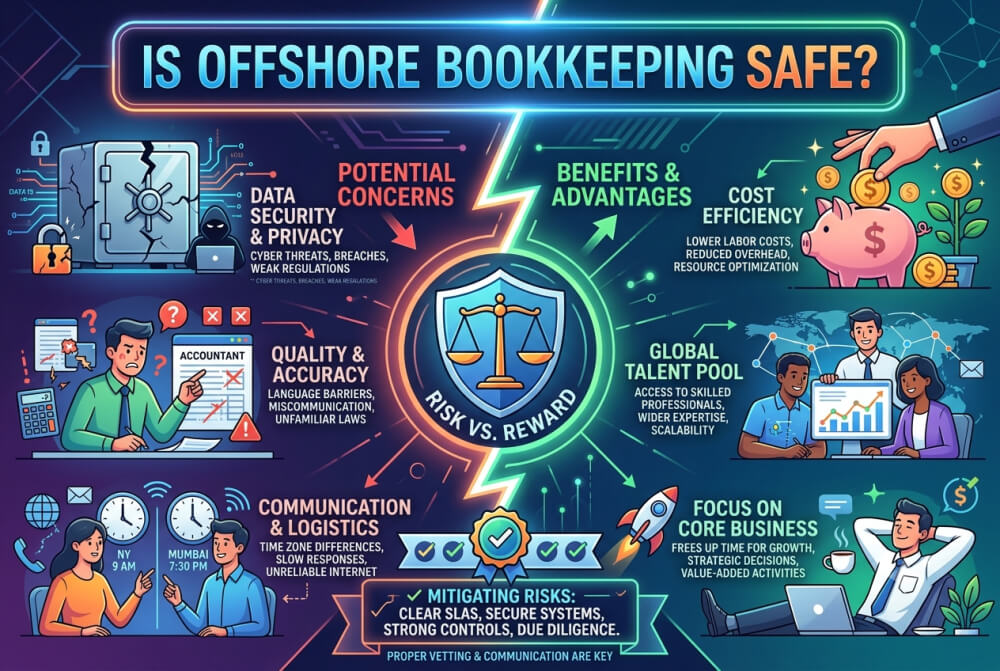
- What is offshore bookkeeping, and why do businesses use it?
- Issue 1: Communication barriers
- Issue 2: Quality control and consistency
- Issue 3: Data security concerns
- Issue 4: Cultural differences
- Issue 5: Hidden costs of offshore outsourcing
- Issue 6: Lack of control and oversight
- Issue 7: Difficulty transitioning back to local services
- How to choose an offshore bookkeeping provider that removes these risks
- FAQs
Yes, offshore bookkeeping is safe when the provider controls data access, contracts, and quality, and you build oversight into the engagement.
The risk has never really been the location of the bookkeeper. It’s whether the arrangement is properly governed. An unmanaged freelancer hired through a marketplace and a dedicated, vetted bookkeeper working under an Australian-law agreement are two completely different risk profiles, even if both happen to sit overseas.
This guide walks through the seven issues Australian businesses most often raise about offshore bookkeeping services, what actually causes each one, and the concrete steps that remove it. If you’re weighing up whether to outsource your books, this is the honest version risks included.
Key takeaways
The biggest risks are unmanaged data access, inconsistent quality, and hidden costs not the offshore model itself.
Most issues are solved by governance: NDAs under your local law, controlled software access, defined review processes, and a single accountable account manager.
A managed provider carries these controls as standard; a DIY freelancer arrangement leaves you to build them yourself.
Final BAS/tax lodgement should always be reviewed and signed off by a registered Australian agent.
What is offshore bookkeeping, and why do businesses use it?
- Cost. A local bookkeeper costs roughly AUD $4,500–$7,500 a month once you add superannuation, payroll tax, leave, and software. An offshore equivalent often lands at a third of that.
- Capacity. Books stay current, backlogs clear, and qualified staff are freed for advisory work rather than data entry.
- Scalability. You can add hours for BAS and end-of-financial-year peaks without committing to a permanent local headcount.
Issue 1: Communication barriers
Language challenges
Bookkeeping is detail work, and detail gets lost when instructions are misread. Vague task briefs, idiom-heavy emails, and assumptions about local terminology (think “BAS,” “super,” “GST-free” vs “input-taxed”) can produce small errors that compound over a quarter.
Time zone differences
A bookkeeper many hours behind your working day can mean a 24-hour lag on every query frustrating when you need a figure before a meeting.
Solutions for better communication
- Hire for English proficiency, not just bookkeeping skill. Both the Philippines and Sri Lanka offer strong English-language talent pools; insist on assessed proficiency before you interview.
- Choose a hub with working-hours overlap. The Philippines sits only 2–3 hours behind AEST, giving you near-real-time collaboration during Australian business hours.
- Standardise the brief. Use written process docs, a shared task tracker, and a weekly check-in so nothing relies on memory or interpretation.
Issue 2: Quality control and consistency
Variability in service standards
On open marketplaces, “bookkeeper” can mean anything from a qualified professional to someone who watched a Xero tutorial last week. Quality varies wildly, and you only discover the gap once the reconciliations don’t balance.
Risks of inaccurate reporting
Inaccurate books aren’t just untidy they distort the numbers you make decisions on, delay your BAS, and create rework for your accountant at the worst possible time of year.
Ensuring quality assurance
- Demand skills testing. Candidates should be tested on real reconciliation and data-entry tasks in your actual software (Xero, MYOB, or QuickBooks) before shortlisting.
- Build in a review layer. Define what gets checked, by whom, and how often. A monthly quality review by an account manager catches drift early.
- Keep a registered agent in the loop. Offshore bookkeepers prepare; an Australian BAS or tax agent reviews and signs off. That separation is your safety net.
Issue 3: Data security concerns
Threats to confidentiality
Your books contain bank details, payroll data, supplier contracts, and customer information. The fear reasonable is that this data sits on an unsecured personal laptop in another country with no controls.
Compliance with regulations
Australian businesses have obligations under the Privacy Act and, depending on industry, additional confidentiality duties. Handing data to a provider with no documented security posture is where the genuine risk lives.
Protecting sensitive information
- Australian-law NDA and IP assignment signed by every individual before day one so enforcement happens under a legal system you understand.
- Controlled environments: encrypted workstations, password vaults, role-based access, and restricted file permissions instead of free-roaming local copies.
- Layered controls for sensitive sectors (legal, medical, financial): screen-recording prevention and data-loss prevention software where warranted.
Issue 4: Cultural differences
Impact on business relationships
Differences in directness, how questions are raised, and how problems are escalated can create friction. A bookkeeper who won’t flag a discrepancy because they don’t want to “bother” you is a cultural-communication issue, not a competence one.
Understanding work ethic variations
Stereotypes here are unhelpful and usually wrong. What matters is expectation alignment defining responsiveness, escalation, and ownership explicitly rather than assuming they’re shared.
Strategies for cultural alignment
- Pick hubs with established Australian-business familiarity. The Philippines and Sri Lanka both have deep experience supporting Australian, UK, and US firms.
- Set explicit norms for escalation and turnaround in writing.
- Treat the bookkeeper as part of the team, not a faceless vendor short regular calls build the rapport that prevents misunderstandings.
Issue 5: Hidden costs of offshore outsourcing
Unexpected financial implications
The headline rate looks cheap, then setup fees, software licences, “premium support,” currency conversion (many marketplaces bill in USD), and per-task charges quietly inflate the total. Hidden costs are one of the most common complaints about offshore bookkeeping services.
Managing budget overruns
- Ask exactly what’s included versus billed separately: HR, IT setup, software access, replacement, and management.
- Watch the currency. Billing in AUD removes exchange-rate surprises that USD marketplace invoices create.
- Beware hourly models for ongoing work they reward slowness and make budgeting unpredictable.
Transparent pricing models
A flat monthly fee in AUD that bundles HR, payroll, IT, security, and account management is far easier to budget than a stack of variable line items. When you compare quotes, compare the all-in figure, not the advertised rate. You can see how an all-inclusive model is structured on our offshore bookkeeping page.
Issue 6: Lack of control and oversight
Monitoring remote teams
“How do I know work is actually getting done?” is the question behind most control concerns. Without visibility, trust erodes and micromanagement creeps in which defeats the purpose of delegating.
Challenges in managing performance
Performance issues are harder to spot, and harder to address, when you have no shared management layer and the person reports to no one but you.
Effective oversight techniques
- A single accountable account manager ideally locally based who owns the relationship and surfaces problems before you have to chase them.
- Output-based metrics: transactions reconciled, days-to-close, error rate not hours logged.
- Cadence: weekly check-ins in the first month, then monthly, with a standing escalation path.
Issue 7: Difficulty transitioning back to local services
Challenges of migration
What happens if you want to bring bookkeeping back in-house, or switch providers? Poorly structured arrangements leave knowledge trapped with one person and data scattered across personal tools.
Maintaining data integrity
The danger is records living outside your control in someone’s spreadsheets rather than in your accounting platform so that an exit means reconstructing months of work.
Planning for a smooth transition
- Keep everything inside your own software. Your Xero/MYOB/QuickBooks file is the single source of truth; the bookkeeper works in it, not around it.
- Document processes from day one so the role can be handed over, not just the person.
- Choose month-to-month terms. No lock-in means you can change course in 30 days, and that optionality keeps a provider honest about quality.
How to choose an offshore bookkeeping provider that removes these risks
- Are candidates skills-tested and English-assessed before you see them?
- Is there an Australian-law NDA and IP agreement on every hire?
- What is the data-security model workstations, access control, monitoring?
- Is pricing a flat, all-inclusive AUD fee, or a stack of variable charges?
- Who is your single accountable contact, and what’s the review cadence?
- Are terms month-to-month with a replacement guarantee?
- Does a registered Australian agent review BAS/tax before lodgement?
Conclusion: navigating the challenges of offshore bookkeeping
FAQs
Is offshore bookkeeping safe for Australian businesses?
Yes, when the provider enforces an Australian-law NDA, controls data access through encrypted workstations and role-based permissions, and a registered Australian agent reviews BAS and tax before lodgement. The risk comes from unmanaged arrangements, not from the offshore location itself.
What are the main risks of offshore bookkeeping services?
The most common issues are communication barriers, inconsistent quality, data security exposure, cultural misalignment, hidden costs, lack of oversight, and difficulty transitioning back in-house. Each can be managed with vetting, contracts, controlled software access, transparent AUD pricing, and a defined review process.
How do I protect my financial data when outsourcing bookkeeping offshore?
Require a signed NDA and IP agreement under Australian law, insist bookkeepers work on secured, encrypted workstations with restricted access, keep all records inside your own accounting software, and add data-loss prevention for sensitive industries.
Can an offshore bookkeeper handle Australian BAS and GST?
Offshore bookkeepers can prepare GST-coded, BAS-ready books and reconciliations, but final lodgement should be reviewed and signed off by a registered Australian BAS or tax agent to ensure ATO compliance.
Are offshore bookkeeping services cheaper than hiring locally?
Typically yes often around a third of the cost of a local Australian bookkeeper once superannuation, payroll tax, leave, and software are included. Watch for hidden costs and currency conversion; an all-inclusive flat fee in AUD is the most predictable to budget.
What if I want to bring bookkeeping back in-house later?
Keep all records inside your own accounting platform, document processes from the outset, and choose month-to-month terms. That keeps your data and knowledge under your control and makes any future transition straightforward.