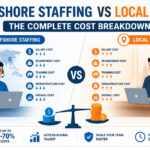
Offshore Accounting Staff for Australian Firms: The Complete 2026 Guide

Offshore accounting staff for Australian firms 2026 - Xero bookkeeper cost comparison, Webco Talent"

The Accounting Talent Problem in Australia Is Structural. So Is the Solution.

More than 60% of Australian accounting firms reported significant staffing shortages in 2025, according to CPA Australia research. That figure has not improved heading into 2026. It has worsened.

Demand for bookkeeping, BAS preparation, payroll processing, and tax compliance work keeps rising as the client base of Australian SMEs grows and ATO compliance requirements become more complex. Single Touch Payroll Phase 2 has added reporting detail that requires trained hands to manage. Payday Super arrives in July 2026, tightening cash flow and payroll administration for every employer in the country. And through all of it, the pipeline of qualified Australian bookkeepers and junior accountants has not kept pace.

The result is a market where a competent bookkeeper with three years of experience can be choosy about who they work for, what they are paid, and how flexible their arrangement is. For small accounting firms and Australian SMEs trying to build or maintain a finance function, that market dynamic has made local hiring increasingly difficult to justify on a pure cost and availability basis.

Offshore accounting staff are the structural response to this structural problem. Not as a workaround. As a deliberate, sustainable model that more than 400 Australian firms and businesses have adopted, including businesses that work with Webco Talent since 2008.

This guide covers everything you need to make the decision clearly: what offshore accounting staff cost, what they can handle, how Xero and MYOB integration works, what the compliance picture looks like, how to screen and hire correctly, and what the first 90 days looks like in practice.

If you want to see numbers specific to your role, start with the free calculator or book a 30-minute call with our Melbourne team.

1. What Offshore Accounting Staff Actually Means in 2026

Offshore accounting staff for Australian firms means dedicated, full-time accounting professionals based in countries such as Sri Lanka or the Philippines who work exclusively for your firm, using your systems, following your processes, and reporting to your team. This is distinct from outsourced accounting services, where a third party delivers accounting outputs. With offshore staff, you retain full operational control. The offshore provider manages HR, payroll, equipment, and local compliance.


This distinction matters because the two models produce very different outcomes. Outsourced accounting services give you a deliverable. Offshore accounting staff give you a person integrated into your team.


For Australian accounting firms, the difference is significant. A dedicated offshore bookkeeper joins your client management workflow. They know your templates, your review standards, your turnaround expectations, and your clients by name over time. That consistency is what makes offshore accounting staff an operational capability, not just a cost tactic.
 
The model works in three layers:
  1. What you own: The work, the client relationships, the review and sign-off process, and the direction of the offshore staff member’s daily activities.
  2. What the offshore provider manages: Recruitment, payroll in the country of employment, equipment, office infrastructure, HR administration, performance management support, and local compliance.
  3. What the offshore staff member delivers: Accounting tasks, as defined by your firm, to your standards, using your software, within the turnaround times you set.


Webco Talent’s Offshore Bookkeeping Services for Australian Businesses page covers the specific roles available and how the engagement is structured from brief to first day.

2. The Real Cost of an Australian Bookkeeper or Accountant in 2026

Before any comparison is useful, the local cost needs to be built correctly. Most Australian firm principals underestimate this number because they anchor to salary.


Australian Bookkeeper (Mid-Level, 3 to 5 Years Experience)
The average annual salary for an Australian bookkeeper in 2026 ranges from AU$65,000 to AU$85,000, depending on experience and location. Employers must cover superannuation contributions at 12%, paid leave and other statutory entitlements, adding approximately 20% – 30% to the base salary.


Here is the full employer cost breakdown at a $72,000 base salary:


Cost component
Rate
Annual cost
Base salary
 
$72,000
Superannuation (July 2025 rate)
12%
$8,640
Annual leave (4 weeks)
7.7%
$5,544
Personal/carer’s leave (10 days)
3.8%
$2,736
Long service leave accrual
1.7%
$1,224
Workers compensation
1.5%
$1,080
Statutory subtotal
 
$91,224
Recruitment (amortised over 3 years)
 
$6,000
Equipment and setup (amortised)
 
$1,500
Software licences (Xero, MYOB, Dext)
 
$1,800
Management overhead
 
$4,200
Operational subtotal
 
$13,500
Total fully loaded cost
 
$104,724
In Sydney, bookkeeper salaries for mid-level roles reach $85,000 to $100,000 in base salary, with senior bookkeepers managing teams or complex operations reaching $95,000 to $110,000 base. At those figures, the loaded cost with management overhead reaches $108,000 to $120,000 annually.


Australian Accountant (Graduate to Mid-Level)
Accountants generally earn more than bookkeepers in Australia, averaging $75,000 to $90,000 compared to $50,000 to $65,000 for bookkeeping roles, reflecting higher qualifications, analytical responsibilities, and strategic decision-making requirements.
At $82,000 base salary, the fully loaded employer cost for a junior-to-mid accountant runs approximately $118,000 to $128,000 per year when all statutory and operational costs are included.


Most firms reaching the break-even point where internal staff cost less than alternative engagement models require complete cost information rather than advertised salaries, and the right answer changes as the business scales.


For a complete methodology on how Australian employment costs compound, see our article on The Real Cost of an Australian Employee in 2026
"We had a great bookkeeper leave for a firm that could pay $15,000 more per year than us. We simply could not match it and keep the business viable. That was the conversation that made offshore staffing feel urgent rather than optional. Within eight weeks of speaking to Webco Talent we had someone in place who has now been with us for two years."
- Principal, Melbourne-based accounting practice, 9 staff

3. What Offshore Accounting Staff Cost Through Webco Talent

Webco Talent operates a fully managed offshore staffing model. The monthly rate is all-in: it includes the offshore staff member’s salary, HR and payroll administration in the country of employment, equipment, infrastructure, and your Melbourne-based account manager. There are no hidden fees, no replacement charges, no currency risk, and no lock-in contracts.
All invoices are issued in Australian dollars.


Offshore Bookkeeper (Mid-Level, Xero or MYOB Proficient)


Delivery market
Monthly all-in rate
Annual all-in cost
Sri Lanka
$1,800 – $2,600
$21,600 – $31,200
Philippines
$2,000 – $2,800
$24,000 – $33,600


Offshore Accountant (Graduate to Mid-Level, Australian Compliance Trained)


Delivery market
Monthly all-in rate
Annual all-in cost
Sri Lanka
$2,200 – $3,200
$26,400 – $38,400
Philippines
$2,500 – $3,500
$30,000 – $42,000


Offshore Payroll Specialist (STP Phase 2, Superannuation Proficient)


Delivery market
Monthly all-in rate
Annual all-in cost
Sri Lanka
$1,800 – $2,600
$21,600 – $31,200
Philippines
$2,000 – $2,800
$24,000 – $33,600


Offshore Senior Accountant / Tax Workpaper Specialist


Delivery market
Monthly all-in rate
Annual all-in cost
Sri Lanka
$2,800 – $4,000
$33,600 – $48,000
Philippines
$3,200 – $4,500
$38,400 – $54,000


Managed offshore bookkeeping services in Australia typically range from AUD $12 to $22 per hour all-inclusive. For accounting firms billing clients at AUD $80 to $150 per hour for bookkeeping work, the margin improvement is substantial.
Expressed as an hourly equivalent, Webco Talent’s all-in monthly rates for a bookkeeper at $2,200 per month ($26,400 per year) represent approximately $12.69 per hour based on a standard 40-hour working week across 52 weeks. That is the fully loaded figure: salary, HR, equipment, management, and local compliance included.
 

4. Full Cost Comparison by Accounting Role

The following table uses fully loaded local hire costs against Webco Talent all-in offshore rates. Australian figures include salary, super, leave, workers comp, recruitment amortised over three years, equipment, software, and management overhead. Payroll tax is excluded and represents additional saving for firms above state threshold.

Bookkeeper (Mid-Level)

 
Australian local hire
Offshore via Webco Talent
Annual saving
Saving %
Annual all-in cost
$100,000 – $120,000
$21,600 – $33,600
$66,400 – $98,400
58 – 68%

Accounts Payable / Receivable Officer

 
Australian local hire
Offshore via Webco Talent
Annual saving
Saving %
Annual all-in cost
$85,000 – $108,000
$18,000 – $28,800
$56,200 – $89,200
60 – 70%

Payroll Specialist

 
Australian local hire
Offshore via Webco Talent
Annual saving
Saving %
Annual all-in cost
$95,000 – $115,000
$21,600 – $33,600
$61,400 – $93,400
58 – 68%

Graduate Accountant / Tax Workpaper Preparer

 
Australian local hire
Offshore via Webco Talent
Annual saving
Saving %
Annual all-in cost
$85,000 – $110,000
$26,400 – $42,000
$43,000 – $84,000
50 – 63%

Senior Accountant / Financial Reporting Specialist

 
Australian local hire
Offshore via Webco Talent
Annual saving
Saving %
Annual all-in cost
$130,000 – $165,000
$33,600 – $54,000
$76,000 – $131,000
50 – 62%

Five-Year Cumulative Saving: Two Offshore Accounting Hires

For an accounting firm that replaces a local bookkeeper and a local accounts payable officer with offshore equivalents through Webco Talent, the five-year cumulative saving using conservative figures (local costs rising 4% annually, offshore costs rising 2% annually):
Year
Local cost (2 roles)
Offshore cost (2 roles)
Annual saving
Cumulative saving
Year 1
$205,000
$45,000
$160,000
$160,000
Year 2
$213,200
$45,900
$167,300
$327,300
Year 3
$221,728
$46,818
$174,910
$502,210
Year 4
$230,597
$47,754
$182,843
$685,053
Year 5
$239,821
$48,709
$191,112
$876,165
Five-year cumulative saving on two roles: $876,165.
That is not the total cost reduction across the firm. It is the saving from two roles alone. For a firm that offshores three to five accounting positions over the same period, the cumulative figure crosses $2 million.

5. What Tasks Offshore Accounting Staff Handle for Australian Firms

Virtually all routine bookkeeping functions can be performed offshore or by an outsourced provider. Common scope includes bank reconciliations covering daily or weekly matching of transactions against bank feeds in Xero or MYOB, accounts payable processing including supplier invoices, coding to correct accounts and managing payment runs, accounts receivable including raising invoices, following up debtor payments and reconciling receipts, payroll processing covering pay run calculations, STP Phase 2 submissions, leave management and superannuation remittance, BAS preparation including GST reconciliation, PAYG withholding, fuel tax credits and lodgement-ready workpapers, and management reporting covering monthly P&L, balance sheet and cash flow reports formatted to your template.


For accounting firms specifically, the scope extends further:

Tax workpaper preparation

Individual tax returns (ITR), company, trust and partnership returns, depreciation schedules, FBT return preparation, and pre-fill review. The offshore accountant prepares to review-ready standard. The onshore principal reviews, advises, and lodges.

SMSF bookkeeping

Contribution processing, investment income recording, pension calculations, minimum drawdown schedules, audit workpaper preparation in BGL or Class Super.

Financial statement preparation

Profit and loss statements, balance sheets, cash flow statements formatted to your firm’s template and standards.

Accounts production for accounting firms

Working in your client’s Xero or MYOB file, producing accounts in draft for your senior review. White-label delivery is standard practice.

What stays onshore

Client communication, advisory conversations, final review, and ATO correspondence stay onshore. For tax work, complex tax planning, client strategy sessions, review and lodgement, and ATO dispute handling remain with the onshore team. For SMSF, trustee advice, SIS Act compliance review, investment strategy documentation, and member communications stay onshore.

The division of labour is consistent: offshore handles volume, complexity, and execution. Onshore handles judgment, relationships, and regulated sign-off. That division is what makes the model sustainable and compliant.
"Our offshore bookkeeper handles six of our smaller clients completely independently. I review the work before it goes out but honestly her accuracy rate is higher than the last local hire we had. The Webco Talent account manager was across any early issues and sorted them without us needing to manage it."
- Director, Brisbane-based bookkeeping practice, 7 staff

6. Xero and MYOB: How Offshore Staff Integrate with Your Systems

The most important practical question for Australian accounting firms considering offshore staff is whether the offshore bookkeeper or accountant can work in the same systems, at the same quality level, that local staff would.
 
The answer, for both Xero and MYOB, is yes, and the technical integration is more straightforward than most principals expect before they have done it.

Xero integration

The shift to cloud accounting software, primarily Xero but also MYOB AccountRight Online and QuickBooks, has made bookkeeping outsourcing significantly more practical. An offshore bookkeeper can access your Xero file in real time from any location with the same functionality as an in-house staff member.


Best practices for Xero access in an outsourced arrangement: assign the outsourced bookkeeper as a Standard User in Xero rather than Admin, which limits access to transaction entry, bank reconciliation and reporting without granting settings or user management permissions. Enable two-factor authentication on all Xero accounts including the outsourced user. Use Xero’s audit trail to monitor changes made by the outsourced user, as transaction edits, voids and journal entries are all logged.


Xero certification is a practical screening criterion for offshore accounting candidates. Webco Talent verifies Xero certifications directly as part of the candidate assessment process, not from CV claims alone.

MYOB integration

MYOB AccountRight Online and MYOB Business (cloud) both support remote access by authorised users. For firms still using MYOB AccountRight desktop, remote access via a hosted environment or terminal server is standard and well-supported by MYOB’s Australian partner network.


MYOB has deep ATO and IRD integration, and a large installed base of existing clients. Its longevity means accounting firm tools that understand how Australian compliance work is structured.


For firms with a split client base across Xero and MYOB, Webco Talent screens offshore candidates for proficiency in both platforms. The offshore accounting talent pools in Sri Lanka and the Philippines have significant exposure to both systems through prior work with Australian firms.


Other platforms commonly used by offshore accounting staff for Australian clients:
Dext (formerly Receipt Bank), Hubdoc, QuickBooks Online, Karbon, XPM (Xero Practice Manager), BGL Simple Fund 360, Class Super, Figured, ApprovalMax, and Spotlight Reporting.


Ask about specific platform experience during the candidate interview. Webco Talent structures candidate assessments around the exact platform mix your firm uses.
Need offshore staff who already understand your systems?
Speak with our Melbourne team about your platform requirements, and we’ll match candidates to your software stack.
 

7. BAS, STP, GST, and Payroll: What Offshore Staff Can and Cannot Do

This is the section that most guides on offshore accounting staff handle vaguely. Clarity here is essential, because the line between what offshore staff can do and what requires Australian registration is a compliance matter, not just a preference.

What offshore staff can do without Australian registration:

Bank reconciliations and transaction coding in Xero or MYOB. Accounts payable and receivable processing. Payroll run calculations and entry, including leave calculations and superannuation amounts. STP Phase 2 data preparation and submission where the Australian-based principal reviews and approves before lodgement. BAS workpaper preparation, including GST reconciliation and PAYG calculations, ready for the registered BAS agent to review and lodge. Tax return workpaper preparation for the registered tax agent to review and sign off. Financial statement preparation for the principal’s review. SMSF bookkeeping and audit workpaper preparation for the licensed trustee’s review.

What requires Australian registration to perform independently:

BAS lodgement as the responsible agent requires a registered BAS agent under the Tax Practitioners Board. Tax return lodgement requires a registered tax agent. Financial advice requires an AFSL. SMSF audit requires an approved SMSF auditor.
The key principle: preparation and processing can be done offshore. Regulated sign-off and lodgement requires an Australian-registered practitioner. The offshore staff member prepares the work to review-ready standard. The onshore registered practitioner reviews, approves, and lodges.


For accounting firms: if you outsource client bookkeeping offshore, your engagement letters should disclose this to clients. Many accounting bodies including CPA Australia, CA ANZ, and IPA have guidance on disclosure obligations for offshore service arrangements.
This disclosure is standard practice and is straightforward to implement. It does not damage client relationships when handled professionally. Most clients, when told clearly that their bookkeeping is prepared by an offshore team and reviewed by the Australian principal, are satisfied by the combination of lower cost and quality oversight.

STP Phase 2 and Payday Super:

STP Phase 2, which requires more detailed payroll information reported to the ATO with each pay event, is well within the capability of trained offshore payroll specialists. Webco Talent screens for STP Phase 2 experience specifically in payroll role assessments.


Payday Super, effective July 2026, requires superannuation to be paid at the same time as wages rather than quarterly. This changes payroll processing cadence significantly. Offshore payroll specialists who are set up to process more frequent pay events without the cash flow management pressures of a local payroll administrator are well-positioned for this change. It is a process change, not a complexity change, and offshore staff handle it as a workflow adjustment.

8. Privacy Act and Data Security: The Compliance Questions Answered

Does the Australian Privacy Act apply when offshore staff handle client financial data?

Yes. The Australian Privacy Act 1988, including the Australian Privacy Principles, applies to Australian firms that handle personal information of Australian individuals, regardless of where that handling takes place. If your offshore bookkeeper processes payroll data, bank statement information, or client financial records that contain personal details, the Privacy Act governs how that information is handled.
The practical response is not to avoid offshore staff. It is to ensure appropriate safeguards are in place.

Standard safeguards Webco Talent implements as part of every accounting staff engagement:

Confidentiality and non-disclosure agreements executed by offshore staff as a condition of employment. Secure remote access to client systems, including two-factor authentication on all accounting platform accounts. Prohibition on downloading, copying, or storing client data outside authorised systems. Physical workspace security in managed office environments with access controls. Regular security training for offshore staff including data handling obligations under Australian standards.

Can Australian client data be stored offshore?

Cloud accounting platforms including Xero and MYOB store data on servers that may not be located in Australia. This is already the case for firms using these platforms with local staff. The relevant question is not where the data is stored, but how access is controlled and what happens if there is a breach. Webco Talent’s data protection framework addresses both.
For firms handling sensitive client data and wanting additional contractual certainty, Webco Talent can assist with data processing agreements and custom data handling protocols as part of the engagement setup.

9. How to Screen and Hire Offshore Accounting Staff Correctly

The quality of an offshore accounting hire depends almost entirely on how thoroughly the screening process is run. The most common mistakes Australian firms make when hiring offshore accounting staff are: relying on CV claims without verification, not testing for Australian compliance knowledge specifically, and not running a practical skills assessment in the accounting software they use.


Here is the screening framework Webco Talent applies for every offshore accounting role:


Stage 1: CV and credential verification
Employment history confirmed with prior employers. Academic qualifications verified with issuing institution. Professional certifications, including Xero partner certification, MYOB certification, CPA, CA, or CPA equivalent qualifications, verified directly rather than from candidate claims.


Stage 2: Australian compliance knowledge assessment
Written or verbal assessment covering GST rules, BAS structure, STP Phase 2 reporting requirements, superannuation contribution rules and rates, payroll tax concepts, and the distinction between bookkeeping and regulated accounting functions. Candidates without genuine working knowledge of Australian tax and compliance standards are filtered at this stage regardless of general accounting ability.


Stage 3: Software proficiency test
A live task in the relevant accounting software, ideally within 24 to 48 hours, demonstrates attention to detail, software fluency, and the ability to follow Australian accounting standards. A live video interview assesses soft skills, communication, and the ability to navigate tools via screen share.
The task mirrors an actual work scenario from your firm: a bank reconciliation in your Xero file, a BAS workpaper preparation using your template, or a payroll run in your MYOB environment.


Stage 4: Communication and cultural fit assessment
A structured interview assessing English communication clarity, ability to ask questions when unclear rather than guessing, responsiveness, and comfort with the asynchronous communication patterns of remote work. For client-facing roles, a more extended communication assessment is appropriate.


Webco Talent delivers shortlisted CVs within 10 business days of receiving a brief. You interview from a shortlist that has already cleared all four stages. Your selection is from candidates who can do the work, not a pool that requires further filtering.

10. The First 90 Days: Onboarding an Offshore Bookkeeper into Your Firm

How the first 90 days are structured determines whether the offshore hire reaches full productivity in six weeks or six months. This is the variable most within your control, and it is more important than the capability of the hire itself.


Before day one:
Provision system access, including Xero or MYOB as a Standard User with appropriate permissions, Slack or Teams, your document management system, and any practice management platforms you use. Prepare a short orientation document covering your firm’s processes, your standard templates, your client confidentiality expectations, and how you prefer to give and receive feedback.


Week 1 to 2: Orientation and supervised execution
Walk the offshore hire through your systems and templates via video screen share. Assign two or three low-complexity client files for initial work. Review their output daily, giving specific and written feedback on any formatting, coding, or process gaps. The goal is calibrating their output to your standards, not assessing their capability.


Week 3 to 6: Increasing autonomy with structured check-ins
The offshore hire works through a larger file set with daily written end-of-day summaries pushed to Slack. You review completed work before it is finalised rather than at each step. Weekly 30-minute video check-ins replace daily review for files meeting standard.


Week 6 to 12: Independent operation with exception-based oversight
Realistically, four to eight weeks from the start of the engagement brings someone to working independently on straightforward files, assuming proper onboarding including shared procedures, walkthrough of templates, system access, and a local contact for questions. Firms that rush this stage always take longer overall.


By week 12, a well-onboarded offshore bookkeeper should be managing their client file allocation with minimal daily oversight, filing completed work for review, and flagging exceptions without needing prompting. At that point the relationship operates like any well-functioning remote team member, not like an ongoing management burden.


For the full step-by-step offshore onboarding guide, see our complete onboarding resource here.
 

11. The Hybrid Model: What Leading Australian Accounting Firms Do in 2026

Australian accounting firms are increasingly leveraging offshore teams for functions such as bookkeeping, accounts payable and receivable, payroll processing, and tax preparation support, allowing their local teams to focus on advisory and client relationships.


The firms that have been using offshore accounting staff for two or more years have converged on a consistent model. It is not fully offshore and it is not fully local. It is a deliberate division of labour that places each activity where it creates the most value.


Local team: Partners and principals who own client relationships, perform regulated sign-off and lodgement, handle strategic advisory conversations, manage ATO correspondence, and direct the work of the offshore team.


Offshore team: Bookkeepers, accounts processing officers, payroll specialists, and junior accountants who handle transaction processing, reconciliations, payroll runs, workpaper preparation, and management reporting to review-ready standard.


The offshore team is not a back-office support layer. It is the firm’s production capacity. The local team is not doing bookkeeping. It is doing the work that justifies the billing rates, builds the client relationships, and drives the business forward.


This model makes a firm that would have previously needed eight local staff to service its client base serviceable with four local staff and four offshore. The local payroll drops by half. The margin on accounting services expands significantly. The capacity to take on new clients exists without the bottleneck of local recruitment.


Most firms save between 50% – 70% on staffing costs by hiring offshore teams, thanks to lower salaries and lower overhead costs. Applied to a practice with $1.5 million in revenue and a local staffing bill of $600,000 per year, the hybrid model can reduce that staffing cost to $300,000 to $350,000, adding $250,000 to $300,000 directly to firm profitability without reducing client service quality.
 

12. Why Webco Talent for Offshore Accounting Staff

Webco Talent is an Australian offshore staffing agency headquartered in Melbourne, operating since 2008, with managed delivery teams in Colombo, Sri Lanka and Manila, Philippines.


For Australian accounting firms and SMEs hiring offshore accounting staff, here is what distinguishes the Webco Talent model:


Australian accounting knowledge in the screening process. We screen offshore accounting candidates specifically for knowledge of Australian GST, BAS, STP, superannuation, and MYOB and Xero, not generic accounting competency. A candidate who cannot demonstrate working knowledge of Australian compliance does not reach your shortlist.


Dedicated staff, not shared resources. Your offshore bookkeeper or accountant works exclusively for your firm. They are not split across multiple clients of ours. They are your team member who happens to be based offshore.


Full management, no operational burden. HR, payroll in the country of employment, equipment, office infrastructure, performance management support, and local compliance are all managed by Webco Talent. You focus on the work. We manage everything behind the offshore staff member.


Melbourne-based account manager for every engagement. A real Australian contact, reachable by phone during business hours, who knows your firm, knows your offshore team member, and can resolve issues before they reach you as a problem.


No lock-in contracts. We operate without minimum term penalties because our retention is built on service quality. If an engagement is not working, you can exit without financial punishment.


Replacement at no cost. If a placement does not meet agreed performance standards, we manage the replacement sourcing process at no additional fee.


AUD billing, no currency risk. All invoices in Australian dollars. No exchange rate fluctuation, no international payment fees.


CVs within 10 business days. From brief to shortlist, ten business days. From shortlist to first day, typically three to four weeks total.

13. Frequently Asked Questions

What does offshore accounting staff mean for an Australian firm?

Offshore accounting staff means dedicated, full-time accounting professionals, typically bookkeepers, payroll specialists, accounts processing officers, or junior accountants, based in countries such as Sri Lanka or the Philippines, who work exclusively for your firm using your systems and following your processes. The offshore provider manages HR, payroll, equipment, and local compliance. You retain full operational control of the work.

The all-in cost of an offshore bookkeeper through Webco Talent ranges from $21,600 to $33,600 per year depending on experience and delivery market. This compares to a fully loaded local bookkeeper cost of $100,000 to $120,000 per year, representing a saving of 58 to 68%. The offshore rate includes salary, HR administration, equipment, infrastructure, and account management. All invoices are in Australian dollars.

Offshore accounting staff can prepare BAS workpapers, including GST reconciliation and PAYG calculations, to review-ready standard. BAS lodgement as the responsible agent requires a registered BAS agent under the Tax Practitioners Board. The offshore staff member prepares, the onshore registered practitioner reviews, approves, and lodges. STP Phase 2 data preparation and payroll processing are also within offshore staff scope, with the onshore principal retaining sign-off authority.

Yes. The offshore accounting talent pools in Sri Lanka and the Philippines have significant exposure to Xero and MYOB through prior work with Australian firms. Webco Talent verifies software certifications directly as part of the screening process, not from CV claims alone. Candidates are also assessed with practical tasks in the specific platforms your firm uses.

Yes. The Australian Privacy Act 1988 applies to Australian firms handling personal information regardless of where the handling takes place. The appropriate response is implementing standard safeguards: NDAs, two-factor authentication on all platform accounts, prohibition on storing data outside authorised systems, and secure remote access protocols. Webco Talent implements all of these as standard in every accounting staff engagement.

Client communication, advisory conversations, complex tax planning, ATO correspondence, regulated sign-off and lodgement, SMSF trustee advice, and SIS Act compliance review should remain with the onshore registered practitioner. Offshore staff handle transaction processing, reconciliations, payroll runs, workpaper preparation, and reporting to review-ready standard. If your firm provides offshore bookkeeping under its brand, engagement letters should disclose this in line with CPA Australia, CA ANZ, and IPA guidance.

Webco Talent delivers shortlisted CVs within 10 business days of receiving a brief. Most accounting firm clients complete the process from brief to first day within three to four weeks. This is significantly faster than recruiting an equivalent Australian bookkeeper or accountant, which typically takes two to four months.

One offshore hire is sufficient and is the most common starting point for Australian accounting firms. Most Webco Talent clients begin with a single offshore bookkeeper and expand the offshore team over time as they develop the onboarding workflow and see the productivity and cost outcomes. There is no minimum headcount requirement.

Offshore staff work full-time year-round, including through peak compliance periods. Unlike freelance or task-based arrangements, your dedicated offshore hire is committed to your firm’s workload at full capacity during the periods that matter most. For firms that need additional surge capacity during EOFY, Webco Talent can discuss additional resource options as part of a broader engagement.

The Bottom Line

The accounting talent problem in Australia is not going to ease in 2026. The demand for compliance services keeps growing. The local supply of trained bookkeepers and junior accountants has not kept pace. Salaries are rising in a market where your billing rates are constrained by what clients will accept.


Offshore accounting staff is the structural response. Not because it is the fashionable thing to do, but because the arithmetic is straightforward: a fully loaded local bookkeeper at $104,000 per year versus a fully managed offshore bookkeeper at $26,400 per year, delivering the same output to your review-ready standard, using your Xero or MYOB file, within your turnaround times.


The firms that have made this transition consistently say the same thing: it worked better than expected, and they wish they had done it sooner.


Webco Talent has been placing offshore accounting staff with Australian firms since 2008. The process is fast, the engagement model is transparent, and the Melbourne-based account manager stays involved through the entire relationship.


Webco Talent is an Australian offshore staffing agency headquartered in Melbourne, with managed delivery teams in Colombo, Sri Lanka and Manila, Philippines. Operating since 2008. 400+ Australian business clients. Specialists in offshore bookkeepers, accountants, payroll specialists, and accounts processing staff for Australian firms. No lock-in contracts. Local AUD billing. Dedicated Melbourne-based account manager for every engagement.